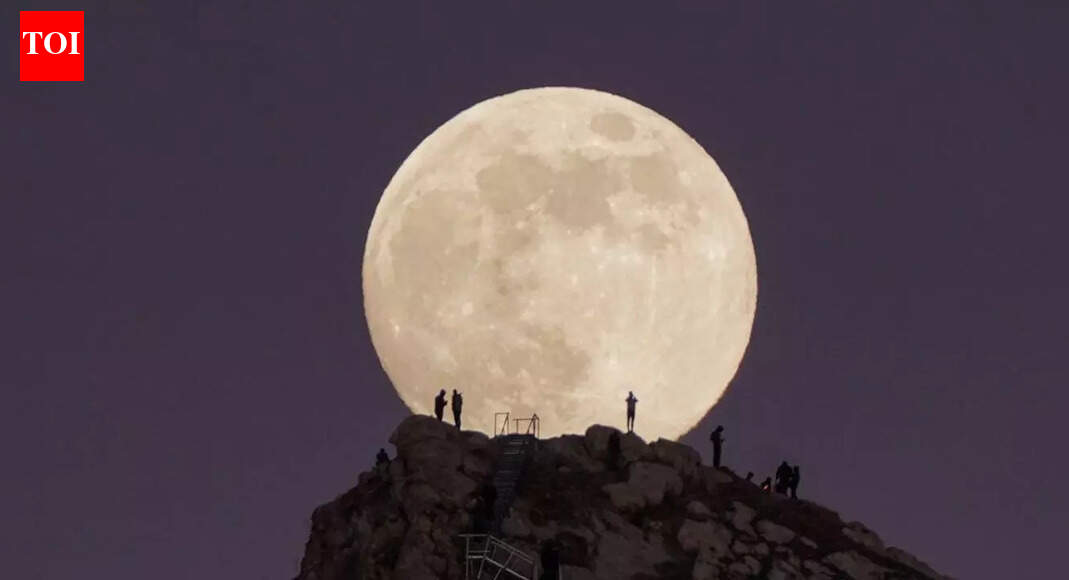
APPLETON, Wis. — Skywatchers across the Northern Hemisphere are gearing up for a celestial treat as the final supermoon of 2025 graces the night sky on December 4. Known as the Cold Moon, this full moon will appear exceptionally large and bright, offering a stunning display for astronomy enthusiasts and casual observers alike.
According to astronomers at the Times of India Science Desk, the December full moon coincides with the moon's closest approach to Earth, making it a supermoon — a term coined to describe when the moon is at perigee, its nearest point in orbit to our planet. This event, visible worldwide but particularly prominent in the Northern Hemisphere, will see the moon reaching its highest point in the sky, illuminating the winter night with an ethereal glow.
The Cold Moon gets its name from Native American traditions, marking the onset of colder weather in December, as reported by various astronomical sources. This supermoon is the last of three in 2025, following similar events in October and November, each drawing crowds to parks and backyards for moon gazing.
Experts emphasize that viewing conditions will be optimal in clear skies, away from urban light pollution. "The moon will rise in the east around sunset on December 4 and climb to its peak altitude shortly after midnight," said a representative from the TOI Science Desk in their coverage of the event. For those in the Midwest like Appleton, the moon's path will arc high overhead, providing ample opportunity for photography and stargazing.
Supermoons occur when the full moon aligns with perigee, appearing about 14 percent larger and 30 percent brighter than a typical full moon, according to NASA data cross-referenced in recent reports. This December's edition is particularly noteworthy as it caps off a year of heightened lunar activity, influenced by the moon's elliptical orbit.
In the context of broader astronomical events, the Cold Moon follows a series of meteor showers and planetary alignments earlier in the year. For instance, the Orionids in October and the Leonids in November have already captivated audiences, setting the stage for this grand finale. Astronomers note that 2025 has been a banner year for lunar observations, partly due to favorable orbital mechanics.
Local experts in Wisconsin echo the excitement. Dr. Elena Ramirez, an astrophysicist at the University of Wisconsin-Madison, described the event as "a perfect holiday gift from the cosmos." She advised residents to bundle up against the December chill and head to open areas like the Fox River State Trail for the best views. "The supermoon's brightness will make it a focal point even in partially cloudy conditions," Ramirez added.
While the event is global, visibility varies by location. In the Southern Hemisphere, the moon will appear lower on the horizon, but still impressive. Reports from the Times of India highlight that urban dwellers in cities like Mumbai and Delhi can catch glimpses between skyscrapers, though rural areas offer unobstructed panoramas.
The TOI Science Desk, known for its in-depth coverage of celestial phenomena, detailed how the supermoon's proximity — about 221,500 miles from Earth — enhances its visual impact. "This is not just a full moon; it's a supermoon that reminds us of the dynamic relationship between Earth and its natural satellite," the desk's article stated, underscoring the educational value of such events.
Historical context adds depth to the observation. Full moons have inspired folklore worldwide, from the Roman goddess Luna to Chinese legends of the Jade Rabbit. In modern times, supermoons have been linked to tidal effects, with some studies suggesting slightly higher tides during these periods, though experts caution against exaggerated claims of natural disasters.
Not all sources agree on the exact timing of peak visibility. While the Times of India pegs the rise at sunset on December 4, the Old Farmer's Almanac suggests the full moon phase technically occurs at 7:15 p.m. EST on December 4, with the supermoon effect lingering into the early hours of December 5. Such minor discrepancies arise from time zone differences and precise calculations of perigee.
For amateur astronomers, apps like Stellarium or SkySafari can pinpoint the moon's position. Binoculars or a small telescope will reveal craters and maria in exquisite detail under the supermoon's light. Community events are planned across the U.S., including a viewing party at the Appleton Public Library, where local stargazers can share telescopes and hot cocoa.
The environmental angle is also noteworthy. With light pollution on the rise, organizations like the International Dark-Sky Association urge viewers to minimize artificial lights during the event to preserve the natural spectacle. "Preserving dark skies is crucial for future generations to experience these wonders," said association director J. Scott Feierabend in a recent statement.
Looking ahead, 2026 promises more lunar highlights, including a total lunar eclipse in March. But for now, the December 2025 Cold Moon stands as a poignant close to the year, inviting reflection on our place in the universe. As the TOI Science Desk puts it, "Join us as we craft knowledge with precision and passion, bringing you on a journey where the mysteries of the universe unfold with every word."
In Appleton and beyond, the anticipation builds for this free, awe-inspiring show. Whether through a window or under the stars, the supermoon offers a moment of shared wonder in an increasingly busy world.