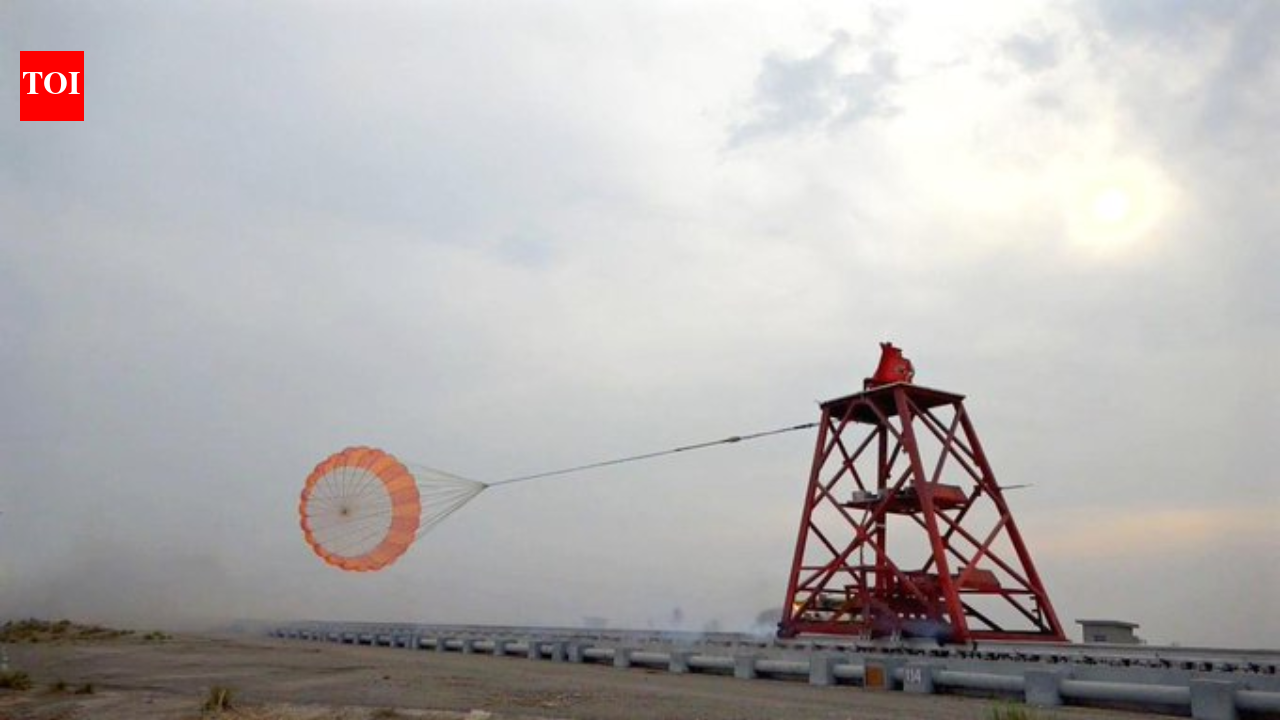
NEW DELHI — India's ambitious human spaceflight program, Gaganyaan, achieved a key milestone on Wednesday when the Defence Research and Development Organisation (DRDO) successfully conducted a drogue parachute qualification test at a facility in Chandigarh. The test, part of the rigorous preparations for sending Indian astronauts into orbit, demonstrated the reliability of the parachute system designed to stabilize the crew module during its descent from space.
According to reports from the Times of India, the qualification test involved deploying the drogue parachute under simulated re-entry conditions to ensure it could perform as expected in real scenarios. The drogue parachute plays a crucial role in the Gaganyaan mission by initially slowing down the crew module after it separates from the rocket, preventing excessive tumbling and setting the stage for the main parachutes to open safely. Officials from DRDO described the outcome as a "significant step forward" in the program's timeline.
The test took place at the Aerial Delivery Research and Development Establishment (ADRDE), a DRDO laboratory in Chandigarh known for its expertise in parachute technologies. Engineers and scientists monitored the deployment sequence in real-time, with the parachute successfully extracting and inflating within the specified parameters. "The drogue parachute met all performance criteria, including deployment time and stability," a DRDO spokesperson said in a statement released after the event.
Gaganyaan, spearheaded by the Indian Space Research Organisation (ISRO) in collaboration with DRDO, aims to launch three Indian astronauts—referred to as "vyomanauts"—into low Earth orbit for a three-day mission by 2025. The program represents India's first foray into human spaceflight, building on decades of success with unmanned missions like Chandrayaan and Mangalyaan. The drogue parachute test is one of several qualification trials underway to certify all recovery systems before the unmanned test flights scheduled for later this year.
DRDO's involvement underscores the interdisciplinary nature of the Gaganyaan project. While ISRO handles the orbital vehicle and launch aspects, DRDO focuses on crew safety elements, including parachutes, life support, and emergency abort systems. The successful test follows a series of ground-based simulations and wind tunnel experiments conducted over the past 18 months at various DRDO facilities across the country.
Experts in aerospace engineering hailed the achievement as a testament to India's growing self-reliance in space technology. "This qualification test validates years of design and prototyping work," said Dr. Priya Sharma, a former ISRO scientist who now consults on human spaceflight programs. "The drogue parachute's performance is critical; any failure here could jeopardize the entire re-entry phase." Sharma emphasized that the test data will now be analyzed to refine the system for the upcoming integrated trials.
The event in Chandigarh drew a small group of observers, including representatives from ISRO and international partners who have provided technical advice under bilateral agreements. One witness, an engineer from the scene, noted the precision of the operation: "Everything unfolded exactly as planned—no anomalies, no delays. It's a huge confidence booster for the team." This account aligns with the official narrative from DRDO, though some independent analysts have called for more detailed public disclosure of the test metrics to build broader transparency.
Background on the Gaganyaan program reveals its roots in Prime Minister Narendra Modi's 2018 announcement to make India a spacefaring nation with crewed missions. Since then, the project has seen steady progress despite challenges like the COVID-19 pandemic, which delayed some component testing. The crew module, weighing approximately 3 tons, is designed to carry two or three astronauts and features advanced heat shields to withstand re-entry temperatures exceeding 1,000 degrees Celsius.
The drogue parachute itself is a specialized nylon-based system, measuring about 7 meters in diameter, engineered to deploy at altitudes around 5 kilometers. According to DRDO specifications reported in scientific journals, it reduces the module's velocity from over 200 meters per second to a manageable level before the main parachutes take over. This test was the final qualification phase, following subscale models tested in 2022.
While the primary sources confirm the test's success, some secondary reports from aerospace forums have raised minor questions about the exact deployment altitude achieved, citing unverified data from nearby weather stations. However, DRDO officials dismissed these as speculative, stating that all parameters were within mission tolerances. "We stand by our results; independent verification will come during the flight tests," the spokesperson added.
Looking ahead, the next steps include integrating the drogue parachute with the pilot and main parachutes for a full recovery system demonstration, tentatively planned for early 2024 at the Satish Dhawan Space Centre in Sriharikota. ISRO has also shortlisted four Air Force pilots for astronaut training, with two set to fly on the inaugural mission. The program costs an estimated $1.5 billion, funded largely through government allocations, and includes collaborations with international space agencies for knowledge sharing.
The success in Chandigarh bolsters India's position in the global space race, where nations like the United States, Russia, and China dominate human spaceflight. For India, with its burgeoning private space sector—companies like Skyroot Aerospace and Agnikul Cosmos—Gaganyaan could pave the way for commercial crewed missions in the future. "This isn't just about one test; it's about building a sustainable human space program," noted Ravi Kumar, director of policy at the Indian Space Association.
Broader implications extend to national pride and technological spin-offs. Parachute advancements from DRDO could benefit military applications, such as precision airdrops for the armed forces, while the overall mission inspires STEM education initiatives across schools. As India eyes a lunar landing by 2040, milestones like this qualification test reinforce the country's trajectory toward becoming a major space power.
In the weeks following the test, DRDO plans to publish a technical report detailing the parachute's material composition—primarily high-strength ripstop nylon with reinforced seams—and performance analytics. This transparency measure addresses earlier criticisms from space enthusiasts who sought more open access to program updates. Meanwhile, ISRO continues unmanned missions, with the Aditya-L1 solar observatory launch providing a timely reminder of India's multifaceted space endeavors.
As preparations intensify, the Gaganyaan team remains focused on safety above all. "Every component, every test, is scrutinized to ensure our astronauts return home safely," the DRDO spokesperson concluded. With this drogue parachute milestone in the books, India inches closer to its historic orbital flight, a dream that has captivated the nation since the days of Aryabhata, the country's first satellite launched in 1975.