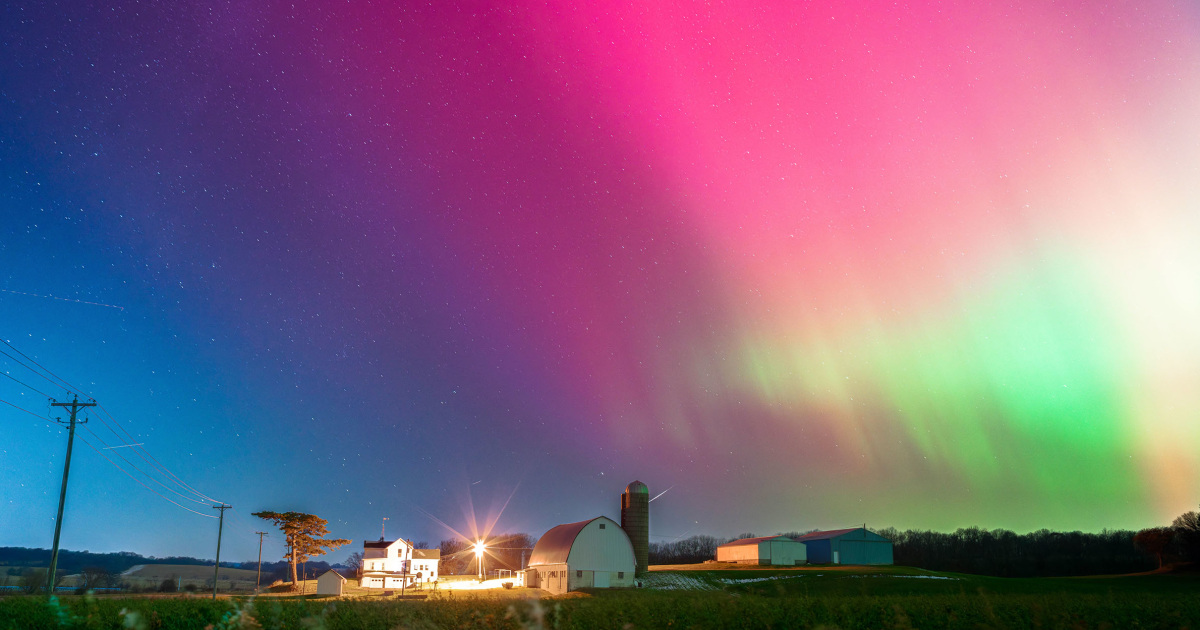
APPLETON, Wis. — A powerful geomagnetic storm fueled by solar eruptions has painted the night skies across the United States with vibrant displays of the northern lights, visible as far south as Florida. The phenomenon, caused by coronal mass ejections (CMEs) from the sun, has captivated skywatchers and raised concerns among experts about potential disruptions to technology and communications.
According to forecasters at the National Oceanic and Atmospheric Administration's (NOAA) Space Weather Prediction Center, the storm reached a G4 level on the five-step geomagnetic scale — the second-highest rating — as two CMEs already impacted Earth. These massive clouds of protons, electrons, and magnetic fields, erupting from the sun's outer atmosphere at high speeds, collided with Earth's magnetosphere, exciting particles in the atmosphere to produce the colorful auroras.
Red, purple, and green hues lit up the skies in states including Alabama, Ohio, and Texas, with reports of sightings extending to southern locations like Florida. Shawn Dahl, a forecaster at the Space Weather Prediction Center in Boulder, Colorado, described the event's intensity in a video posted on X, formerly Twitter. "The overall strength of the magnetic field from the passing CMEs was not only eight times stronger than what’s normal but is also favorable at the moment for continued activity," Dahl said.
The aurora borealis, often called the northern lights, occurs when charged particles from the sun interact with gases in Earth's upper atmosphere, creating glowing curtains of light primarily visible near the poles. In the southern hemisphere, a similar display is known as the aurora australis. This current event, however, has pushed the lights unusually far south due to the storm's potency.
Forecasters have issued a rare advisory for the G4-level storm, warning of possible power fluctuations, degradation in GPS signals, and intermittent disruptions to radio communications. "Watches at this level are very rare," the Space Weather Prediction Center stated in an advisory released early Wednesday. The agency noted that the "heart" of the current CME — referred to as the magnetic cloud — was passing over Earth and expected to continue through the overnight hours.
As of Wednesday morning, the second-highest level advisory remained in effect for several more hours. Dahl indicated that the storm could potentially escalate to G5, the highest rating on the scale, which would mark an even more extreme event. Such a classification would amplify risks to infrastructure and expand aurora visibility across even broader regions of the U.S.
The surge in solar activity stems from a series of CMEs launched from the sun in recent days. Two have already arrived, but a third — described as the "final and most energetic" — is anticipated to reach Earth on Wednesday afternoon. Meteorologists say this incoming CME could intensify the geomagnetic storm, leading to more spectacular light shows and heightened technological concerns.
Historical context underscores the rarity of such events. Geomagnetic storms of G4 or higher occur infrequently, with the last G5 storm recorded in 2003, which caused widespread blackouts in Sweden and damaged satellites. While modern power grids are more resilient, experts emphasize preparedness. The Space Weather Prediction Center's alerts aim to help utilities and satellite operators mitigate impacts.
Eyewitness accounts from across the country highlight the awe-inspiring nature of the display. In Ohio, residents reported seeing vivid green and purple ribbons dancing overhead late Tuesday night. Similar sightings in Texas and Alabama drew crowds to dark-sky areas, where the lights rivaled professional light shows. Even in Florida, where auroras are exceptionally rare, social media buzzed with photos of faint red glows on the horizon.
Scientists explain that the sun is currently in an active phase of its 11-year solar cycle, approaching its peak around 2025. This period, known as solar maximum, brings increased sunspot activity and more frequent CMEs. While beautiful to behold, these events remind us of the sun's influence on Earth. "When it reaches the Earth’s magnetic field, also called the magnetosphere, it collides with the particles around the planet, producing colorful light," Dahl explained in his forecast.
Beyond visual spectacle, the storm's practical effects are already being monitored. Airlines have reported minor GPS issues during polar flights, and some high-frequency radio users in the northern U.S. experienced static and signal loss. Power companies, particularly in Canada and Scandinavia, are on high alert, drawing lessons from past events like the 1989 Quebec blackout triggered by a similar solar storm.
The Space Weather Prediction Center continues to track the incoming third CME, which could arrive as early as Wednesday afternoon. If it delivers the expected punch, auroras might become visible in additional southern states, potentially reaching as far as the Gulf Coast. Dahl cautioned that while the current G4 conditions are significant, the full scope of the third ejection remains uncertain until it interacts with Earth's field.
Experts advise the public to enjoy the natural wonder safely by avoiding light-polluted areas and checking local forecasts. Apps and websites from NOAA provide real-time updates on aurora visibility. As the storm unfolds, it serves as a vivid illustration of space weather's reach, bridging the gap between cosmic events and everyday life on Earth.
Looking ahead, this geomagnetic episode could contribute to ongoing research into solar impacts on technology. With increasing reliance on satellites for everything from weather forecasting to global communications, understanding and predicting these storms is crucial. The current event, while disruptive in minor ways, has so far spared major outages, but forecasters urge vigilance through at least Thursday.
In Boulder, where the Space Weather Prediction Center operates, teams work around the clock to model the sun's behavior. Their efforts not only enhance scientific knowledge but also protect critical infrastructure. As the third CME approaches, the world watches — some for the lights, others for the lessons in resilience.