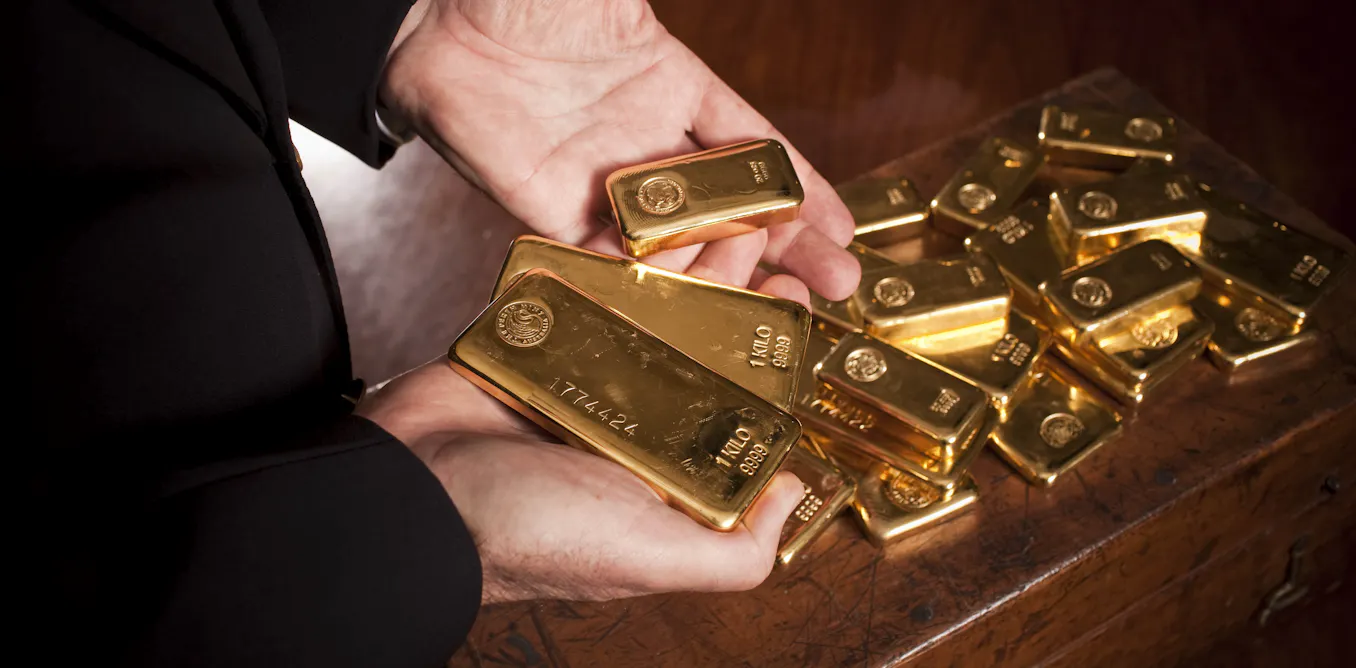
In the midst of escalating conflict in the Middle East, gold prices have taken an unexpected tumble, defying its long-standing reputation as a financial safe haven. Late last month, as reports of major damage to oil and gas facilities emerged from the region, the price of gold plummeted about 20% from its peak, according to market data tracked by financial analysts. This slide comes just months after the precious metal hit an all-time high of nearly $5,600 per ounce in late January, more than double its value from a year prior.
The volatility has left investors scratching their heads, especially as global markets grapple with the fallout from interrupted oil supplies and heightened geopolitical tensions. Gold, often touted as a steady anchor in turbulent times, has instead behaved like a roller coaster, surging and then crashing amid the chaos. Despite the recent drop, the metal remains at elevated levels by historical measures, having climbed almost 300% over the past decade, driven largely by what experts call 'financialisation'—the proliferation of investment vehicles that allow speculation without owning the physical asset.
To understand this paradox, it's helpful to distinguish between a hedge and a safe haven in investment terms. A hedge, as described in financial literature, is an asset that typically moves inversely to the broader market over the long term, offering protection like an umbrella on a rainy day but potentially limiting gains in good weather. A safe haven, by contrast, shines during acute crises, serving as a storm shelter when markets face sudden shocks.
Research published in 2016 by a team of economists, including one who analyzed precious metals during major downturns, highlighted gold's safe haven qualities in specific contexts. 'During the 2008 global financial crisis, gold was the most stable commodity among the precious metals we studied,' the study noted. 'Its price did drop, but it avoided the catastrophic losses seen in other precious metals.' The analysis covered share markets in Australia, the United States, Germany, and France, showing gold's resilience when financial systems faltered, such as in 2011 when Standard & Poor's downgraded the U.S. credit rating from AAA to AA+ for the first time, triggering widespread stock market declines.
Those events, however, stemmed from within the financial sector—a banking collapse in 2008 and a sovereign credit hit in 2011. The current situation in the Middle East represents a different beast: a severe energy shock. Reports from the region indicate significant disruptions to oil production and exports, with facilities targeted in ongoing hostilities. As a result, oil prices have spiked, exacerbating inflation fears and straining global supply chains.
In a forthcoming 2025 research paper co-authored by the same economists, the nuances of gold's behavior in recent crises, including the COVID-19 pandemic, are explored further. The paper argues that while gold remains a popular choice for investors fleeing riskier assets, it is far from immune to broader market turbulence. 'Gold is still a go-to choice for investors moving out of riskier investments. But it is not an untouchable storm shelter,' the authors write. Instead, they found that gold absorbs volatility from both stock and energy markets, which can drive its price downward even as panic spreads.
Several factors contribute to this vulnerability. During periods of market chaos, large institutional investors may be compelled to sell gold holdings to cover losses elsewhere or meet margin calls—demands from lenders for additional funds as asset values fall. 'For one, market chaos means some large investors may be forced to sell gold to cover other losses or meet financial obligations, such as margin calls,' according to the analysis.
Profit-taking also plays a role. After gold's rally to $5,600 per ounce in January, some investors viewed the peak as an opportune moment to cash out, rebalancing portfolios amid the uncertainty. This behavior was evident as prices began to erode in February, coinciding with initial reports of escalating conflict in the Middle East.
Another key element is gold's limited industrial utility compared to commodities like oil. While gold holds value as a store of wealth and in jewelry, it lacks the essential demand that oil commands in manufacturing, transportation, and energy production. 'In a severe crisis, forced to choose between a commodity like oil and gold, what does global industry really need? Oil,' the researchers observe. As oil shortages threaten economic output worldwide, capital flows toward energy-related assets, sidelining gold.
The rise of financialisation has amplified these dynamics. Over decades, gold has evolved from a physical bullion trade to a highly speculative market dominated by derivatives—complex contracts that bet on price movements—and exchange-traded funds (ETFs) that track gold's value without requiring actual ownership. 'With these funds, you aren’t buying gold itself. You’re buying an asset whose price is designed to track the price of gold in some way,' explains the 2025 paper.
This shift has flooded the market with speculative capital from both institutional heavyweights and retail traders. As a result, gold prices now respond more acutely to financial sentiment than to traditional supply-and-demand fundamentals. 'Today, a massive rise in speculative investment means that commodity prices depend on far more than real-world supply and demand,' the authors note. Because many investors hold gold-linked products alongside stocks, shared exposures to shocks—like the energy crisis—can trigger correlated sell-offs.
Historical precedents underscore these patterns. During the COVID-19 pandemic, gold initially surged as lockdowns crippled economies, but its safe haven allure waned as central banks pumped liquidity into markets and energy prices fluctuated wildly. Similarly, in the early stages of the Russia-Ukraine war in 2022, gold briefly rallied before stabilizing, influenced by overlapping commodity pressures.
Market watchers in New York and London have reported heightened trading volumes in gold futures since the Middle East flare-up, with the COMEX exchange in New York seeing daily volumes exceed 500,000 contracts last week alone. Analysts at firms like JPMorgan Chase have cautioned that prolonged oil disruptions could further pressure gold, potentially pushing prices below $4,000 per ounce if inflation persists without corresponding interest rate hikes.
Looking ahead, the implications for investors are stark. Traditional advice to flock to gold in wartime may need rethinking, especially when conflicts disrupt energy markets. Central banks, which hold vast gold reserves—over 36,000 tons globally, according to the World Gold Council—continue to accumulate the metal as a hedge against currency devaluation, but retail and institutional players face a more volatile landscape.
As the situation in the Middle East evolves, with diplomatic efforts underway in Geneva and Washington to broker ceasefires, gold's trajectory remains uncertain. Officials from the International Energy Agency have warned of potential supply shortfalls lasting into 2025 if infrastructure damage isn't repaired swiftly. For now, the precious metal's crash serves as a reminder that in an interconnected world, no asset is entirely insulated from the storms of geopolitics and energy economics.