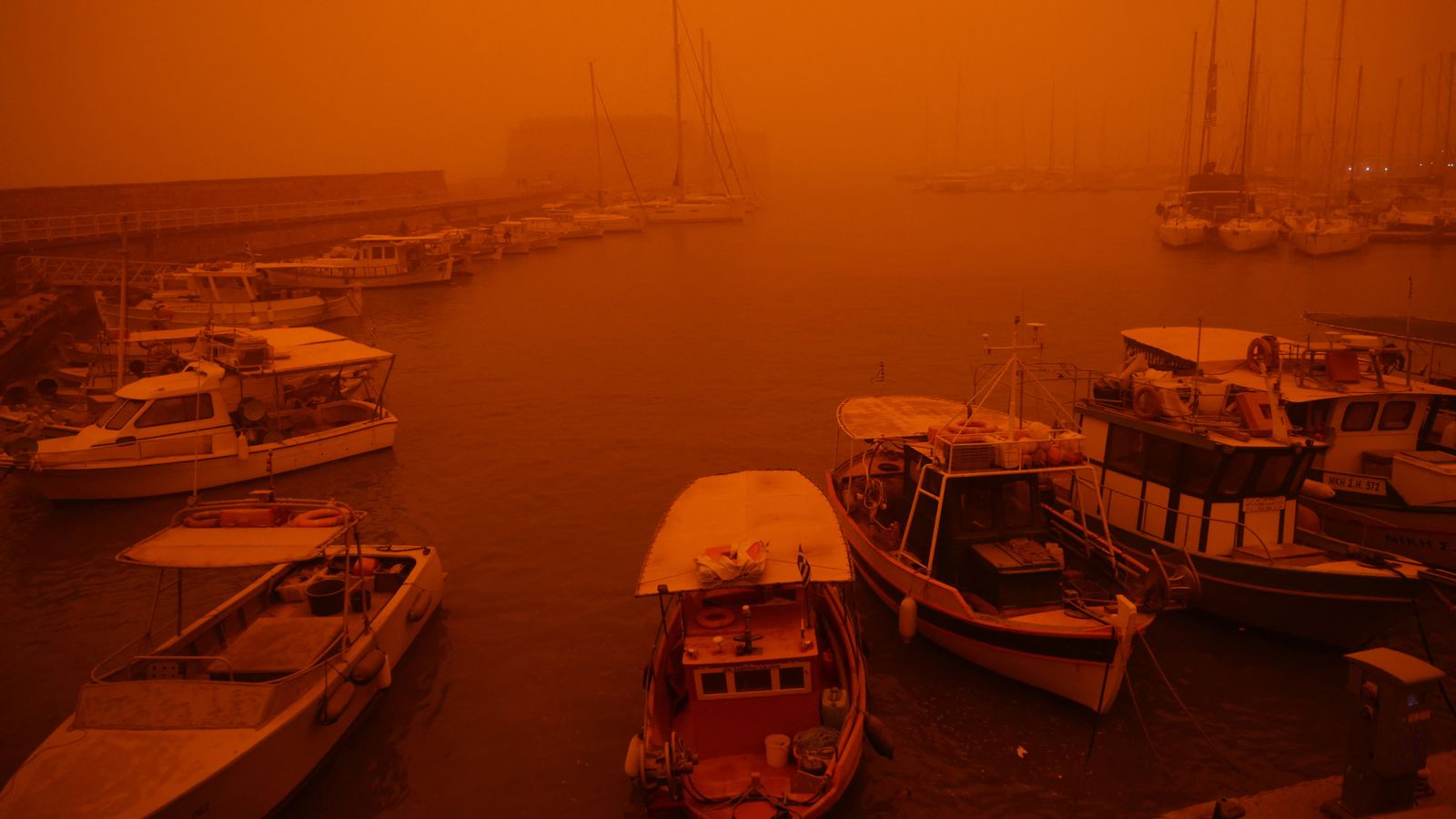
CRETE, Greece — The idyllic island of Crete, famed for its azure skies and sun-drenched landscapes, has been transformed into an otherworldly scene straight out of a dystopian novel. A massive plume of Saharan dust, carried across the Mediterranean by powerful winds from Storm Erminio, has blanketed the region, turning the clear blue heavens a haunting blood red. This unusual meteorological event struck just ahead of the Easter holidays, disrupting travel and daily life for residents and tourists alike.
The dust storm, originating from the vast deserts of North Africa, began enveloping Crete on Wednesday, according to reports from local meteorological services. Dramatic photographs circulating on social media and news outlets captured the eerie transformation: cars caked in reddish mud, buildings streaked with grime, and skies that resembled a perpetual sunset. Residents in cities like Heraklion and Chania donned face masks to shield themselves from the fine particles, which have been known to irritate eyes and respiratory systems.
Storm Erminio, which has been battering Greece with gale-force winds and heavy rainfall, exacerbated the situation. Winds gusting up to 100 kilometers per hour whipped the dust into a suffocating haze, while the rain mixed with the airborne particles to create a sticky mud that coated everything in its path. A red weather warning, the highest alert level, was issued by Greek authorities and remained in effect until late Thursday, urging people to stay indoors and avoid unnecessary travel.
Travel to and from Crete ground to a halt on Wednesday as flights were canceled and ferries suspended amid the chaos. Airlines including Aegean Airlines and Olympic Air reported delays and diversions, stranding thousands of passengers at airports in Athens and other hubs. Ferry services between Crete and the mainland, vital for locals and holidaymakers, were also disrupted, with operators citing poor visibility and rough seas as the culprits. One traveler, speaking to reporters at Heraklion International Airport, described the scene as "apocalyptic," saying the red dust made it feel like "the end of the world was nigh."
The impacts extended beyond Crete to other parts of Greece. On the mainland, near Athens, a man was found dead early Thursday morning in the flooded Nea Makri area, according to the fire department. He was discovered pinned under a car that had been swept away by rising waters, highlighting the storm's deadly potential. Firefighters responded to multiple calls for flooding and fallen trees across Attica, the region surrounding the capital, where emergency services worked around the clock to clear debris and rescue stranded motorists.
Santorini, another crown jewel of Greek tourism with its iconic white-washed cliffs, was similarly shrouded in the red dust. Visitors to the volcanic island reported reduced visibility and a surreal atmosphere, with tour operators canceling boat trips and hikes. The dust has settled on the famous caldera views, temporarily marring the postcard-perfect vistas that draw millions each year. Local officials in Santorini urged caution, warning of potential health risks from prolonged exposure to the particles.
This Saharan dust intrusion is not an isolated incident but part of a broader pattern affecting the Mediterranean. Similar events have occurred in recent years, with dust plumes from the Sahara reaching as far as southern Europe and even the Alps. Scientists attribute these episodes to shifting wind patterns influenced by climate change, which can intensify desertification and atmospheric transport of particulates. In Greece, the combination of dust and extreme weather has compounded challenges from recent natural disasters.
Over the past decade, Greece has grappled with a series of devastating floods and wildfires, events that analysts link to a rapidly warming climate. The 2021 floods in Thessaly, for instance, displaced thousands and destroyed crops, while the 2018 Mati wildfire near Athens claimed over 100 lives. Experts from the European Environment Agency have warned that rising temperatures could make such extremes more frequent, straining the country's infrastructure and emergency response capabilities.
The timing of the current storm could not be worse, coinciding with Orthodox Easter preparations. Greece's Easter, celebrated later than its Western counterpart, is a major cultural and religious event, with families gathering for feasts and church services. On Crete, where tourism accounts for a significant portion of the economy, the disruptions threaten to dampen the holiday spirit and economic boost. Hoteliers in popular spots like Rethymno expressed concerns over cancellations, with one owner telling local media, "We've had bookings drop by 30 percent already; this red sky is scaring people away."
Across the sea in North Africa, the same dust storm has wrought havoc in Libya. A state of emergency was declared in the eastern city of Tobruk on Wednesday as red skies descended, forcing schools and businesses to close. Libyan authorities reported visibility dropping to near zero, leading to traffic accidents and heightened air quality alerts. The event underscores the transboundary nature of desert dust, which can travel thousands of kilometers and affect air quality far from its source.
Greek meteorological experts have provided some reassurance, noting that the dust levels, while high, are not unprecedented. Nikos Mihalakopoulos, a senior forecaster with the National Observatory of Athens, explained in a recent briefing that Saharan dust events typically peak in spring and can last several days. "The particles will settle with rainfall, but we advise vulnerable groups—children, the elderly, and those with asthma—to limit outdoor activities," he said. Monitoring stations across Crete recorded particulate matter levels exceeding 500 micrograms per cubic meter, far above the World Health Organization's recommended daily limit of 45.
As the storm begins to wane, cleanup efforts are underway on Crete. Municipal workers in Heraklion deployed hoses and brushes to wash down streets and public spaces, though the mud's tenacity has slowed progress. Environmental groups have called for better preparedness, pointing to the need for early warning systems tailored to dust incursions. One activist from the Hellenic Ornithological Society highlighted the ecological toll, noting that the dust can harm bird migration patterns and contaminate water sources.
Looking ahead, the Easter weekend may see partial recovery, with forecasters predicting clearer skies by Friday. However, lingering effects could persist, including potential spikes in respiratory illnesses reported at local clinics. The Greek government has allocated emergency funds for affected regions, and tourism officials are launching campaigns to reassure visitors that the island remains safe and beautiful beneath the temporary veil.
This episode serves as a stark reminder of the interconnectedness of global weather systems in an era of climate variability. As Greece emerges from the red haze, questions linger about how to adapt to increasingly erratic conditions. For now, the resilient spirit of Cretans—evident in their masked faces and community support—offers a glimmer of hope amid the dust.
In related developments, the storm's reach has prompted international attention, with the European Union monitoring air quality across member states. Officials in Italy and Spain have issued advisories for possible dust traces in the coming days, emphasizing the need for regional cooperation on environmental threats.