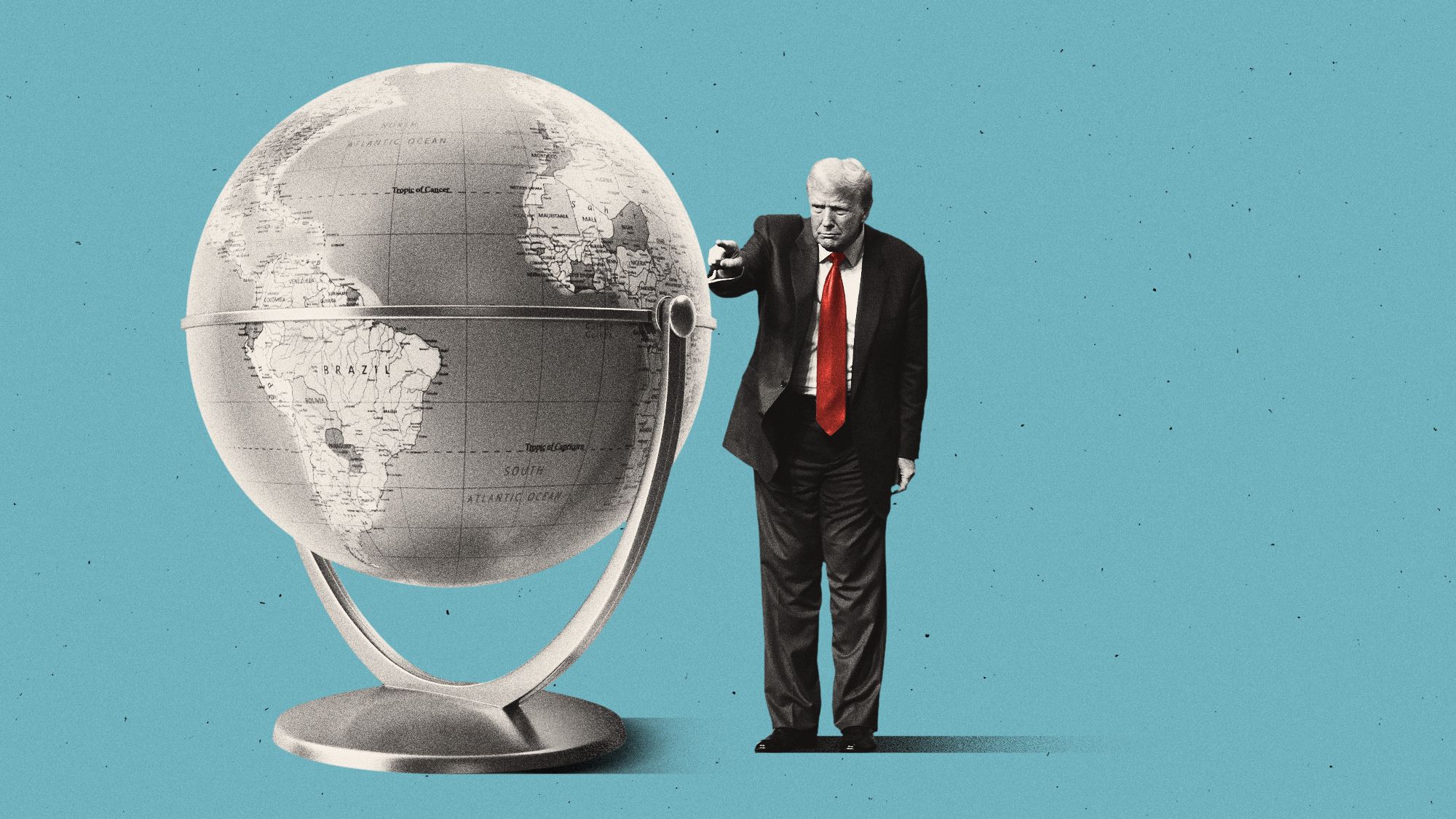
In the wake of the dramatic U.S. operation that led to the capture of Venezuelan President Nicolás Maduro, President Donald Trump has issued a series of pointed warnings to several nations, signaling a potential expansion of American military and diplomatic pressure across Latin America and beyond. Speaking from Air Force One on Tuesday, Trump reiterated his interest in acquiring Greenland for national security reasons, while also targeting Colombia, Cuba, and even hinting at actions against Iran. The moves come as the Trump administration touts the Venezuela extraction as a success in restoring U.S. pre-eminence in the Western Hemisphere.
The operation to remove Maduro, described by Trump as a 'stunning extraction,' was announced during a White House press conference last week, where the president outlined a revised national security strategy aimed at protecting 'commerce and territory and resources that are core to national security.' Trump emphasized that these principles represent 'the iron laws that have always determined global power and we're going to keep it that way.' The strategy echoes long-standing U.S. doctrines of forward defense, though critics argue it marks a departure from international norms.
Trump's rhetoric has sharpened toward Colombia, where he referred to President Gustavo Petro as the country's 'sick man' and threatened potential military action if Bogotá does not align more closely with U.S. interests. In a statement released Monday, the Colombian government dismissed the comments as 'unhelpful interference,' with Foreign Minister Laura Sarabia urging Washington to respect sovereignty. Petro, a left-leaning leader who took office in 2022, has faced domestic challenges including protests over economic policies, but U.S. officials have cited concerns over alleged ties to Venezuelan elements as justification for the pressure.
Similarly, Trump warned Mexico's leaders to 'get their act together' amid ongoing border security disputes, referencing migration flows and cartel violence that have strained bilateral relations since his return to the White House in January 2025. Mexican President Claudia Sheinbaum responded during a press briefing in Mexico City on Wednesday, stating, 'We will not be dictated to by threats; cooperation must be based on mutual respect.' The comments follow a series of U.S. deportations that have escalated tensions, with over 500,000 repatriations reported in the first half of the year according to U.S. Customs and Border Protection data.
Cuba has also drawn Trump's ire, with the president declaring during the same Air Force One remarks that the island nation is 'ready to fall.' This echoes his administration's tightened sanctions imposed earlier this year, which U.S. officials say aim to support 'peaceful protesters' against the Cuban regime. Havana's foreign ministry condemned the statements as 'imperialist saber-rattling,' linking them to a broader pattern of U.S. aggression. The U.S. has maintained an embargo on Cuba since 1960, but recent protests in 2024 over blackouts and food shortages have prompted renewed calls in Washington for regime change.
Extending beyond the Americas, Trump's comments on Iran suggest readiness for intervention, telling the Islamic Republic that America is 'locked and loaded and ready' to aid demonstrators. This follows reports of unrest in Tehran last month, where at least 20 protesters were killed in clashes with security forces, according to human rights groups. Iranian Supreme Leader Ali Khamenei dismissed the threats in a televised address, calling them 'empty bluster from a failing empire.' The U.S. has increased naval deployments in the Persian Gulf since March, citing threats to shipping lanes.
Trump's renewed push for Greenland, a semi-autonomous Danish territory, has provoked sharp backlash from European allies. On Tuesday, British Prime Minister Keir Starmer described the idea as 'deeply concerning,' warning it could undermine NATO unity. Denmark's government echoed this, with Prime Minister Mette Frederiksen stating in Copenhagen that 'Greenland is not for sale, and sovereignty is non-negotiable.' Trump's interest dates back to 2019, when he first proposed purchasing the island for its strategic Arctic position, but the current context ties it to broader security goals amid Russian and Chinese activities in the region.
Experts offer varied interpretations of these developments. Juan Luis Manfredi, a professor of journalism at Spain's University of Castilla-La Mancha, argued in an analysis for The Conversation that 'the attack on Venezuela and the capture of Maduro herald the decoupling of Trump’s United States from the rules-based international order' and signal 'the crumbling of the liberal order as a whole.' He described a 'new international order' emerging 'based on the use of force, revisionism and security on the American continent.'
'There are two ways to view all this,' wrote Simon Tisdall in The Guardian. 'A benign interpretation is that in matters of war and peace, Trump has no idea what he is doing – no strategy, no clue – and he is making up policy as he goes along. The sinister interpretation is that he knows exactly what he’s at and that more and worse is to come.'
Contrasting this, historian Jeremy Black in The Telegraph cautioned against 'the heady rush to instant criticism that can divorce policy from its historical contexts.' He noted that Trump's actions are 'in line with long-standing patterns of American behaviour, not least with the idea of forward defence against possible foreign threats.' Black added that while U.S. policies 'clash with notions of the national sovereignty of others,' such notions can also 'protect dictatorships and oppression,' as seen with Maduro and potentially in Iran and North Korea.
Courtney Subramanian and Kate Sullivan, writing for Bloomberg, identified a 'common thread' in Trump's foreign policy: a 'focus on short-term achievements over more complicated, longer-term questions about governance and stability,' similar to U.S. approaches in Ukraine, Yemen, and the Israel-Gaza conflict. They warned that this 'philosophy could backfire on American interests,' potentially emboldening China to act on Taiwan or Russia to intensify efforts against Ukraine's Volodymyr Zelenskyy.
Ryan Berg, a Latin America specialist at the Center for Strategic and International Studies, told Politico that the 'axis of authoritarians,' including Moscow and Beijing, 'may feel additional urgency to prove their value' in supporting allies like Venezuela. This could lead to heightened proxy conflicts, with Russia already increasing military aid to Caracas before Maduro's ouster.
The Venezuela operation itself, conducted in late August 2025 with special forces inserting via helicopter into Caracas, resulted in Maduro's transfer to U.S. custody at Guantánamo Bay. Venezuelan opposition leader María Corina Machado hailed it as a 'victory for democracy,' but interim President Edmundo González has struggled to stabilize the country, facing hyperinflation rates exceeding 1,000% and widespread blackouts. U.S. aid pledges of $2 billion were announced to support reconstruction, though delivery has been delayed by logistical issues.
Looking ahead, the trajectory of U.S. policy may hinge on Venezuela's post-Maduro stability. Latin America geoeconomics analyst Jimena Zuniga told Bloomberg that success there 'could encourage the U.S. administration to expand its pressure campaign to Cuba or other disfavored regimes.' Conversely, any failure 'could temper its appetite for intervention.' With midterm elections approaching in November 2026, Trump faces domestic pressure to demonstrate foreign policy wins, but allies like Senate Majority Leader John Thune have urged caution to avoid overextension.
International reactions underscore the stakes. The United Nations Security Council held an emergency session on Wednesday, where China's ambassador accused the U.S. of 'unilateral aggression,' while France's representative called for dialogue. As Trump prepares for a summit with Latin American leaders in Miami next month, the world watches whether these threats will translate into action or remain rhetorical flourishes in an era of renewed U.S. assertiveness.