In a sharp escalation of partisan tensions over voting rights, former Vice President Kamala Harris accused President Donald Trump and his Republican allies of attempting to 'rig' the 2026 midterm elections following a decision by the Virginia Supreme Court to invalidate a voter-approved redistricting measure. The ruling, issued on May 8, 2026, struck down a referendum that had narrowly passed in April, which would have temporarily transferred redistricting authority from the state's nonpartisan commission to the Democrat-controlled legislature through 2030. Harris, speaking out via a post on X, described the court's action as ignoring 'the will of the people' and providing a 'boost' to Republican efforts to undermine democratic processes.
The Virginia Supreme Court, in a unanimous decision, declared that the legislative process used to advance the referendum violated Article XII, Section 1 of the Virginia Constitution. 'We hold that the legislative process employed to advance this proposal violated Article XII, Section 1 of the Constitution of Virginia,' the court stated in its opinion. 'This constitutional violation incurably taints the resulting referendum vote and nullifies its legal efficacy.' The measure had been approved by voters on April 21, 2026, at polling locations including the Fairfax Government Center, with 51 percent in favor and 49 percent opposed. If implemented, it was projected to reshape Virginia's congressional districts in a way that could give Democrats a commanding 10-1 majority in the state's 11-member delegation, expanding on their current 6-5 edge.
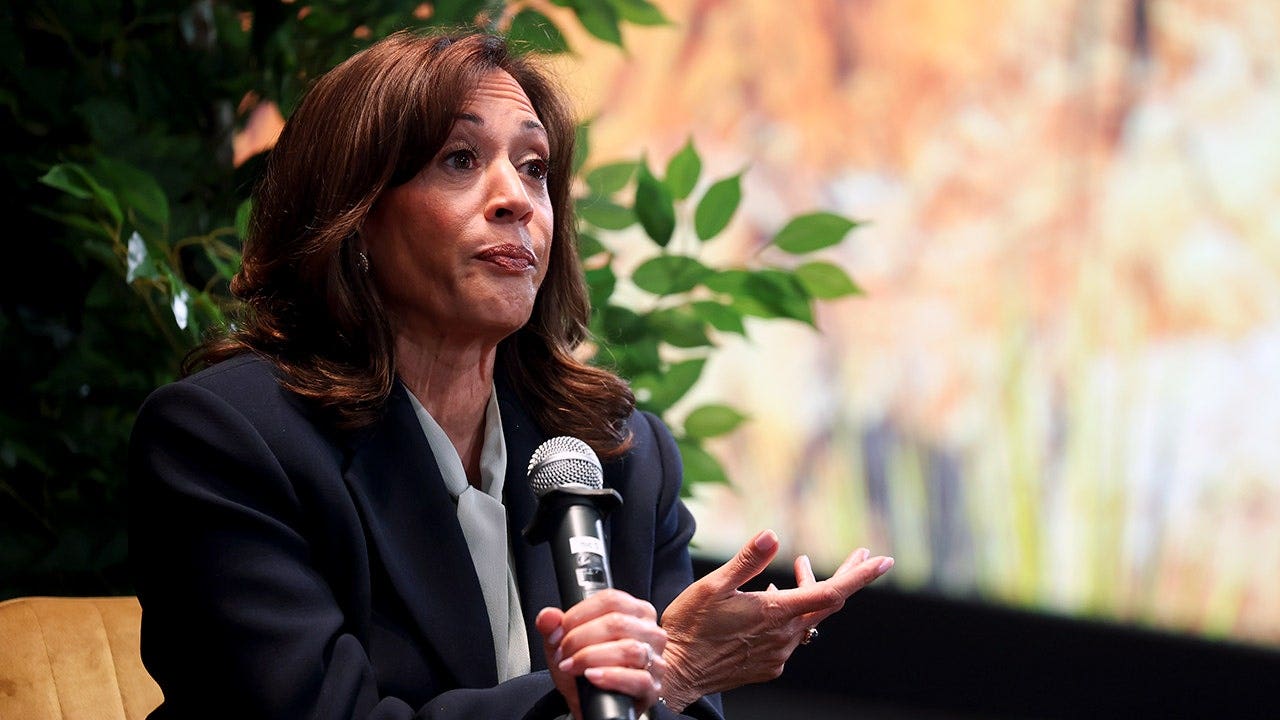
Harris, who has been actively campaigning and speaking on political issues amid speculation about her future role in the Democratic Party, made her comments during a series of appearances, including a fireside chat at the MEET Las Vegas event on May 7, 2026. In her X post the following day, she wrote, 'Today, the Virginia Supreme Court ignored the will of the people and overturned those democratically chosen maps. This ruling gives a boost to Donald Trump's effort to rig the 2026 elections and the Republicans' long game to attack voting rights.' She further emphasized resilience in the face of the setback, adding, 'We are rightfully outraged, but we will not give up. We must continue our fight to restore the power of the people.'
President Trump quickly celebrated the court's decision on his Truth Social platform, framing it as a triumph against Democratic overreach. 'The Virginia Supreme Court has just struck down the Democrats’ horrible gerrymander,' Trump posted. He called it a 'Huge win for the Republican Party, and America, in Virginia.' The ruling represents a significant victory for Republicans, who have argued that the referendum was an unconstitutional power grab by Democrats to entrench their influence in a state that has trended blue in recent elections but remains competitive at the congressional level.
Democrats, however, decried the decision as an assault on voter sovereignty. Democratic National Committee Chair Ken Martin issued a statement lambasting the court, saying, 'a group of unelected judges on the Virginia Supreme Court chose to put partisan politics over the will of the people.' Virginia Attorney General Jay Jones echoed this sentiment, asserting that the ruling 'silences the voices of the millions of Virginians who cast their ballots' in the referendum. Jones indicated that his office is 'evaluating every legal pathway forward,' hinting at potential appeals or further challenges to the decision.
The controversy stems from a broader national struggle over redistricting, which occurs every decade following the U.S. Census to account for population shifts. Virginia, like many states, established an independent redistricting commission in 2020 through a constitutional amendment aimed at curbing partisan gerrymandering. The referendum in question sought to bypass this commission for the upcoming cycle, allowing the state legislature—currently controlled by Democrats with a slim majority—to draw the maps. Critics, including Republican lawmakers, contended that this move violated the state's constitutional framework for impartial mapmaking.
This is not the first time Virginia's political maps have been a flashpoint. In 2021, the state Supreme Court intervened in a previous redistricting dispute, upholding maps drawn by the commission despite Democratic objections. The current ruling continues that pattern of judicial oversight, but it has reignited accusations of bias from both sides. Republicans point to the decision as evidence of the judiciary protecting fair processes, while Democrats argue it overrides direct democracy. Former Attorney General Eric Holder, a prominent voice on voting rights, has separately accused Republicans of 'stealing seats' through similar tactics nationwide, though he was not directly quoted on the Virginia case.
Harris's outspoken reaction comes as she navigates her post-vice presidential profile, with increased travel and commentary signaling potential ambitions for 2028. At the Las Vegas event, she addressed broader themes of empowerment and the American dream, stating, 'For far too many people in our country, the American dream, is not real. And in fact, for many people in their lived experience, it's what they would consider an American myth.' She also took a firm stance against downplaying Trump's influence, saying, 'I’m not going to dismiss him as being an idiot. He’s dangerous.' These remarks underscore her ongoing engagement in partisan battles, even as the 2026 midterms loom as a critical test for both parties' control of Congress.
Top Democrats have been cautious about endorsing Harris as the party's standard-bearer for the next presidential cycle. When asked about her potential 2028 run, Rep. Jim Clyburn, D-S.C., told Fox News Digital, 'I have no idea.' Rep. Dan Goldman, D-N.Y., similarly deferred, saying, 'I have no idea who's running, and we'll focus on 2028 after 2026.' Rep. John Larson, D-Conn., suggested openness, noting that the decision 'ultimately rests with Harris' but advocating for 'a wide-open Democratic primary.' This reticence reflects internal party dynamics as figures like Harris position themselves amid a crowded field of potential contenders.
The Virginia ruling arrives at a pivotal moment in the redistricting wars, with states across the country still finalizing maps that will shape the 2026 midterms. Control of the House of Representatives, where Republicans hold a narrow majority, hangs in the balance, and even small shifts in delegations like Virginia's could tip the scales. Analysts estimate that Democratic gains in Virginia could have added pressure on GOP incumbents in swing districts, making the court's intervention a strategic boon for Republicans aiming to defend their seats.
Beyond the immediate legal and political ramifications, the decision highlights ongoing debates about the role of independent commissions versus legislative control in drawing district lines. Proponents of commissions, including bipartisan groups, argue they reduce gerrymandering, while critics say they can be manipulated or overly rigid. In Virginia, the referendum's defeat means the nonpartisan commission will likely proceed with map proposals, subject to further review by the legislature and courts.
Harris, undeterred, rallied supporters with a message of persistence during her Las Vegas appearance. 'I firmly and strongly believe that when you feel powerless, you are powerless,' she said. 'And when you feel powerful, you are powerful. And we are powerful and we are powerful. And so let's just show ourselves, each other, our power around the midterms and every day.' Her words signal a commitment to mobilizing voters on issues like redistricting and voting access as the midterms approach.
Looking ahead, the Virginia case could set precedents for similar challenges in other states, such as North Carolina and Georgia, where redistricting battles are also underway. Legal experts anticipate appeals to the U.S. Supreme Court if state-level remedies fail, potentially drawing national attention. For now, the ruling stands as a setback for Democratic strategies in a key battleground, intensifying the stakes for the 2026 elections.
As both parties gear up for the midterms, the Virginia decision underscores the high-wire act of balancing voter will with constitutional constraints. Republicans view it as a defense against partisan manipulation, while Democrats see it as a barrier to representation. With Harris and Trump trading barbs, the episode exemplifies the polarized landscape shaping American democracy.