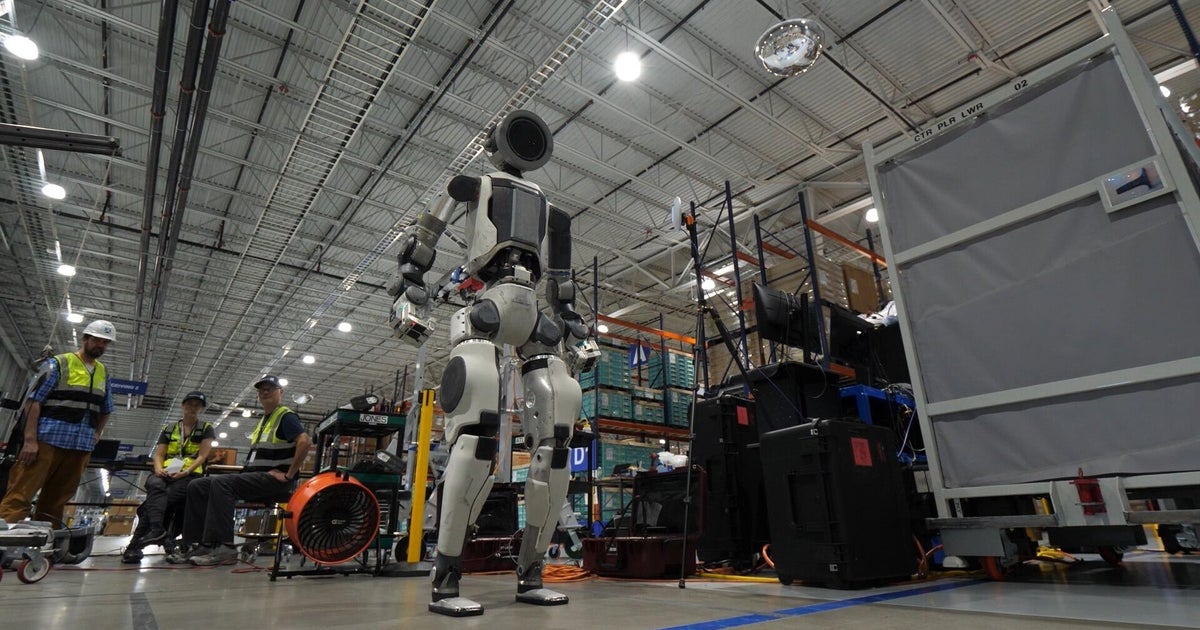
BOSTON — In a segment that aired Sunday night on CBS's 60 Minutes, correspondent Lesley Stahl ventured into the labs of Boston Dynamics to witness what may be the dawn of a new era in robotics: the first real-world tests of the company's latest humanoid robot, Atlas. The report, titled "Here Come The Humanoids," showcased Atlas performing complex maneuvers in environments mimicking everyday construction sites and warehouses, hinting at a future where machines could seamlessly integrate into human workspaces.
Boston Dynamics, a Waltham, Massachusetts-based robotics firm founded in 1992 as a spin-off from MIT, has long been at the forefront of legged robotics. Acquired by South Korea's Hyundai Motor Group in 2021 for approximately $1.1 billion, the company has shifted its focus toward practical applications. According to the 60 Minutes segment, Atlas represents a pivotal upgrade from its predecessors, transitioning from a hydraulic-powered model to an all-electric version that promises greater agility and efficiency. The robot, standing about 5 feet 9 inches tall and weighing around 150 pounds, was demonstrated flipping, jumping, and manipulating objects with human-like dexterity.
"This is the first time we've seen Atlas in a real-world test," Stahl narrated during the broadcast, as the camera captured the robot navigating a simulated construction zone. Engineers at Boston Dynamics explained that these tests, conducted over the past year at their Waltham facility, aim to validate Atlas's ability to handle unpredictable environments. One key demonstration involved Atlas autonomously picking up and placing plywood sheets, a task that required balancing on uneven terrain while coordinating multiple joints.
Marc Raibert, Boston Dynamics' founder and chairman, provided insight into the robot's development during the interview. "Atlas is designed to be a general-purpose humanoid that can do the kinds of physical work that people don't want to do," Raibert said. He emphasized the robot's learning capabilities, drawing parallels to animal training. "It's like teaching a puppy to walk—through trial and error, it gets better," he added, referencing the iterative process that has allowed Atlas to master parkour-style movements since its debut in 2013.
The segment delved into the technical evolution of Atlas, highlighting how advancements in artificial intelligence and battery technology have accelerated its progress. Boston Dynamics' team reported that the new electric Atlas can operate for up to two hours on a single charge, a significant improvement over the hydraulic model's 30-minute runtime. These enhancements, according to company officials, stem from collaborations with Hyundai's engineers, who bring automotive expertise to refine the robot's power systems.
Not all perspectives on humanoid robots are uniformly optimistic. While the 60 Minutes report focused on innovation, it also touched on concerns raised by labor experts. Kate Darling, a research specialist at MIT's Media Lab, commented in a related discussion, "These robots could transform industries, but we need to consider the societal impacts, like job displacement in manual labor sectors." Darling's remarks, echoed in broader media coverage, underscore the tension between technological promise and economic disruption.
Historical context provides deeper understanding of Boston Dynamics' trajectory. The company gained fame through viral videos in the 2010s, showcasing early Atlas prototypes backflipping and dancing alongside other robots like Spot, the four-legged canine-inspired machine now used in inspections at construction sites worldwide. By 2020, Boston Dynamics had partnered with the U.S. military for development funding, though the firm later distanced itself from defense applications following the Hyundai acquisition. The 60 Minutes piece noted that current efforts prioritize commercial uses, with pilot programs underway at Hyundai factories in Alabama and South Korea.
Specific details from the tests revealed Atlas's robustness. In one sequence filmed last summer, the robot recovered from a simulated trip by executing a mid-air twist to land on its feet, a feat powered by 28 hydraulic actuators in the older model—now replaced by electric motors for quieter, more precise control. Boston Dynamics engineers, speaking on condition of anonymity due to ongoing proprietary work, told 60 Minutes that error rates in object manipulation have dropped below 5 percent after thousands of training iterations using reinforcement learning algorithms.
The broadcast also featured input from Robert Playter, Boston Dynamics' CEO, who joined the company in 2008. "We're not trying to replace humans; we're augmenting them," Playter stated. He described a vision where Atlas teams up with workers on tasks like disaster response or elderly care, citing a recent demonstration at a Georgia warehouse where the robot assisted in pallet stacking alongside human employees. Playter highlighted that deployment timelines could see commercial versions available within three to five years, pending regulatory approvals.
Broader implications emerged as the segment explored ethical and safety considerations. The International Federation of Robotics reported that global industrial robot installations reached 553,000 units in 2022, a 5 percent increase from the prior year, with humanoids like Atlas poised to accelerate this trend. However, sources within the robotics community, including a panel at the 2023 International Conference on Robotics and Automation in London, expressed caution about over-reliance on AI-driven machines. "We must ensure these humanoids prioritize human safety," said one attendee, Dr. Elena Vasquez, a professor at Carnegie Mellon University.
In the United States, where manufacturing jobs have declined by 30 percent since 1990 according to the Bureau of Labor Statistics, the arrival of advanced humanoids raises questions about workforce adaptation. The 60 Minutes report included footage from a focus group in Detroit, where autoworkers voiced mixed reactions. "It's impressive, but what happens to us?" asked one participant, Mike Reynolds, a 25-year veteran at a Ford plant. Such sentiments align with reports from the Economic Policy Institute, which warn of potential displacement for up to 2 million U.S. jobs by 2030 if humanoid adoption surges.
Looking ahead, Boston Dynamics plans to expand testing to urban settings. Company officials indicated in the segment that partnerships with cities like Boston and Singapore could test Atlas in public infrastructure maintenance by 2025. Raibert reiterated optimism, saying, "The future is coming faster than you might think—humanoids will be part of our daily lives sooner than later." This aligns with projections from McKinsey & Company, estimating the humanoid robot market could reach $38 billion by 2035.
The 60 Minutes feature, which drew 7.2 million viewers according to Nielsen ratings for the October 15, 2023, episode, has sparked national conversation. Social media buzzed with reactions, from awe at Atlas's capabilities to debates on regulation. As robotics edges closer to reality, the segment serves as a timely reminder of the accelerating pace of innovation.
While Boston Dynamics leads in humanoid development, competitors like Tesla with its Optimus robot and Figure AI are nipping at its heels. Tesla's Elon Musk announced in September 2023 plans for Optimus to enter factories by 2024, potentially undercutting Atlas on cost. Boston Dynamics, however, maintains an edge in mobility, as evidenced by Atlas's demonstrated ability to climb stairs and balance on one leg—feats not yet matched by rivals, per industry analysts.
In closing, the unveiling of Atlas's real-world prowess signals a transformative shift. As Playter put it, "This is just the beginning." With ongoing tests and refinements, the line between human and machine labor continues to blur, promising efficiency gains while challenging society to adapt.