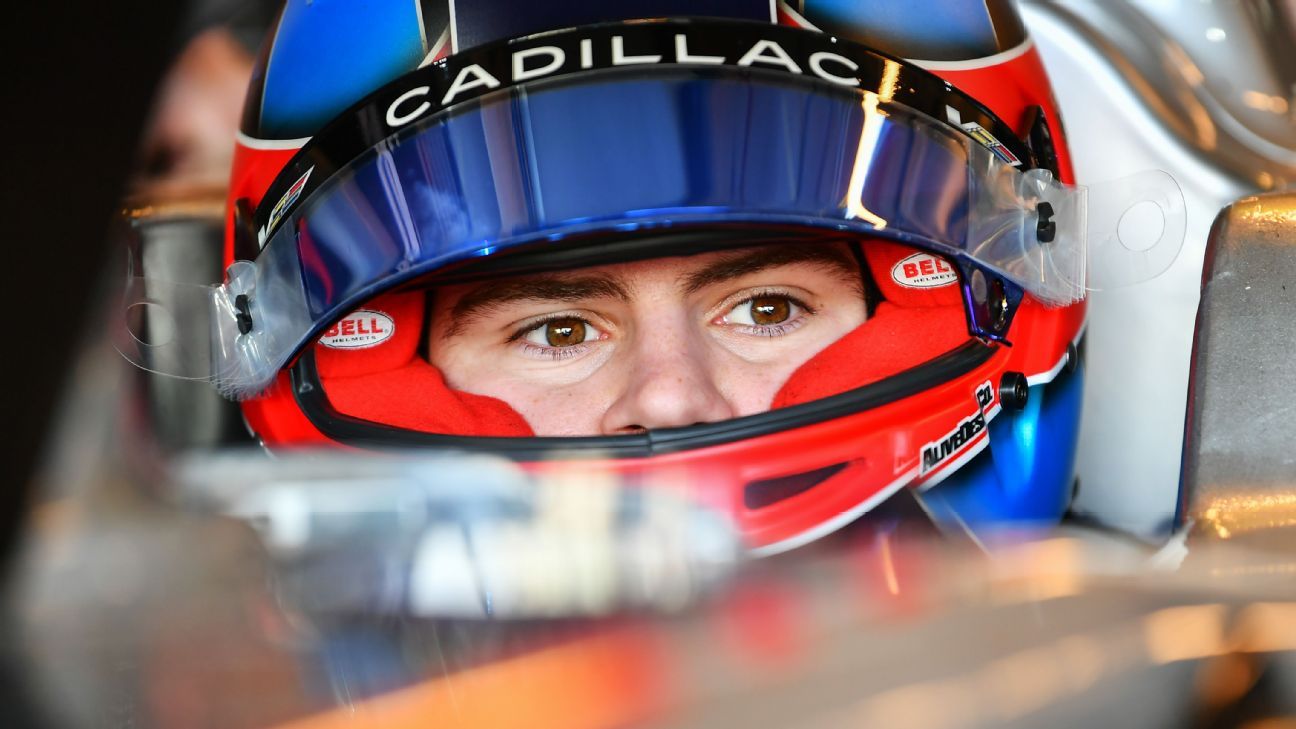
In a move that's turning heads in the world of motorsports, Colton Herta, one of IndyCar's brightest stars, has stepped away from the series after eight seasons to compete in Formula 2 next year. The 25-year-old Californian, who finished second in the 2024 IndyCar championship with Andretti Global, is aiming to earn the superlicense points needed to join the Formula 1 grid as part of the upcoming Cadillac F1 team. Herta's decision, announced recently, marks an unprecedented detour for a driver of his caliber, as he seeks to bridge the gap between American open-wheel racing and the global pinnacle of the sport.
Herta burst onto the IndyCar scene in 2018, making his professional debut just a week before Buffalo Bills quarterback Josh Allen entered the NFL. Over 116 starts, he has secured nine victories, including becoming the series' youngest winner at age 18 during the 2019 Indy 500 qualifying. Despite his success, Herta has been on the cusp of a championship breakthrough without quite clinching it, much like Allen's perennial contention in football. IndyCar even featured Herta's image alone in the drivers' section of its 2025 media guide, underscoring his prominence in the series.
Yet, the path to Formula 1 has eluded Herta due to the FIA's superlicense requirements, which demand a minimum of 40 points accumulated through performances in feeder series like F2. Despite his IndyCar pedigree, Herta lacks sufficient points from those categories, a hurdle that wouldn't have existed in earlier eras of the sport. As 1978 F1 world champion Mario Andretti recalled in an interview with ESPN, drivers like Dan Gurney could transition directly to Grand Prix racing based on talent alone. "I was in a midget in 1963, age 23, in Hatfield, Pennsylvania, and who was I thinking about? Dan Gurney, (who) just got right into Formula 1," Andretti said. "And I'm thinking, 'Someday, that's where I want to be.' And I was in the third-of-a-mile dirt track in a midget thinking of Formula 1."
To address the points shortfall, Herta has partnered with TWG Motorsports, the parent company of the Cadillac F1 project backed by Los Angeles Lakers and Dodgers controlling owner Mark Walter. The plan involves Herta racing with the Hitech TGR F2 team in 2026, a step designed to accumulate the necessary credentials for an F1 seat. Andretti, Herta's team owner and a racing legend, fully endorses the gamble. "It's now or never, and he knows that, and he's willing to take that chance," Andretti told ESPN. "That's how important it is to him. And that is a beautiful commitment I would support 3,000 percent, to go one step down to go two steps forward, but he knows what he's doing and he'll accomplish what he's after, I'm positive."
The transition won't be straightforward. Herta recently spent three days testing in Abu Dhabi with the F2 field, where he focused on acclimating to the car. By the third day, he posted the 14th-fastest time in the morning session among 22 drivers and 19th in the afternoon. "It was all about getting comfortable, and I am still pretty far from being super comfortable in the car," Herta said midway through the test. "It's good first steps, it's such an important three days for us, it's important to maximize everything that we do here. It's fun to be here, fun to be in a car in the offseason, and I am looking forward to the next two days."
Adapting to F2 presents unique challenges compared to IndyCar's high-speed, endurance-style racing on Firestone tires. American driver Max Esterson, who raced in F2 in 2025 before switching to IMSA's endurance series for 2026, highlighted the series' stringent tire management rules using Pirelli rubber. Esterson, from New York, described how sessions are structured around limited high-speed laps to preserve tire surfaces. "The biggest change is the lack of useful laps," Esterson explained to ESPN. "The way the tire works, at pretty much every track, you do an out lap and then a warmup lap and then a push lap, and then you have to cool the tires. And the out lap and warmup lap are very structured and very slow; you're not actually driving at speed. The out lap is probably 20 or 30 seconds off the pace and you don't actually take a corner at speed at all. And same with the warmup lap. So it's a lot of treating the surface of the tire super delicately. That's the hard part. You just have to be careful not to damage the surface."
Qualifying is hard to explain because you basically troll around, and then you arrive in Turn 1 at 200 miles an hour and have to nail it with the one good lap you have on the tires after trolling around for the previous five minutes. You have practice sessions, but your practice is on the hard compounds, so you basically have no experience on the qualifying tire before the first push lap, and then the tire is best on the first push lap. In IndyCar, you at least get to drive on the qualifying tire and get more useful laps. Credit is due to whoever does well, because it's a different skill set than old-school racing. It's perfection with very little preparation.
Esterson's experience underscores the shift Herta must make from IndyCar's more forgiving tire usage to F2's precision demands. Meanwhile, Texan Jak Crawford nearly captured the 2025 F2 championship on his third try, showing that American talent can thrive there, but Esterson's move to IMSA suggests not everyone adapts seamlessly.
Herta's former Andretti teammate, Pato O'Ward, who leads Arrow McLaren's IndyCar program and tests for McLaren F1, expressed strong support for the move while acknowledging its risks. O'Ward, a Mexican driver, sees both personal and series-wide stakes in Herta's success. "I want him to do well," O'Ward told ESPN. "Because this is definitely a risk that he's taking, maybe not so much financially, but more of a personal risk. I hope he gets that Formula 1 seat that we all think he's going to get, and when he gets there, hopefully he has that chance to actually show what we all know he can do and what we've seen in IndyCar. He's been a great competitor."
O'Ward emphasized the learning curve in F1's ecosystem, where established drivers hold an edge. "He's very talented, but it won't automatically fall into his hands," he said. "You're up against guys that have been there for many years, that know how everything works with much more experience over there. There's a steep learning curve that he's going to have to go through. It's a very different driving style and it takes time to adapt. It's not just a flick of a switch, and like, 'Hey, I'm going to be instantly competitive.' If it doesn't go well, there's always going to be those guys that hook to that and use that as rage bait. So that's the reality."
From IndyCar's perspective, Herta's F2 stint carries broader implications. A strong performance could elevate the series' global standing, proving its drivers are ready for F1's intensity. Conversely, struggles might fuel criticism from F1 purists who already question IndyCar's competitiveness. O'Ward captured this duality: "I think it's for us to support his decision and to wish him the best for the sake of showing well for us. Because he is the first one that's going to make the move like he's doing from IndyCar going to F2. And we want that to be good, because it would only help the situation maybe with people that don't have a lot of good things to say about IndyCar. Colton doing well would be a win for IndyCar."
The Cadillac F1 team, set to enter the grid in 2026, represents a significant U.S. investment in the sport, with TWG Motorsports providing the backing. Herta's involvement aligns with efforts to bring American talent to F1, potentially alongside other U.S.-based initiatives. As the only major American driver making this leap, his journey echoes historical transitions but in a modern, points-driven context.
Looking ahead, Herta's 2026 F2 season will be closely watched. Success could secure his F1 superlicense and a Cadillac seat, validating the backward step as a forward leap. For IndyCar, the outcome may shape perceptions among international fans and teams, highlighting whether the series produces world-class talent or serves as a domestic proving ground. As Andretti put it, Herta's commitment is a "beautiful" one, rooted in ambition that could redefine opportunities for future American drivers.
While Herta prepares for the challenges of F2's tire management and qualifying precision, the motorsports community rallies behind him. O'Ward's hope that Herta gets "the tools in order to showcase himself" reflects a shared belief in his potential. Whether this unorthodox path leads to F1 glory or serves as a cautionary tale, it underscores the evolving landscape of global racing, where talent alone isn't always enough to cross borders.