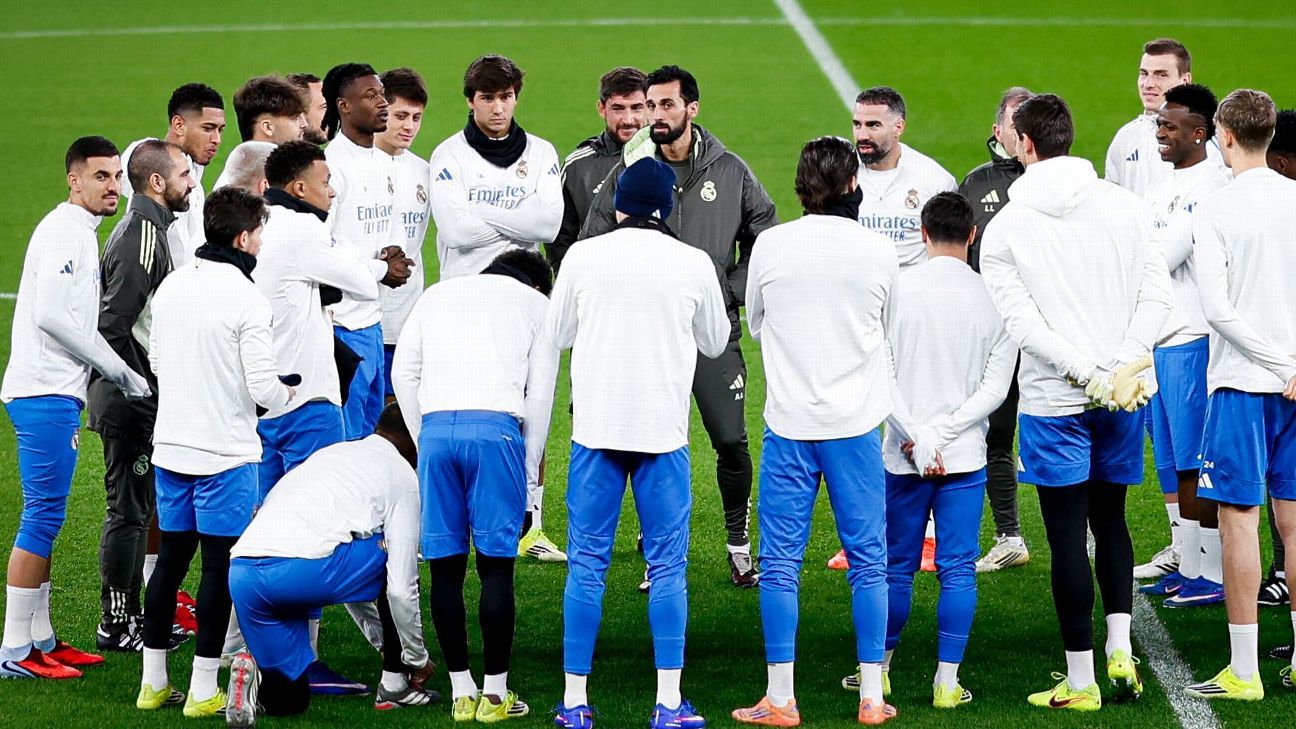
MADRID, Spain — In the wake of Real Madrid's thrilling 3-2 victory over rivals Atlético Madrid in Sunday's LaLiga derby at the Wanda Metropolitano, coach Álvaro Arbeloa faced a final question during his post-match news conference: What would he say to those who had doubted his appointment? 'That they didn't know the players I had,' Arbeloa replied, a statement that encapsulated his tenure since taking over on January 12.
Arbeloa's arrival came amid turmoil, following the sacking of Xabi Alonso after a disappointing stretch that left Real Madrid four points behind leaders Barcelona in LaLiga. Since then, the team has staged a remarkable turnaround, winning 17 of 21 games across all competitions and losing just four. This resurgence has kept them in contention for the title, with the pivotal Clásico against Barcelona scheduled for May 10. In the UEFA Champions League, they advanced to the quarterfinals by eliminating Manchester City 5-1 on aggregate and now prepare to face Bayern Munich.
The derby win highlighted Arbeloa's impact, as Madrid came from behind to secure the points against Diego Simeone's side. It marked the third victory under Arbeloa against teams led by managerial luminaries, including José Mourinho's Benfica and Pep Guardiola's City. Yet, the path hasn't been smooth. Arbeloa's debut as first-team coach ended in a Copa del Rey exit to second-division Albacete, and back-to-back LaLiga defeats to Osasuna and Getafe in February prompted club sources to tell ESPN that, barring a miracle or a Champions League triumph, he would likely be replaced in the summer.
Central to Madrid's revival has been the rehabilitation of star forward Vinícius Júnior, who had become a symbol of discontent under Alonso. Last October, during the Clásico, Vinícius reacted petulantly to being substituted, drawing public scrutiny. ESPN reported that Alonso had considered dropping him during the FIFA Club World Cup last summer and later left him out of lineups despite his fitness, leading to a three-month goal drought and whistles from Bernabéu fans. Contract talks for a new deal, set to expire in 2027, stalled, with Alonso cited as a major obstacle.
Arbeloa made restoring Vinícius a priority. 'I'm going to work to get the best out of Vinícius,' he said in January. 'I'm going to demand that [the other] players look for him [with the ball]. He's fearless. He's one of the most dangerous players, if not the most dangerous, in the world. He embodies what a Real Madrid player is.' The faith paid off: Vinícius scored in five straight games in February, matching his career best, followed by braces against City and Atlético. On Sunday, after his late substitution, Arbeloa greeted him with a bear hug on the touchline. 'I don't know if [Vinícius] is in the best form of his career, but he's not far off,' the coach said afterward.
While on international duty with Brazil this week, Vinícius expressed renewed commitment. 'I now wish to stay at Madrid for a long time,' he said, signaling a shift from earlier uncertainties.
Another beneficiary of Arbeloa's approach is midfielder Federico Valverde, who, along with Vinícius and Jude Bellingham, was reportedly unconvinced by Alonso's methods. Sources close to the dressing room told ESPN of Valverde's frustration, evident in TV footage of him warming up unenthusiastically before a September match against Kairat Almaty. Under Alonso, he was often deployed at right-back—a role he once said he 'wasn't born to play'—due to injuries to Trent Alexander-Arnold and Dani Carvajal. Valverde hadn't scored all season until the January Spanish Supercopa.
Arbeloa repositioned him to the right wing, where he had excelled under previous coach Carlo Ancelotti. The change sparked a scoring spree: six goals in a month, including a hat trick against City and the decisive second goal in the 94th minute against Celta Vigo on March 6. 'Fede is everything a Real Madrid player should be,' Arbeloa said after that winner. 'He has the spirit of [1980s club legend] Juanito. He has that quality which the great players in our history have had, and today he carried the team on his back.'
Arbeloa's background with Madrid's youth system has also shone through. As former coach of the reserve team Castilla and youth squads, he has integrated homegrown talents more than anticipated. In a 4-1 LaLiga win over Elche at the Bernabéu on March 14, 18-year-old midfielder Thiago Pitarch started, and Arbeloa later introduced five more academy products: Gonzalo García, Daniel Yáñez, Diego Aguado, Manuel Ángel, and César Palacios. At the time, Madrid led only 2-0, making the risks notable.
'I can die in peace after a night like this,' Arbeloa said post-match, with evident pride. 'For someone who came up through the youth ranks and made it to the first team, this is a day of immense happiness and pride ... It reminded me of the Madrid of the [famous 1980s homegrown team] Quinta del Buitre era.' Pitarch has since started the last six games, adding dynamism to the midfield, while Yáñez provided an assist against Elche. Club executives, according to sources, are pleased with this focus on the cantera, as it boosts valuations for prospects like Pitarch.
Tactically, Arbeloa has implemented a compact 4-4-2 formation, with an athletic midfield of Pitarch, Aurélien Tchouaméni, Valverde, and Arda Güler. Up front, Vinícius starts on the left but drifts inside for shots. With Kylian Mbappé sidelined by a knee sprain, Brahim Díaz has filled the 'false No. 9' role, starting the last five games, including both legs against City. Díaz, who had struggled since joining Madrid and made just one start in Arbeloa's early months after the Africa Cup of Nations, has grown into the position.
'[Díaz] is understanding well what I want from him,' Arbeloa noted on Sunday. 'When opponents sit deep, he has a lot of freedom to move between the lines. He wanted opportunities, and just not making mistakes wasn't enough. He's a player who should take chances, have one-on-ones, get shots on goal and win penalties like today. That's the Brahim we need.'
The atmosphere at Valdebebas, Madrid's training complex, has improved markedly since Arbeloa's arrival, multiple sources close to the squad told ESPN. This contrasts with the tense end to Alonso's reign, where the former coach emphasized tactical fixes over emotional support. Executives view this as validation of their decision to sack Alonso. However, after the losses to Osasuna and Getafe, sources painted a bleaker picture, with players criticizing Arbeloa's messaging and executives deeming his job in jeopardy.
Looking ahead, the returns of Mbappé—who substituted against City—and Bellingham, who came on against Atlético, pose challenges. As top scorer, Mbappé is set to displace Díaz, while Bellingham may edge out Pitarch or Güler. Yet, sources note that the superstars' individual brilliance might not match the selfless work rates of their replacements, potentially disrupting the unit's cohesion.
After the international break, Madrid face Mallorca in LaLiga before hosting Bayern Munich in the Champions League quarterfinals on April 9. Despite recent successes, club sources remain cautious, unwilling to confirm Arbeloa's future without a trophy. 'I'm not Gandalf,' he quipped last month when asked about reversing fortunes. 'What I'm getting is what I wanted from my players: commitment and effort.' Eliminating Bayern could be his defining achievement, offering hope that Arbeloa's player-centric approach might yet secure his position and salvage Madrid's season.