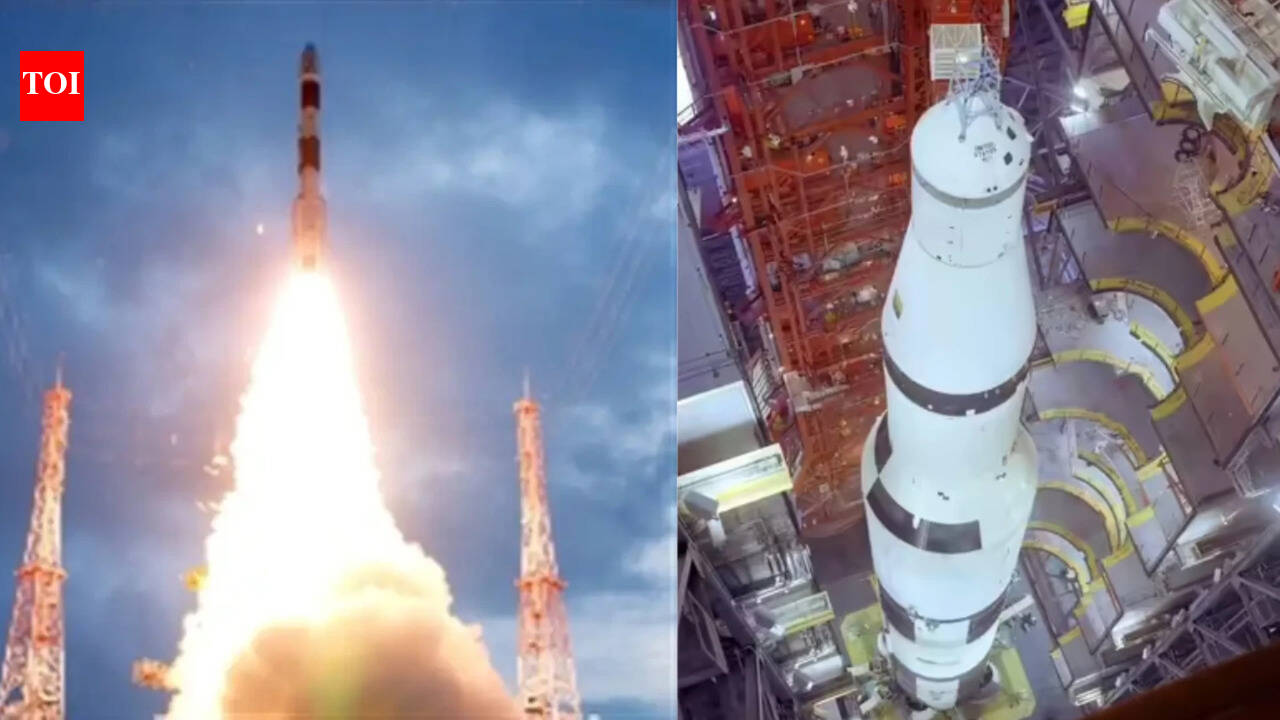
BENGALURU, India — In the vast expanse of space exploration history, India's Chandrayaan-1 mission, launched over 15 years ago, quietly reshaped humanity's ambitions for the Moon. What began as a modest endeavor by the Indian Space Research Organisation (ISRO) in 2008 has been credited with reigniting global interest in lunar exploration, tipping the scales toward a new era of missions like NASA's Artemis program. According to space experts, the spacecraft's unexpected discovery of water molecules on the lunar surface provided a scientific spark that transformed the Moon from a forgotten relic of the Apollo era into a prime target for future human settlement.
The story of Chandrayaan-1 starts on October 22, 2008, when the 1,380-kilogram orbiter blasted off from the Satish Dhawan Space Centre in Sriharikota, Andhra Pradesh. Costing just $83 million — a fraction of the Apollo program's budget — the mission was India's first venture beyond Earth's orbit. Equipped with 11 scientific instruments, including five from international partners like NASA and the European Space Agency, Chandrayaan-1 was designed to map the Moon's surface, study its composition, and search for signs of water. At the time, the Moon seemed like a distant memory for space agencies worldwide. The last human footsteps on its surface had been left by NASA's Apollo 17 crew in December 1972, and subsequent decades saw lunar ambitions wane amid shifting priorities toward Mars and low-Earth orbit satellites.
But Chandrayaan-1 changed that narrative. Just nine months into its mission, on November 21, 2008, the Moon Mineralogy Mapper (M3) instrument, provided by NASA, detected absorption features in sunlight reflected off the lunar surface — clear signatures of water and hydroxyl molecules. This finding, initially tentative, was confirmed through data analysis back on Earth. 'The discovery of water on the Moon was a game-changer,' said JPL scientist Carle Pieters, who led the M3 team, in a 2009 NASA press release. 'It suggested that the lunar poles could hold resources essential for future exploration, like fuel and life support.'
The implications were profound. Prior to Chandrayaan-1, lunar water was mostly theoretical, based on hints from earlier missions like Clementine in 1994. But the Indian probe's data provided the first direct evidence, showing hydrated minerals scattered across the Moon's poles and even in sunlit areas. ISRO Chairman K. Sivan later reflected on the mission's impact, stating in a 2019 interview, 'Chandrayaan-1 not only put India on the global space map but also opened doors to sustainable lunar presence.' The spacecraft operated for 312 days before losing contact in August 2009, far short of its intended two-year lifespan, but its legacy endured through the terabytes of data it beamed back.
This breakthrough came at a time when the international space community was reevaluating its goals. In the late 20th century, as the Cold War space race concluded, the Moon was often dismissed as a 'closed chapter,' according to a recent analysis in the Times of India. Apollo's 382 kilograms of lunar samples had revealed a barren, dry world, leading many to pivot resources elsewhere. Yet, whispers of renewed interest persisted. Japan's SELENE mission in 2007 had hinted at polar ice, but it was Chandrayaan-1's unambiguous detection that galvanized action. 'The water discovery acted as a catalyst,' noted space policy expert Ajay Lele from the Institute for Defence Studies and Analyses in New Delhi. 'It shifted the economic calculus, making the Moon viable for long-term bases rather than fleeting visits.'
Across the Atlantic, NASA's response was swift. The agency incorporated Chandrayaan-1's findings into its Lunar Reconnaissance Orbiter (LRO), launched in 2009, which further mapped potential water deposits. By 2010, the Obama administration's space policy explicitly referenced lunar water as a key enabler for deep-space missions. This momentum built toward the Artemis program, announced in 2017, aiming to land the first woman and next man on the Moon by 2025. Artemis II, slated for no earlier than September 2025, will send four astronauts — commander Reid Wiseman, pilot Victor Glover, mission specialist Christina Koch, and Canadian Jeremy Hansen — on a crewed flyby of the Moon, the first since Apollo 17.
International collaboration amplified the effect. China's Chang'e missions, starting with Chang'e-1 in 2007, echoed Chandrayaan's water hunt, but India's findings provided a benchmark. Europe's SMART-1 in 2003 had laid groundwork, yet it was the 2009 confirmation that prompted a surge in proposals. 'Chandrayaan-1's data was pivotal in the Global Lunar Conference of 2010,' recalled former ISRO scientist Mylswamy Annadurai, who oversaw the mission. 'Nations that had sidelined the Moon suddenly saw it as a stepping stone to Mars and beyond.'
Not all perspectives aligned perfectly. Some scientists argued that Chandrayaan-1's water detection was overstated, pointing to the trace amounts — mere molecules, not vast oceans. A 2010 study in Science magazine, co-authored by Pieters, clarified that the water was likely endogenous, formed through solar wind interactions, rather than from ancient volcanoes as some theorized. 'It's not a lake, but it's enough to sustain life support systems,' Pieters said, tempering expectations while underscoring potential. ISRO officials, meanwhile, emphasized the mission's broader contributions, like high-resolution 3D maps that aided later orbiters such as NASA's LRO and India's own Chandrayaan-2 in 2019.
The mission's journey wasn't without hurdles. During its 21-day cruise to the Moon, Chandrayaan-1 executed a flawless lunar orbit insertion on November 8, 2008, at an altitude of 100 kilometers. Instruments like the Terrain Mapping Camera captured images revealing the Moon's rugged south pole, while the Hyper Spectral Imager pinpointed mineral variations. International partners praised the data-sharing ethos; NASA's M3 alone generated over 70 gigabytes of spectral maps. Yet, technical glitches, including orientation issues with the solar panels, shortened the mission. 'We achieved 95 percent of our objectives despite the challenges,' Annadurai reported at the time.
Fast-forward to today, and the Moon's resurgence is evident. Private players like SpaceX and Blue Origin are vying for lunar contracts under NASA's Commercial Lunar Payload Services. India's Chandrayaan-3, which successfully soft-landed near the south pole in August 2023, directly built on its predecessor's water legacy by analyzing the soil for volatiles. Globally, over 20 nations have lunar ambitions, from Russia's Luna program to the UAE's orbiter. 'Chandrayaan-1 was the unsung hero,' said NASA Administrator Bill Nelson in a 2022 speech. 'Its discovery reminded us that the Moon holds the keys to our solar system future.'
The broader implications extend to resource utilization. Water ice, if confirmed in shadowed craters, could be split into hydrogen and oxygen for rocket propellant, reducing the need to launch fuel from Earth. This in-situ resource utilization (ISRU) concept, validated by Chandrayaan-1, underpins Artemis Base Camp plans for the 2030s. Economists estimate a trillion-dollar lunar economy by 2040, driven by mining and tourism. However, challenges remain: radiation exposure, dust hazards, and geopolitical tensions over lunar territories, as outlined in the 2020 Artemis Accords signed by 40 countries, including India.
Critics, including some environmental advocates, question the rush back to the Moon. 'We must avoid repeating Apollo's environmental oversights,' warned planetary scientist Clive Neal of the University of Notre Dame. He advocates for sustainable practices, citing Chandrayaan-1's non-invasive mapping as a model. Meanwhile, developing nations like India highlight equity; ISRO's low-cost approach — Chandrayaan-1 at under $100 million — contrasts with NASA's $93 billion Artemis budget through 2025.
Looking ahead, the Moon's revival promises collaborative triumphs. Artemis III, targeting 2026, will see astronauts drill for water samples, echoing Chandrayaan-1's spectral clues. India's Gaganyaan human spaceflight by 2025 could pave the way for joint lunar crews. As Chethan Kumar, senior assistant editor at the Times of India, wrote in a recent piece, 'From the dusty plains of Sriharikota to the stark lunar horizon, Chandrayaan-1 bridged eras, pulling the Moon back into humanity's orbit.'
In Bengaluru, home to ISRO's headquarters, scientists continue to mine Chandrayaan-1's archives for insights. The mission's data has fueled over 100 research papers, influencing missions from Europe's Lunar Pathfinder to Japan's SLIM lander, which touched down in January 2024. As the world eyes the next giant leap, one thing is clear: a 2008 Indian probe played an outsized role in scripting it.
The Appleton Times will continue monitoring developments in international space exploration as humanity sets its sights lunarward once more.