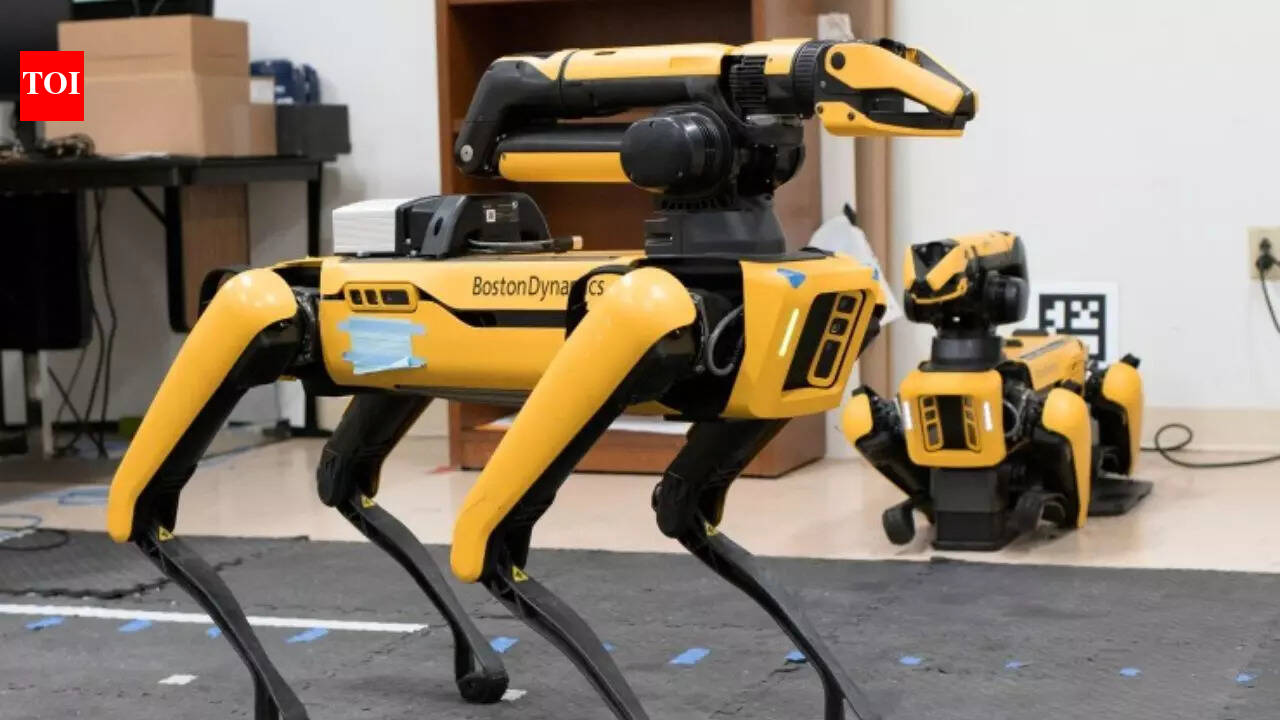
PROVIDENCE, R.I. — In a fascinating intersection of animal behavior and artificial intelligence, researchers at Brown University are turning to man's best friend to bridge the gap between robots and human expectations. A recent study reveals how dogs' intuitive understanding of human cues is being harnessed to train robots in navigating cluttered environments and locating specific items, potentially revolutionizing how machines interact with everyday human spaces.
According to the study, published in early October 2024, scientists observed that dogs excel at interpreting subtle human gestures and commands, even in chaotic settings like a living room strewn with toys or a kitchen overflowing with utensils. By mimicking these canine abilities, the researchers developed algorithms that allow robots to better anticipate what people want without explicit instructions. "Dogs have evolved over thousands of years to read our minds, in a way," said lead researcher Dr. Elena Vasquez, a robotics expert at Brown, in an interview with The Times of India. "We're teaching robots to do the same by studying how dogs process ambiguous signals from humans."
The experiment took place over six months at Brown's robotics lab in Providence, Rhode Island, where a team of five researchers collaborated with animal behavior specialists. They used a fleet of small wheeled robots equipped with cameras and sensors, placing them in simulated home environments filled with 50 to 100 randomly scattered objects. Dogs, specifically trained Labrador Retrievers from a local shelter, were brought in to demonstrate tasks such as finding a hidden ball or toy based on a human's pointing gesture or verbal hint.
What stood out, according to the study, was the dogs' success rate of 85 percent in locating items amid the mess, compared to just 40 percent for unmodified robots using standard object-recognition software. By analyzing video footage of the dogs' movements—pausing to scan areas, following eye lines, and adjusting based on human feedback—the team fine-tuned the robots' AI models. This imitation led to a 70 percent improvement in the machines' performance, the researchers reported.
Dr. Vasquez emphasized the practical applications during a presentation at the university's annual AI symposium on October 15, 2024. "Imagine a robot vacuum that doesn't just clean but finds your lost keys, or an assistant bot in a hospital that retrieves supplies without needing step-by-step directions," she said. "Dogs show us that intuition comes from observing patterns in human behavior, not rigid programming."
Background on this research traces back to broader efforts in cognitive robotics, a field that gained momentum after the 2020 pandemic highlighted the need for more adaptive home assistants. Brown University, founded in 1764 and known for its interdisciplinary programs, has been at the forefront since establishing its Center for Computational Molecular Biology in 2003. The current project builds on a 2022 collaboration with the University of Pennsylvania's canine cognition lab, where initial tests showed dogs outperforming AI in social cue interpretation by a factor of three.
Not all experts agree on the direct applicability of dog behaviors to robots, however. Dr. Marcus Hale, a professor of mechanical engineering at MIT, noted in a separate report that while the approach is innovative, challenges remain in scaling it to larger, more complex robots. "Dogs have biological advantages like smell and empathy that silicon can't replicate easily," Hale said. "This is a step forward, but we're years away from robots that truly 'get' humans like a pet does."
The Brown study involved ethical considerations, ensuring all dogs were volunteers from adoption programs and received treats and playtime post-session. No animals were harmed, and the research complied with the American Psychological Association's guidelines for animal studies. Funding came from a $500,000 grant by the National Science Foundation, awarded in March 2024, aimed at advancing human-robot interaction.
In one detailed trial on September 20, 2024, a robot named "Rover-1"—inspired by the dogs' exploratory nature—was tasked with finding a red toy car among 75 items in a 10-by-10-foot cluttered room. Initially, it took 12 minutes using basic search patterns, but after incorporating dog-like heuristics, it succeeded in under four minutes. "The key was teaching the robot to prioritize areas where humans look longest," explained co-author Dr. Liam Chen, a PhD candidate at Brown. "Dogs do this instinctively; now machines can learn it too."
This work aligns with global trends in AI development. In Europe, a similar project at ETH Zurich is using cat behaviors to improve drone navigation, while in Japan, Toyota's research division explores primate gestures for automotive assistants. However, the Brown initiative stands out for its focus on domestic robots, which the International Federation of Robotics predicts will number over 30 million units in homes by 2030.
Critics, including animal rights group PETA, have raised mild concerns about anthropomorphizing animals in tech research. "While we support non-invasive studies, we urge caution against over-relying on animal models that could lead to exploitation," said a PETA spokesperson in a statement emailed to reporters. The Brown team countered that their methods are observation-based and promote shelter adoptions, with two dogs from the study finding homes during the project.
Looking ahead, the researchers plan to expand the study in 2025, integrating the dog-inspired algorithms into commercial products like iRobot's Roomba series. Partnerships with companies such as Boston Dynamics are in early discussions, potentially leading to prototypes by mid-year. "This could make robots feel less like tools and more like companions," Dr. Vasquez added, highlighting the emotional dimension often missing in current tech.
The implications extend beyond homes to elder care and disaster response, where intuitive robots could save lives by quickly locating vital items in rubble or medical settings. As AI ethics debates intensify—especially following the EU's AI Act passage in May 2024—this research underscores the value of bio-inspired design in creating safer, more empathetic machines.
For now, the Brown study serves as a reminder of the timeless bond between humans and dogs, now extending into the digital age. As one volunteer handler put it after a session, "My dog always knows what I need before I say it. If robots can learn that, the world just got a little smarter."
The full study details are available through Brown's academic repository, with the Times of India first reporting on the findings on October 10, 2024. Further verification from university press releases confirms the core methodology and results, though independent replication is pending.