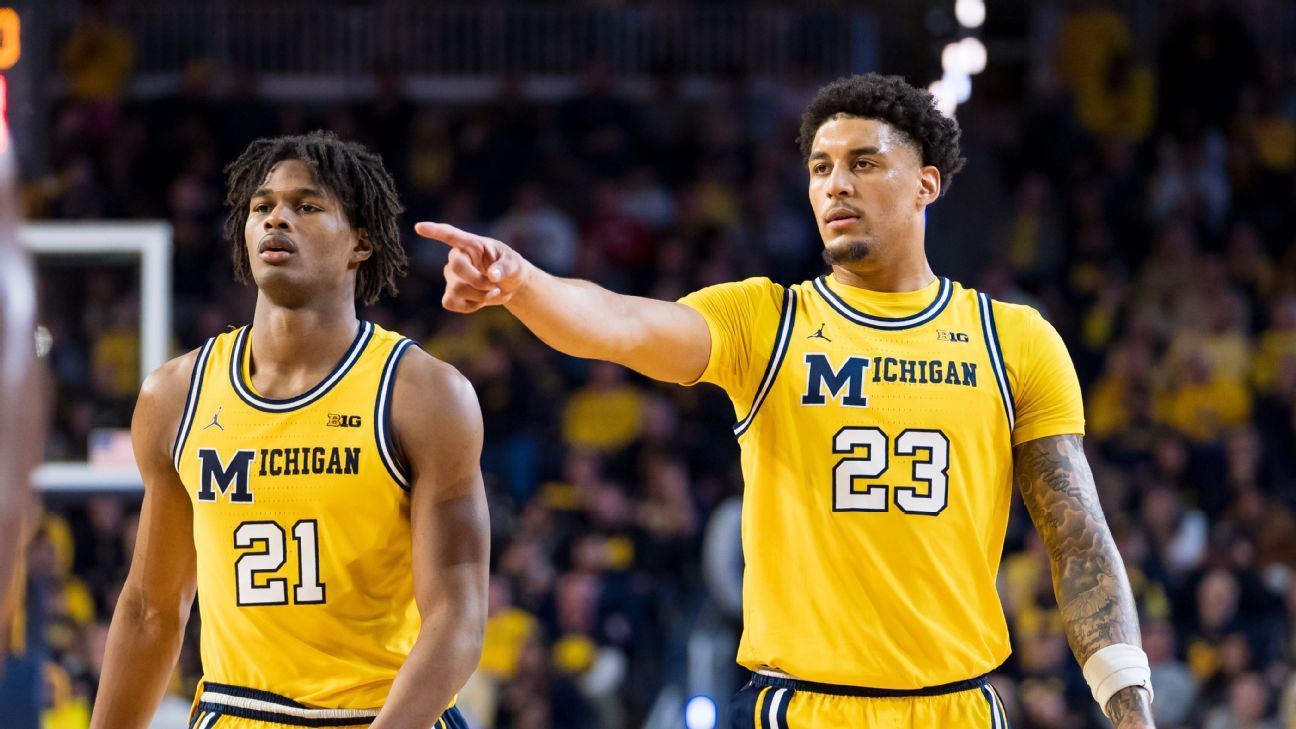
In a stunning display of dominance at the MGM Grand Garden Arena in Las Vegas last November, the Michigan Wolverines basketball team dismantled Gonzaga by 40 points, capping off a tournament run that saw them crush three opponents by a combined 110 points. This victory at the Players Era Festival propelled Michigan to the top of the college basketball world, earning them the No. 1 ranking in the AP poll for the first time since the 2012-13 season. At the center of this ascent is head coach Dusty May's unconventional strategy: starting three towering transfers, each 6-foot-9 or taller, who previously anchored their old teams as centers—Yaxel Lendeborg from UAB, Morez Johnson Jr. from Illinois, and Aday Mara from UCLA.
Gonzaga coach Mark Few, standing at the podium after the lopsided loss, appeared visibly puzzled as he addressed the media. His Bulldogs, led by 6-foot-9 Graham Ike and 6-foot-10 Braden Huff, had entered the tournament on a high note, defeating Alabama by 10 points and routing Maryland by 39. Yet Michigan flipped the script, stifling Gonzaga's interior scoring, which ranks first nationally in points in the paint. "Look, we're a team that really scores well inside ... And we literally couldn't generate any scoring there at all all night," Few said. "That's something that just doesn't ordinarily happen to us." This marked Gonzaga's most decisive defeat since Few took over in 1999.
Since that tournament triumph, Michigan has compiled a 25-1 record, with their sole loss coming by just three points. Only four of their wins have been close calls decided by a single possession, while an impressive 10 victories have exceeded 30 points—a Division I best. These results position the Wolverines for their fourth NCAA tournament No. 1 seed in program history. Players have embraced a bold team mantra: "best team ever assembled." "We say it before every game when we step onto the court," Johnson told ESPN. "Everybody truly believes that. We believe we can win a national championship."
May's affinity for oversized lineups isn't new. Last season at Florida Atlantic, he paired 7-footers Danny Wolf and Vladislav Goldin, leading the Owls to a Big Ten tournament title and a Sweet 16 berth. When May arrived at Michigan, he envisioned replicating that success. Newly hired assistant and defensive coordinator Mike Boynton initially questioned the plan. Recalling his first conversation with May, Boynton said, "My immediate question to him was, 'Is Vlad not coming with you?'" Goldin was set to follow, but May sought another giant to complement him.
Boynton scrutinized film of Yale transfer Wolf, wondering if the duo could handle switching in ball screens against elite guards like Purdue's Braden Smith or Rutgers' Dylan Harper. Even Wolf was skeptical at first, but May showed him footage from Florida Atlantic's 2023 Final Four run, where backup big Giancarlo Rosado operated alongside Goldin in high-low and pick-and-roll sets. Convinced, Wolf thrived as the offensive hub, handling the ball in pick-and-rolls and emerging as a first-round NBA draft pick. May traces his size obsession back further, to his assistant days under Mike White at Florida in 2016-17. There, the Gators started two 6-foot-8 forwards with 6-foot-11 center John Egbunu, winning 27 games and reaching the Elite Eight as a No. 4 seed. "We didn't overwhelm people defensively [at Florida], but we were big and in decent position. We were top five in the country in defensive efficiency," May said. "From that point on, I was like, wow, size is how you're good defensively."
With Wolf and Goldin departed—Wolf to the pros and Goldin out of eligibility—Michigan rebuilt its frontcourt swiftly last April. Within two weeks, Lendeborg, Johnson, and Mara committed. May knew Lendeborg well from two 2023-24 matchups against UAB, where the big man notched 17 points and 21 rebounds in an overtime win over Florida Atlantic. "He had a nose for the ball. He was competitive. He took it personal," May said. Johnson's physicality impressed May despite a broken wrist sidelining him during Illinois' game against Michigan last season. Mara's shot-blocking and potential shone in limited minutes against the Wolverines while at UCLA.
"We wanted to double down," Boynton said. "But all three [had] to be mobile, and they [had] to be able to pass." Lendeborg's recruitment was the linchpin; he entered the NBA draft with first-round buzz after the combine but withdrew after nearly two months, committing to Michigan. Offseason logistics complicated early integration: Lendeborg's draft process, Johnson's FIBA U-19 World Cup duties in Switzerland, and preseason injuries to Johnson and Mara delayed full practices until a week before the season opener.
Initial games exposed rust. Michigan nearly dropped contests to Wake Forest and TCU, and Lendeborg managed just 10.5 points and 4.5 rebounds in his first two outings—well below his UAB averages of 17.7 points and 11.4 rebounds. "It was fairly difficult. I had to figure out a way to be more effective on the perimeter," Lendeborg told ESPN. "It helped that Morez and Aday are beasts down low ... but it did take me about six games to finally figure out where I needed to be in the offense to not clog things up." Three of Michigan's five worst offensive performances occurred in the first four games.
The breakthrough came at the Players Era Festival, where Michigan became the first AP poll-era team to notch consecutive 30-point wins over ranked foes, including a 102-72 rout of Auburn. "We're the best frontcourt in the nation and we're going to show everybody," Lendeborg declared to TNT post-Auburn. The Wolverines' style defies their size: they rank top five in offensive efficiency, 13th in tempo, third in assist rate, and above 36% from three-point range. "Pace and tempo, we work on a lot. Every single day, it's part of what we do. We're convicted in it," May said. "If you're committed to running, you're going to be in a position to make teams counter what you do."
This mobility enables transition dominance, ranking Michigan inside the top 60 in fast-break points. Purdue coach Matt Painter, after a Tuesday loss to the Wolverines, highlighted the peril of trailing in transition: "If you get behind, like on a long shot or you get behind on a turnover, oh good luck to you. I'd rather teach third grade. Because you're fouling them. If you're behind a play and they have numbers, you're in trouble." Lendeborg stretches the floor with perimeter shooting, Mara excels as a post scorer and passer at 7-foot-3, and Johnson's NBA-caliber play adds versatility. A Big Ten coach noted, "Yaxel being able to stretch the floor is a tremendous help. [Aday] is a guy you can throw the ball in the post and he can score with his back to the basket, but he's a phenomenal passer, so he creates a dilemma for you, too. Do we guard him one-on-one or do we try to double? And he's 7-3 so it doesn't matter, he can pass over you. Morez is an NBA player, he's as good a big guy as there is in the country."
Defensively, Michigan leads the nation in adjusted efficiency, ranking No. 2 in field goal percentage defense, No. 2 in two-point defense, and No. 4 in block rate. May sticks with a switching man-to-man scheme, unaltered from his two-big days. "They have three defensive 5s," Painter observed. "The difference isn't in their scheme. Their difference is how hard they play, how long they are and how athletic. But that versatility—because Mara can guard a 5, right? And he can cause problems. But you can pick on him, just like people could pick on Zach [Edey]. ... but [Lendeborg and Johnson], they're difference-makers defensively." Opposing coaches and Michigan's staff pinpoint Johnson as the defensive anchor. "The toughness of our team is Morez," Boynton said. "He's the biggest difference between this year and last year."
Beyond the frontcourt, Michigan's depth fuels their success. North Carolina transfer Elliot Cadeau has evolved into a reliable point guard, shooting and decision-making markedly improved. Trey McKenney has blossomed as an offensive spark over the past month. Nimari Burnett and Roddy Gayle Jr. offer Sweet 16 experience on the wings, while bench contributors like L.J. Cason and Will Tschetter provide impact. The "best team ever assembled" chant originated before the Gonzaga game, per Lendeborg: "[Cadeau] started it off for us before the Gonzaga game. Right before we went out, he said 'we're the best team ever assembled' ... and then we won by 40."
Looking ahead, Michigan faces stern tests: No. 3 Duke and star Cameron Boozer in Washington D.C. on Saturday at 6 p.m. ET on ESPN, followed by No. 10 Illinois next Friday—the nation's top offense. Boynton emphasized how Michigan's personnel forces adjustments: "If they double Morez or Aday in the post, then we love to play advantage basketball. If you're not, then you better be really good at three or four different positions, and most teams don't have enough players to just line up and say we're going to guard them straight up." As the Wolverines chase a title, their frontcourt remains the X-factor.
"We all came together to get a national championship, it's been the main goal since day one. Coach said we have the team for it," Lendeborg said. "I think we have a real, real, real shot at accomplishing those goals." With 25 wins already and a path to the fourth No. 1 seed, Michigan's supersized approach has transformed them into legitimate contenders, blending brute force with fluid execution in a way few teams can match.