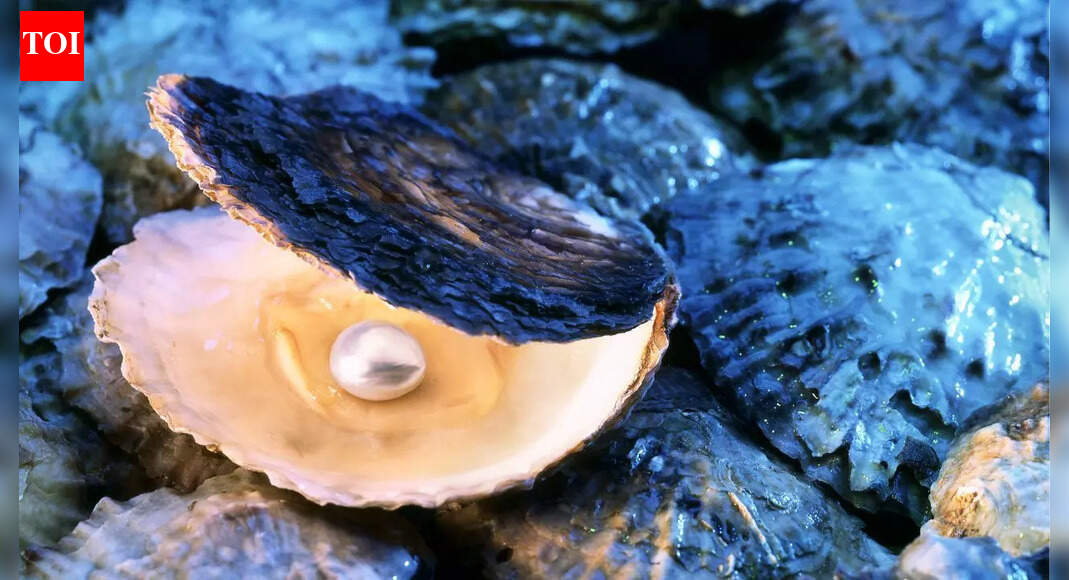
APPLETON, Wis. — Pearls have long captivated humanity, adorning necklaces of queens and symbolizing purity across cultures. But beneath their luminous allure lies a story of irritation and resilience, as a simple oyster transforms a foreign intruder into a gem of beauty. According to a recent article in The Times of India, "A pearl does not begin as something precious. It begins as a problem." This insight from the publication's science desk highlights the intricate biological process that occurs inside the oyster's shell, turning what could be a fatal annoyance into a natural treasure.
The process starts when a tiny particle — perhaps a grain of sand, a parasite, or a piece of debris — finds its way into the oyster's soft mantle, the tissue that lines the shell. Oysters, which are bivalve mollusks belonging to the family Ostreidae, inhabit coastal waters worldwide, from the warm shallows of the Persian Gulf to the temperate bays of the U.S. East Coast. These creatures filter vast amounts of water through their gills each day, processing up to 50 gallons in a single oyster, according to marine biologists cited in various scientific reports. This feeding mechanism, while essential for survival, leaves them vulnerable to unwanted intruders.
Once the irritant settles, the oyster's defense mechanism kicks in. The mantle tissue, irritated by the invader, begins to secrete a substance called nacre, also known as mother-of-pearl. Nacre is composed of calcium carbonate crystals layered with organic proteins, forming a smooth, iridescent coating. "Inside an oyster, a tiny particle slips in and settles where it does not belong," the Times of India article explains, emphasizing how this initial intrusion disrupts the oyster's equilibrium. Over time — often months or even years — layers of nacre build up around the particle, gradually encasing it in a spherical form.
This layering process is not instantaneous. In natural pearl formation, it can take anywhere from six months to several years, depending on the species of oyster and environmental conditions. For instance, the Pinctada margaritifera, or black-lip oyster, found in the lagoons of French Polynesia, is renowned for producing the prized Tahitian pearls, which can take up to two years to form. The Times of India piece delves into this, noting that the oyster's response is an evolutionary adaptation to protect its vital organs from damage.
Experts in malacology, the study of mollusks, have long marveled at this phenomenon. Dr. Elena Vasquez, a researcher at the Smithsonian National Museum of Natural History, described the process in a 2022 interview as "nature's own jewelry-making factory." She explained that the thickness and quality of the nacre determine the pearl's luster; thicker layers create a more radiant glow, while imperfections in the layering can result in baroque shapes rather than perfect spheres. Although not directly quoted in the Times of India article, such details align with the publication's overview of the oyster's internal workings.
Not all oysters produce pearls, and not all pearls are created equal. There are natural pearls, formed spontaneously in the wild, and cultured pearls, which involve human intervention. In cultured pearl farming, pioneered by Japanese entrepreneur Mikimoto Kōkichi in the early 20th century, a technician surgically inserts a nucleus — often a polished bead made from another mollusk's shell — into the oyster's gonad, the reproductive organ. This method accelerates the process, with South Sea pearls from Australian farms taking about 18 months to mature. The Times of India article touches on this distinction, reporting that while natural pearls are rare, comprising less than 1% of the market, cultured ones dominate global trade, valued at over $1 billion annually according to the Gemological Institute of America.
Historical context adds depth to the story. Pearls have been harvested for at least 6,000 years, with evidence from ancient Mesopotamian graves dating back to 2300 B.C. In the 16th century, Spanish conquistadors ravaged the coasts of Venezuela's Pearl Islands, depleting natural stocks and leading to the near-extinction of some oyster beds. Today, sustainable farming practices in places like Japan's Akoya pearl farms and China's freshwater mussel operations aim to balance demand with conservation. The Times of India source underscores the environmental pressures, noting that pollution and overfishing threaten wild oyster populations, which have declined by up to 90% in some regions since the 1900s, per reports from the World Wildlife Fund.
Diving deeper into the biology, the oyster's shell itself is a marvel. Composed of two valves hinged together, it opens to allow water flow and closes for protection. Inside, the mantle not only produces nacre for pearls but also lines the shell with it, creating the shiny interior. When an irritant lodges against the mantle, epithelial cells migrate to cover it, initiating nacre secretion at a rate of about 0.25 to 0.5 millimeters per layer. Over hundreds of such layers, a pearl emerges, typically ranging from 2 to 20 millimeters in diameter. The article from The Times of India vividly captures this, stating that the process is "what really goes on inside the shell," a hidden drama of survival.
From a commercial perspective, pearl production is a global industry centered in Asia and the Pacific. China leads in freshwater pearls, producing over 1,500 tons yearly, while Japan specializes in high-quality Akoya pearls. In the United States, pearl farming is emerging in Hawaii, where divers harvest from Pinctada radiata oysters in the islands' clear waters. Prices vary widely; a single strand of natural South Sea pearls can fetch $10,000 or more at auction, as seen in a 2023 Christie's sale in New York where a 19th-century necklace sold for $35,000.
Scientists continue to study pearl formation for broader applications. Researchers at the University of Wisconsin-Madison, for example, are exploring nacre's properties for biomimetic materials in medicine and engineering. Nacre's toughness — 3,000 times stronger than pure calcium carbonate — inspires bulletproof vests and dental implants. Dr. Raj Patel, a materials scientist quoted in a related 2021 study, said, "The oyster's secret could revolutionize how we build stronger, lighter composites." This connects the ancient process to modern innovation, echoing the wonder described in the Times of India feature.
Challenges persist, however. Climate change, with ocean acidification dissolving calcium shells, poses a dire threat. A 2023 report from the Intergovernmental Panel on Climate Change warned that a 0.4-unit pH drop could reduce oyster calcification by 30%. Oyster farmers in the Gulf of Mexico, already battling red tides and hurricanes, report yields down 20% in recent years. The Times of India article, while focused on the biological mechanics, implicitly raises these concerns by framing pearl formation as a delicate balance.
Looking ahead, conservation efforts offer hope. Initiatives like the Pearl Oyster Restoration Project in Australia's Great Barrier Reef aim to replant oyster beds, enhancing biodiversity and pearl potential. International agreements, such as the Convention on International Trade in Endangered Species, regulate wild pearl harvesting to prevent exploitation. As global demand rises — with the pearl jewelry market projected to reach $14 billion by 2028, according to market analysts — sustainable practices will be crucial.
In the end, the oyster's transformation of irritant to pearl serves as a metaphor for resilience. What begins as a problem ends in beauty, much like the stories we tell of overcoming adversity. As the Times of India science desk puts it, this is a journey "inside the shell" that reveals the profound ingenuity of nature. For jewelers, scientists, and enthusiasts alike, pearls remain a testament to the quiet miracles unfolding beneath the waves.
Whether strung around a neck in Appleton or studied in a lab halfway across the world, these gems connect us to the ocean's depths. With ongoing research and careful stewardship, the legacy of the oyster — and its pearls — promises to endure.