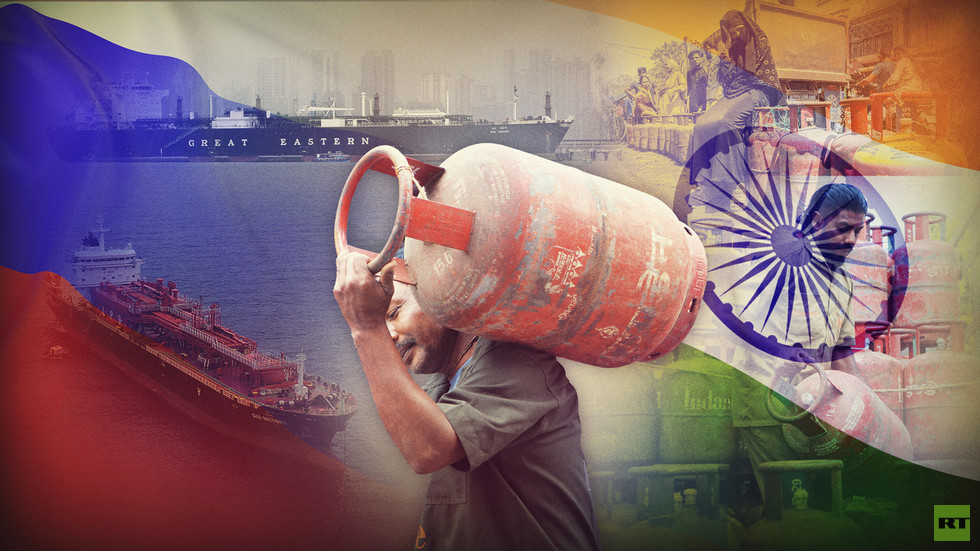
NEW DELHI — As tensions flare in the Middle East, India is racing to secure its liquefied petroleum gas (LPG) supplies, turning to an unlikely partner: Russia. The Strait of Hormuz, a vital chokepoint for global energy shipments, has become a flashpoint, disrupting the flow of imports that meet nearly two-thirds of India's LPG demand. According to Manish Vaid, a junior fellow at the Observer Research Foundation with expertise in strategic energy insights, the recent shortages underscore the fragility of the nation's supply chain for this politically sensitive fuel, essential for millions of households.
Data from the Petroleum Planning and Analysis Cell (PPAC) reveals that LPG consumption in India surged to 31.32 million tonnes in the fiscal year 2024-25, while domestic production lagged at just 12.79 million tonnes. This left approximately 60% of the demand reliant on imports, with the vast majority transiting through the Strait of Hormuz. When disruptions hit the corridor amid the ongoing Middle East conflict, arrivals plummeted. In March 2025, imports dropped to 1.19 million tonnes, marking a 46% decline from previous levels, according to PPAC figures cited by Vaid.
The immediate impact rippled through India's economy. The government prioritized household supplies, curtailing industrial allocations to conserve stocks. With storage capacity limited to about 1.2 million tonnes—equivalent to roughly 15 days of national demand—policymakers had a narrow window to respond. Bottling plants, on average, held only six days' worth of inventory, amplifying the pressure from even brief interruptions. In a swift move, New Delhi ramped up domestic refinery output by approximately 40% in early March, while scrambling to source emergency cargoes from alternative providers like the United States and Norway.
Amid this scramble, Russia has stepped in as a marginal but strategic supplier. Already India's top crude oil provider, Moscow's role in LPG has grown modestly, though constrained by limited export volumes and logistical hurdles. Vaid notes that India's LPG imports have climbed steadily, from 14.81 million tonnes in 2019-20 to 20.67 million tonnes in 2024-25, driven by expanded access to clean cooking fuels and rising consumption. Domestic production, however, has stagnated at 12-13 million tonnes annually, forcing imports to shoulder the increasing burden.
Pre-crisis diversification efforts included a long-term agreement with the U.S. for 2-2.2 million tonnes of LPG annually starting in 2026. Yet, the recent turmoil highlights the limitations of such deals, which remain vulnerable to freight costs and vessel shortages. Reports indicate India has begun securing cargoes from Russia and Japan alongside the U.S. Given monthly consumption of about 2.6 million tonnes—or 80,000-90,000 tonnes daily—even multiple alternative shipments of 40,000-60,000 tonnes each can only bridge a few days' shortfall. As Vaid explains, these initial supplies from Russia and Japan serve as "strategic hedges, not game-changers."
Diversifying suppliers is only part of the equation; rerouting shipments away from Hormuz is equally critical. Enter Russia, with potential pathways like the Northern Sea Route and the proposed Chennai-Vladivostok maritime corridor, which promise alternatives when Middle Eastern routes falter. On the Russian side, the Baltic port of Ust-Luga serves as the primary LPG export hub, managed by the Sibur terminal. Industry reports show exports from Ust-Luga roughly doubled year-on-year from January to May 2025, as European buyers pulled back and sellers shifted focus to Asia. Shipping intelligence tracked at least two India-bound cargoes totaling around 40,000 tonnes once flows resumed.
Indian strategists envision two main corridors for these Russian volumes. The western route would depart from the Baltic or Black Sea, traverse the Mediterranean, Suez Canal, and Red Sea into the Arabian Sea, avoiding Hormuz but introducing risks at the Suez and Bab el-Mandeb straits. Such deliveries to ports like Kochi, Mangaluru, or Jamnagar could take 40 days or longer. Alternatively, an eastern path from Russia's Far East near Vladivostok would cross the Sea of Japan, East and South China Seas, the Strait of Malacca, and the Bay of Bengal to reach eastern Indian ports such as Haldia, Paradip, or Ennore in 12-24 days. This option, while exposing shipments to congestion in Malacca and potential Chinese naval influence, aligns with India's Indo-Pacific strategy, especially if formalized through the Chennai-Vladivostok link.
The Northern Sea Route looms as a more ambitious prospect, touted as a potential energy lifeline. However, Vaid points out its near-term challenges: harsh Arctic ice, a limited fleet of ice-class tankers, elevated insurance costs, and Western sanctions on Russian Arctic projects. Despite record traffic of about 38 million tonnes in 2024, the route handles only a fraction of the hundreds of millions of tonnes passing through the Suez Canal annually. Most analysts, according to Vaid, view it as a niche supplement rather than a viable substitute.
Both India and Russia appear committed to exploring the Vladivostok-Chennai corridor. Indian ministers have described it as operational, noting its early use for crude oil and bulk cargoes between Russia's Far East and India's east coast. Yet, Russia's contribution remains about risk mitigation, not wholesale replacement of Gulf supplies. With India importing 20.67 million tonnes of LPG in 2024-25—equating to 1.7-1.9 million tonnes monthly—Russian capacity could cover only a small slice, similar in scale to the U.S. long-term deal. As Vaid observes, alternative suppliers can "buffer shocks but not substitute the Gulf."
The geographic value of Russian LPG lies in its non-Hormuz pathways, from Ust-Luga via Suez or Vladivostok through Malacca. Even modest volumes help recalibrate India's risk profile, especially as more crude imports now bypass Hormuz, per recent shipping data and official statements on diversification. The key question, Vaid suggests, is whether New Delhi will absorb a "modest route premium" for this security, akin to the extra costs accepted for discounted Russian crude, or stick to ad-hoc crisis responses.
Domestically, the stakes are high. LPG symbolizes the government's clean-cooking initiative, and prolonged shortages could prove electorally toxic—far more so than disruptions in refinery operations. During the crisis, official communications emphasized boosted refinery production and varied sourcing, accompanied by visuals of very large gas carriers (VLGCs) unloading at Indian ports. Authorities repeatedly assured the public that household fuel needs would be met, a message amplified to maintain stability.
For Indian policymakers, the dilemma boils down to investing in domestic infrastructure versus overseas logistics. Expanding storage tanks could provide a buffer, but so could premiums for non-Hormuz cargoes from Russia and elsewhere. Vaid argues that while Russia cannot supplant the Gulf, routes like those from Ust-Luga and Vladivostok offer New Delhi a means to redistribute supply risks beyond West Asia.
From Moscow's perspective, emerging as a reliable swing supplier—even at limited volumes—reinforces its status as a enduring energy ally to India, beyond mere crisis opportunism. As India navigates these turbulent waters, the interplay between bilateral ties and global energy dynamics will shape the subcontinent's resilience in an increasingly volatile world.
Looking ahead, the crisis may accelerate long-term strategies. Discussions around the Chennai-Vladivostok corridor could gain momentum, potentially integrating with broader Indo-Pacific initiatives. Meanwhile, efforts to bolster domestic production and storage remain imperative, ensuring that future disruptions do not escalate into widespread hardship. For now, the modest influx of Russian LPG serves as a timely reminder of the value in diversified partnerships.