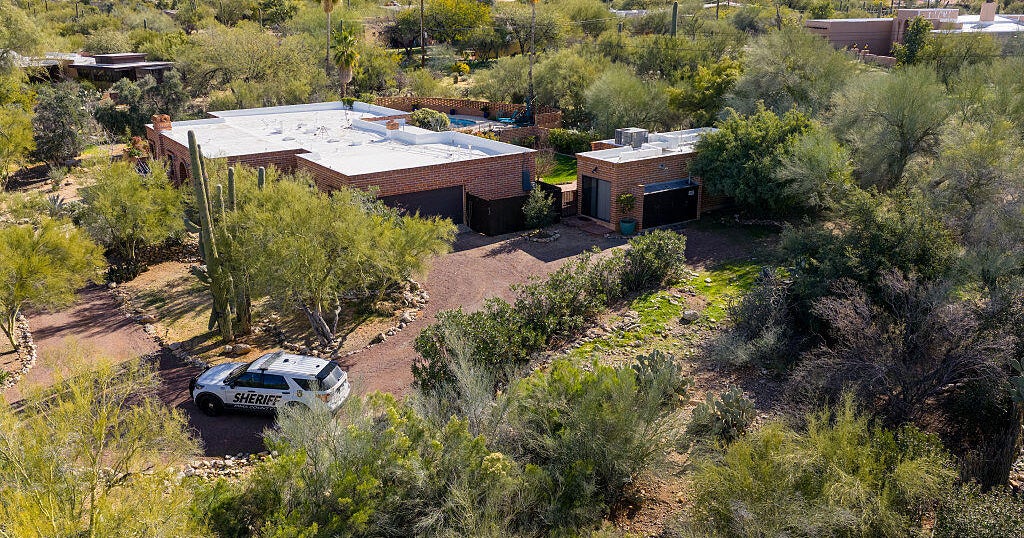
TUCSON, Ariz. — As the search for 84-year-old Nancy Guthrie enters its third week, investigators are turning to cutting-edge technology in a desperate bid to locate the missing mother of "Today" show co-host Savannah Guthrie. The device, known as a signal sniffer, is designed to detect faint Bluetooth signals emitted by Guthrie's pacemaker, offering a potential lifeline in what authorities describe as an apparent abduction from her Tucson home.
Guthrie was last seen at her residence in the early hours of Feb. 1, when she vanished in the middle of the night. According to authorities, she failed to appear for church services that morning, prompting family members to report her missing. A key detail emerged from her cellphone: the pacemaker app indicated the device had been disconnected at precisely 2:28 a.m., suggesting someone may have tampered with her medical equipment during the incident.
The pacemaker in question is equipped with Bluetooth Low Energy technology, a low-power setting that allows the device to operate for years without frequent battery replacements. David Kennedy, a former National Security Agency hacker and the inventor of the signal sniffer being deployed in this case, explained to CBS News how the technology works. "Because Guthrie's pacemaker was disconnected from the app on her phone, it indicates the device is equipped with Bluetooth Low Energy technology," Kennedy said.
Normally, Bluetooth Low Energy signals have a limited range of just 10 to 15 feet, but Kennedy noted that with the right modifications, this can be dramatically extended. He described using signal amplifiers and high-gain antennas to push the detection radius to several hundred feet. In a test conducted at his home, Kennedy attached a non-commercial drone equipped with off-the-shelf items to a signal sniffer and achieved a range of about 800 feet.
"With amplification, with the ability to deploy things like drones or leveraging helicopters, they should be able to cover a lot larger area and then really home in just from a few meters to the actual signal itself," Kennedy told reporters. The pacemaker emits a Bluetooth signal every two to three minutes, providing intermittent pings that the sniffer can capture and trace back to Guthrie's phone for precise location data.
On Monday, law enforcement sources confirmed to CBS News that the signal sniffer was mounted on a helicopter, which flew slowly at low altitude over the search area in Tucson. The aerial operation was aimed at scanning a broad swath of terrain where investigators believe Guthrie might be held or where evidence of her whereabouts could be found. Officials have not disclosed the exact coordinates of the flight path, citing the ongoing nature of the investigation.
Kennedy emphasized that the helicopter served as a "quick stopgap" to establish a general location, but he advocated for more advanced deployment methods. He suggested mounting the device on drones or vehicles, with drones being particularly efficient due to their ability to cover greater distances quickly without interference from urban obstacles like metal buildings or concrete walls. "A drone is more efficient because it can cover greater distances faster, and that using a helicopter or car could interfere with the signal due to metal buildings or concrete walls," he said.
Despite its promise, the technology faces logistical hurdles. Signal sniffers represent a relatively new tool for law enforcement, and agencies lack the infrastructure for widespread use, such as fleets of modified drones. Kennedy estimated that deploying 50 to 60 drones, each covering 300 to 800 feet, could significantly accelerate the search. "You can really cut that time down pretty substantially across the board, you're probably talking, a day or a few days or a maximum of two weeks of being able to cover 120-foot-mile radius, to be able to actually identify it," he explained. "It really comes down to manpower, drone operators [and] the drone technology itself."
The disappearance of Nancy Guthrie has captivated the nation, partly due to her connection to Savannah Guthrie, who has publicly shared her anguish over her mother's vanishing. Savannah, a prominent figure on NBC's morning program, has refrained from detailed comments to avoid jeopardizing the investigation, but sources close to the family say the ordeal has been devastating. Tucson police have described the case as a possible abduction, though no suspects have been named, and details remain scarce.
Investigators have canvassed the neighborhood around Guthrie's home, interviewing neighbors and reviewing surveillance footage from the early morning hours of Feb. 1. The disconnection of the pacemaker app at 2:28 a.m. has been a focal point, raising questions about whether the perpetrator had knowledge of her medical condition. Authorities have not confirmed if foul play is definitively involved, but the circumstances point to an unnatural departure from her routine.
Bluetooth-enabled pacemakers, like the one Guthrie uses, have become increasingly common in recent years, allowing remote monitoring by doctors and patients via smartphone apps. However, this connectivity also introduces vulnerabilities, as demonstrated in this case. Experts in medical device security have noted that while such features improve patient care, they can inadvertently aid criminals if not properly secured. Kennedy's signal sniffer, originally developed for cybersecurity purposes during his time at the NSA, repurposes these signals for rescue operations.
The use of the helicopter on Monday marked a escalation in the search efforts, which began with ground teams and K-9 units scouring deserts and urban areas around Tucson. Arizona's vast landscape, with its mix of rugged terrain and sprawling suburbs, poses unique challenges for missing persons cases. Previous searches in the region have relied on traditional methods, but the integration of signal-sniffing technology signals a shift toward tech-driven investigations.
While Kennedy remains optimistic about the tool's potential, he acknowledged the need for broader adoption. Law enforcement agencies across the country are beginning to explore similar devices, particularly for cases involving elderly individuals with implantable medical tech. In Guthrie's situation, the every-two-to-three-minute signal bursts provide a rhythmic opportunity for detection, but environmental factors like weather or dense foliage could complicate readings.
As the search presses on, family members and supporters have rallied in Tucson, holding vigils and distributing flyers with Guthrie's photo. Savannah Guthrie has used her platform sparingly, urging the public to come forward with any tips. The Pima County Sheriff's Department, leading the effort, has set up a tipline for information, emphasizing that even small details could prove crucial.
Looking ahead, the success of the signal sniffer in this case could set a precedent for future missing persons investigations. If it locates Guthrie, it might encourage investment in drone fleets and training programs for operators. Kennedy suggested that with proper resources, such technology could reduce search times from weeks to days, potentially saving lives in time-sensitive abductions. For now, though, the focus remains on the skies and streets of Tucson, where hope persists amid the uncertainty.
The investigation continues, with no timeline for resolution. Authorities have urged the public to avoid the search areas to prevent interference, while promising updates as they become available. Nancy Guthrie's family waits anxiously, clinging to the possibility that this innovative technology will bring her home safely.