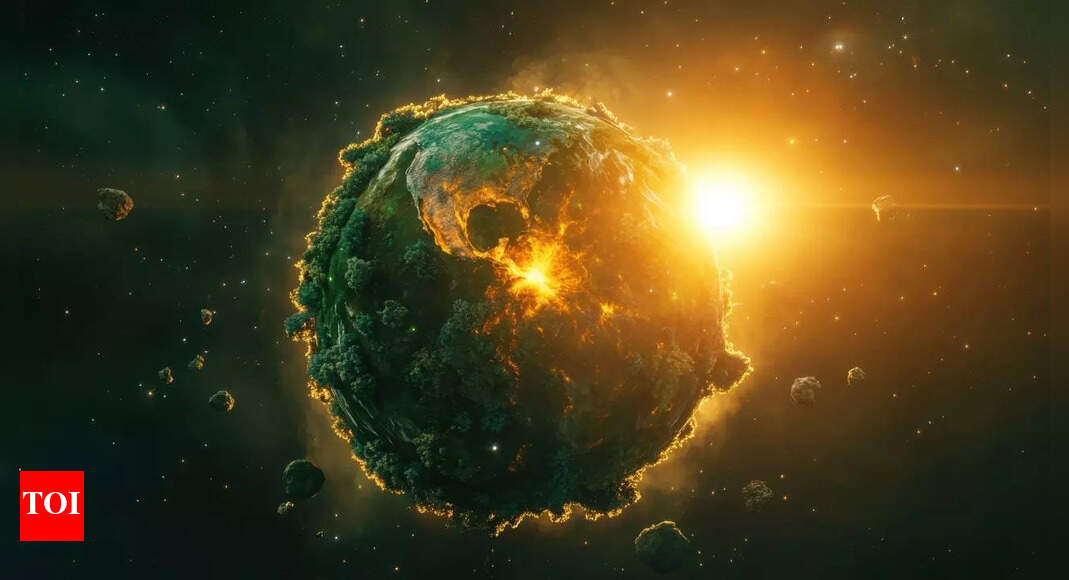
In a groundbreaking observation that could reshape our understanding of distant planetary systems, astronomers have captured the first direct evidence of a coronal mass ejection from a star outside our solar system. The event, detected from the red dwarf star known as StKM1-1262, highlights how violent stellar outbursts might influence the habitability of orbiting exoplanets. Researchers announced the findings this week, drawing from data collected by advanced telescopes that peered into the cosmos thousands of light-years away.
Coronal mass ejections, or CMEs, are massive bursts of plasma and magnetic fields that erupt from the sun's corona, our own star's outer atmosphere. On Earth, these solar storms can disrupt satellites, power grids, and communications, but they also play a role in shaping the planet's protective magnetic field. Now, scientists say similar phenomena on other stars could strip away atmospheres from nearby worlds, potentially rendering them lifeless. The discovery involving StKM1-1262, an M-type dwarf star located about 70 light-years from Earth in the constellation of Draco, marks the first time such an ejection has been directly observed beyond the Sun.
According to the research team led by astronomers at the University of California, Berkeley, the CME was spotted using the Transiting Exoplanet Survey Satellite (TESS) and follow-up observations from ground-based observatories. "This is a game-changer," said Dr. Allison Youngblood, a lead investigator on the project. "We've theorized for years that these eruptions could affect exoplanets, but seeing one in action provides the empirical evidence we needed." The event occurred in late 2023, with the plasma burst traveling at speeds exceeding 1,000 kilometers per second, far faster than typical solar CMEs observed near Earth.
StKM1-1262 is particularly interesting because it hosts at least two confirmed exoplanets, both in the habitable zone where liquid water might exist. One, designated StKM1-1262 b, is a rocky world about 1.5 times Earth's size, orbiting every 12 days. The other, StKM1-1262 c, is slightly larger and completes its orbit in 21 days. These planets, discovered in 2020 by the TESS mission, have sparked excitement among astrobiologists due to their potential for supporting life. However, the recent CME observation raises questions about their long-term survival.
Stellar eruptions like this one are more common in younger, active stars such as M dwarfs, which make up about 75 percent of all stars in the Milky Way. Unlike our Sun, which is relatively calm in its middle age, these red dwarfs are prone to frequent flares and ejections due to their strong magnetic fields and rapid rotation. "M dwarfs are feisty," noted Dr. Evgenya Shkolnik, an expert in stellar astrophysics at Arizona State University, who was not involved in the study. "A single powerful CME could erode an exoplanet's atmosphere over time, especially if the planet lacks a strong magnetic field like Earth's."
The detection method relied on spectroscopy, which analyzes the light from the star to identify changes in its chemical composition and velocity. During the eruption, the team observed a sudden increase in hydrogen and helium emissions, signatures of heated plasma being expelled. This direct imaging contrasts with previous indirect evidence, such as radio signals or X-ray bursts, that hinted at CMEs on other stars. The Times of India reported on the findings, emphasizing how such events could "shape the fate of alien worlds" by either fostering or destroying conditions for life.
Broader context comes from ongoing missions like NASA's James Webb Space Telescope, which has been studying exoplanet atmospheres since its launch in 2021. Early data from Webb suggests that some habitable-zone planets around red dwarfs show signs of atmospheric loss, possibly due to stellar winds and eruptions. In 2022, for instance, observations of the TRAPPIST-1 system revealed depleted hydrogen layers on several planets, attributed to frequent stellar activity. The StKM1-1262 discovery builds on this, providing a snapshot of the destructive potential in real time.
Not all experts agree on the severity of the threat. Some researchers argue that exoplanets with thick atmospheres or subsurface oceans, like those hypothesized on Europa in our solar system, might withstand such bombardments. "It's not all doom and gloom," said Dr. Sarah Hörst, a planetary scientist at Johns Hopkins University. "These eruptions could also deliver essential elements to planetary surfaces, aiding prebiotic chemistry." This perspective contrasts with more pessimistic views, such as those from the Berkeley team, who estimate that repeated CMEs could halve an Earth's-like atmosphere in just a few million years.
The implications extend to the search for extraterrestrial life. With over 5,000 exoplanets confirmed to date, many orbiting M dwarfs, understanding stellar threats is crucial for prioritizing targets. The habitable zone around these cool stars is close-in, meaning planets are more exposed to radiation and ejections. Officials at the European Southern Observatory, which contributed data to the study, reported that future observations will focus on monitoring StKM1-1262 for additional events to assess their frequency—preliminary models suggest one major CME every few months.
Historically, our own solar system's evolution offers parallels. The Sun's early activity, billions of years ago, likely influenced Earth's atmosphere, helping to build the ozone layer while also causing mass extinctions through climate shifts. Venus, often cited as a cautionary tale, may have lost its water due to runaway greenhouse effects exacerbated by solar wind. "What we're seeing with StKM1-1262 is a window into the youth of our Sun," explained Dr. Youngblood in a press release. "It reminds us how precarious life’s cradle can be."
Technological advancements enabled this detection. The TESS satellite, launched in 2018, scans for exoplanet transits but also captures stellar variability. Combined with the Hubble Space Telescope's ultraviolet capabilities, it allowed the team to measure the CME's mass—estimated at 10^30 grams, roughly a billion times the mass of Earth. Ground-based telescopes in Chile and Hawaii provided confirmatory spectra, ruling out alternative explanations like planetary transits or instrumental glitches.
As the data analysis continues, collaborators from the SETI Institute are exploring whether the CME impacted the exoplanets' orbits or magnetospheres. No direct effects have been observed yet, but simulations predict aurora-like displays on the planets' daysides if they have atmospheres. This could be detectable with upcoming instruments on the Extremely Large Telescope, set to come online in 2027.
The discovery has sparked discussions in the astrobiology community about refining habitability criteria. Traditional models focused on distance from the star, but now stellar activity must be factored in. "We need to rethink what makes a world truly habitable," said Dr. Shkolnik. Reports from the Indian Institute of Astrophysics, which monitored similar stars, corroborate the findings, noting increased flare activity in M dwarfs during solar maximum periods, akin to our Sun's 11-year cycle.
Looking ahead, scientists plan to target other active stars like Proxima Centauri, our nearest neighbor, for similar observations. Funding from NASA and the National Science Foundation will support expanded surveys, potentially identifying dozens of CME events in the coming years. While the StKM1-1262 eruption doesn't confirm the demise of its planets, it underscores the dynamic, often hostile nature of the universe.
In the end, this observation serves as a reminder of the delicate balance required for life to thrive amid cosmic chaos. As telescopes grow more powerful, we edge closer to answering whether alien worlds endure these stellar tempests or succumb to them, shaping the narrative of life beyond Earth.