As the dust settles on the highly touted quarterback class of 2026, recruiting analysts are already turning their gaze to the class of 2027, where a group of promising junior signal-callers have begun committing to powerhouse programs across college football. According to ESPN's latest breakdown, nine standout quarterbacks in the SC Next Junior 300 rankings have pledged their futures to schools like Ohio State, Notre Dame, Alabama, and others, each bringing unique skills that align seamlessly with their new teams' offensive philosophies. This early wave of commitments signals a potential reshaping of quarterback rooms at some of the nation's top programs, with experts highlighting how these recruits could thrive in tailored schemes.
Leading the pack is Deuce Bryant, a dynamic dual-threat quarterback from Texas who has committed to Texas Tech. The Red Raiders, currently ranked No. 6 in the College Football Playoff standings, have relied on offensive coordinator Mack Leftwich's Air Raid variation to fuel their success, but they've lacked a true running threat at the position. Bryant, a Texas native with Division I basketball interest, plays with 'sandlot creativity,' relying on improvisational skills and running instincts to extend plays, ESPN reports. 'Expect Texas Tech to pressure opposing defenses by utilizing Bryant's legs in both the run game and outside the pocket,' the analysis states, noting how his unorthodox style could add a new dimension to Lubbock's attack, especially after starter Behren Morton's pocket-passer profile and backup Will Hammond's injury-limited flashes.
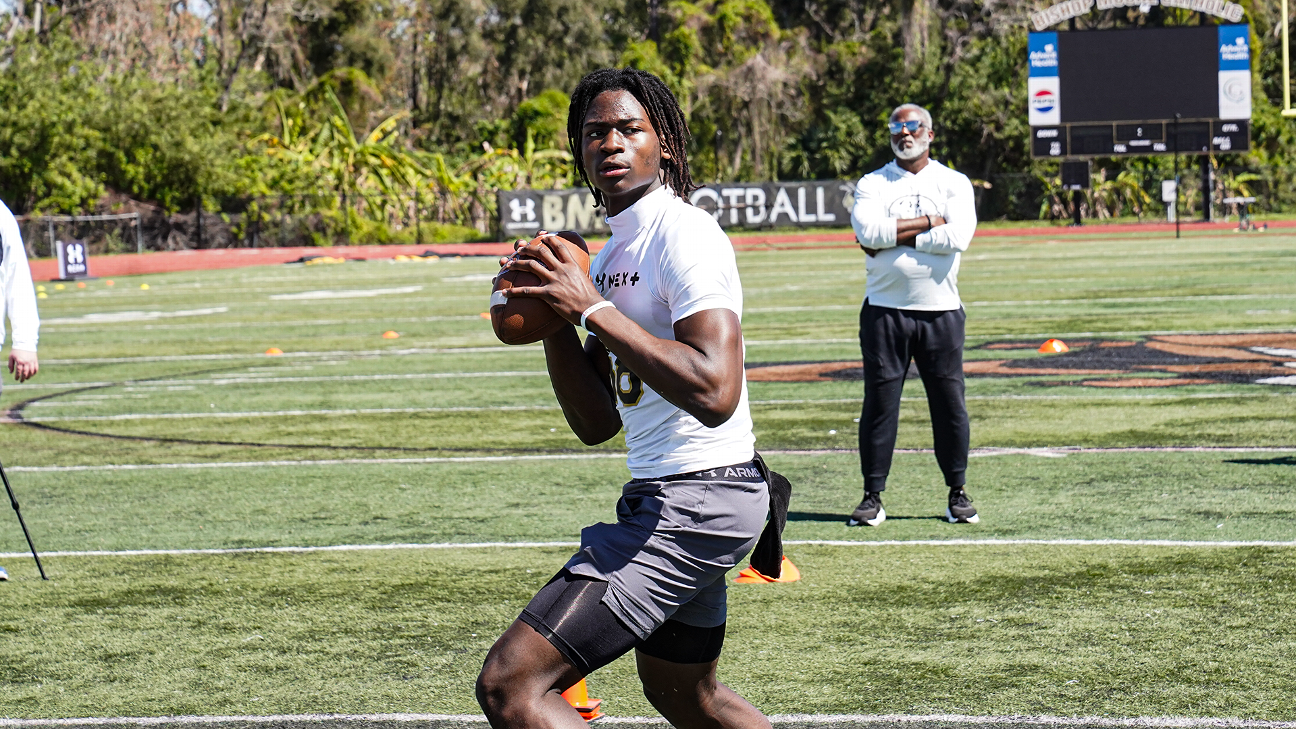
Over in College Station, Texas A&M has secured Jayce Johnson, a 6-foot-4, 210-pound prospect whose size, arm strength, and physicality stand out. Current starter Marcel Reed is more explosive as a runner, but offensive coordinator Collin Klein sees parallels to his own Heisman finalist days at Kansas State. Johnson, described as reminiscent of former Aggie quarterback Jerrod Johnson, could develop into a 'designed power runner between the tackles,' according to ESPN. Impressive footage from the UA Next event in Orlando showcased Johnson's on-time deliveries and strong measurables, with scouts tweeting, 'Impressive work from 2027 standout QB Jayce Johnson at UA Next in ORL 😳 @JayceJohnson09. On time and on target with his deliveries to go with some impressive measurables and testing times. He's one to know in the 2027 class 👀 #UANext.'
Notre Dame's commitment from Jarrard underscores the Irish's eye for developmental upside. At 6-foot-something and still a late bloomer, Jarrard brings natural accuracy that has yet to fully emerge, ESPN notes. With talented quarterbacks already on the roster, he could redshirt and refine his coordination, body control, and arm strength. 'Notre Dame will accentuate Jarrard's ballhandling and play-action fundamentals as this will be a part of a traditionally strong run game under Marcus Freeman,' the report explains. Offensive coordinator Mike Denbrock's track record of coaching efficient quarterbacks positions Jarrard for growth, leveraging his touch on downfield passes.
Ohio State fans might see echoes of former quarterback Will Howard in Kaiden Edmunds, a 6-foot-6, 220-pound pocket passer committed to the Buckeyes. Unlike the mobile Justin Fields or Julian Sayin, Edmunds excels by leveraging his strong arm to 'drive the ball into tight spots' from within the pocket, requiring rhythm and timing to shine. ESPN emphasizes that with elite personnel surrounding the quarterback in Columbus, 'the Buckeyes don't necessarily need a dynamic quarterback to succeed.' Edmunds' size and stature could provide stability in a program always contending for national titles.
In Lincoln, Nebraska has landed a perfect match in Caleb Taylor, whose lightning-quick release fits offensive coordinator Dana Holgorsen's RPO-based Air Raid scheme. The 6-foot-3, 185-pound Illinois native throws well on the move and adjusts arm angles to boost completion rates, thriving on quick-hitters and short passes. 'Taylor and offensive coordinator Dana Holgorsen are a perfect fit,' ESPN declares, adding that he 'should thrive on quick-hitters behind the line of scrimmage and passes under 10 yards down the field.' This commitment comes as Nebraska aims to build on recent stability under Holgorsen.
Illinois, on the cusp of back-to-back winning seasons for the first time since 2010-11, has bolstered its future with Lopati, a prospect with athleticism surpassing current starter Luke Altmyer. Offensive coordinator Barry Lunney Jr.'s run-first, spread offense employs RPOs, which Lopati can operate efficiently, ESPN reports. The scheme will 'move the pocket and create play-action for intermediate and deep shots,' playing to his arm strength. Under head coach Bret Bielema, this addition helps steady the program's resurgence in the Big Ten.
Clemson's recruiting haul includes dual-threat Georgia native Jadyn Hughley, who could evoke memories of former quarterback Tajh Boyd. Hughley's snappy release, strong arm, and 'backyard football mentality' make him a dynamic passer, potentially more efficient than current starter Cade Klubnik. ESPN suggests he would 'thrive in the run concepts offensive coordinator Garrett Riley schemed for Max Duggan at TCU.' If Clemson's other quarterbacks falter, 'he could quickly make an impact,' the analysis posits, adding excitement to a program with a rich quarterback tradition.
Alabama's in-state pickup, Trent Seaborn from Thompson, Alabama, brings excellent precision to Tuscaloosa. Rated as the No. 115 prospect in the ESPN Jr. 300, Seaborn may not match Keelon Russell's full skill set or Ty Simpson's athleticism, but his accuracy spans all three levels of the defense. Offensive coordinator Ryan Grubb, known for 'masterfully homing in on his quarterback's strengths while masking their potential weaknesses,' will emphasize Seaborn's timing and anticipation. Video highlights from a recent touchdown throw drew praise: 'Really impressive deep throw here from Trent Seaborn for the touchdown @TrentSeaborn. The Thompson (AL) QB is one of the best in the 2027 class currently rated as the No. 115 prospect in the ESPN Jr. 300.'
Rounding out the group is Michigan's commitment from Bourque, a 6-foot-5, 200-pound polished passer with sneaky athleticism. Not a burner like Bryce Underwood, Bourque is mobile enough to escape pressure and throw off-platform in RPO situations. Offensive coordinator Chip Lindsey, from the Gus Malzahn tree and former coach of Drake Maye at North Carolina, shares physical traits with the recruit. 'Bourque has a live arm, loose release and the ability to move the pocket to throw off-platform while operating the RPO game,' ESPN details, positioning him as a smooth fit for the Wolverines' evolving offense.
These commitments come amid a broader landscape where the 2027 class is already drawing comparisons to the talent-rich 2026 group, with ESPN noting that 'the dominoes settling on the 2026 quarterback class' has accelerated focus on the juniors. Programs like Texas Tech, riding high at No. 6 in the playoff rankings, and Illinois, eyeing historic consistency, are investing early in quarterback stability—a position that often dictates success in college football. The fits appear tailored, from Bryant's legs enhancing Air Raid elements to Seaborn's precision suiting Grubb's schemes.
Recruiting experts caution that while these pledges are exciting, the class is still fluid, with uncommitted talents like Bryce Underwood potentially shifting dynamics. Notre Dame's developmental approach with Jarrard, for instance, relies on redshirting amid a crowded room, while Clemson's Hughley could accelerate if needs arise. Background context from recent seasons underscores the stakes: Texas A&M's Marcel Reed has provided spark, but Johnson's power could evolve the Aggies' ground game, much like Klein's past innovations at Kansas State.
Broader implications extend to conference battles, with Big Ten powers Ohio State, Illinois, Nebraska, and Michigan loading up on pocket passers and RPO operators, potentially intensifying rivalries. In the SEC, Alabama and Texas A&M's additions signal arms races for elite talent, while ACC contender Clemson eyes Hughley's dynamism to sustain its championship pedigree. As these recruits develop—many still refining coordination and arm strength—their arrivals could redefine offenses by 2028 or sooner.
Looking ahead, the 2027 cycle will intensify with events like UA Next continuing to spotlight prospects, as seen with Johnson's Orlando performance. Officials from these programs have not yet commented extensively on the fits, but the enthusiasm from analysts is palpable. For fans and coaches alike, this class promises to solidify the most important position in the sport, ensuring competitive balance for years to come.