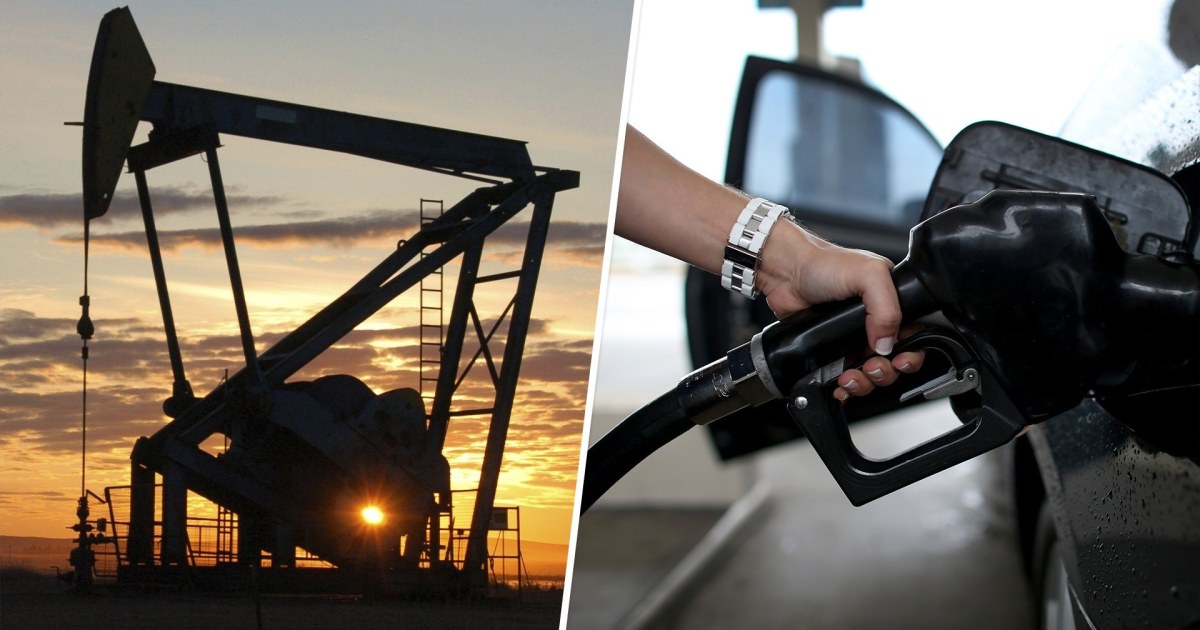
In a bold statement that has sent ripples through international energy markets, President Donald Trump announced on January 5, 2026, that he envisions United States oil companies taking over the operations of Venezuela's vast oil reserves. Speaking from the White House, Trump declared his desire for American firms to manage the South American nation's petroleum industry, a move he framed as essential for stabilizing global energy supplies and boosting U.S. economic interests. The announcement comes amid escalating tensions between the U.S. and Venezuela, where sanctions have long curtailed the flow of Venezuelan crude to international markets.
Trump's comments were highlighted during a segment on NBC's TODAY show, where financial analyst Christine Romans provided an in-depth analysis of the potential ramifications for American consumers. 'President Donald Trump says he wants United States oil companies to run Venezuela’s oil operation,' Romans explained, underscoring the president's vision for a more direct U.S. involvement in Venezuela's energy sector. She joined the program to dissect how such a development could influence oil and gas prices at the pump for everyday Americans, noting the country's significant role as a former major exporter of heavy crude to U.S. refineries.
Venezuela, sitting atop the world's largest proven oil reserves estimated at over 300 billion barrels by the Organization of the Petroleum Exporting Countries (OPEC), has seen its production plummet from around 3 million barrels per day in the early 2000s to less than 800,000 barrels per day in recent years, according to data from the U.S. Energy Information Administration (EIA). The decline stems from political instability, mismanagement under the Maduro regime, and U.S. sanctions imposed since 2017, which aimed to pressure the Venezuelan government over human rights concerns and electoral fraud allegations. Trump's proposal appears to build on these sanctions, potentially escalating U.S. intervention in the region's energy dynamics.
During the TODAY broadcast, Romans pointed out that reintegrating Venezuelan oil into the global market could alleviate some pressure on prices. 'NBC’s Christine Romans joins TODAY to break down the potential impact on oil and gas prices for Americans,' the segment introduction stated, emphasizing the immediacy of the discussion. Experts like Romans have previously noted that Venezuelan heavy oil is particularly suited for U.S. Gulf Coast refineries, which process about 1.5 million barrels of imported Venezuelan crude annually before the sanctions tightened. A U.S.-led takeover, she suggested, might increase supply and thereby moderate prices, potentially lowering gasoline costs by 10 to 20 cents per gallon in the short term, based on historical supply-demand models.
However, the proposal has drawn sharp criticism from international observers and Venezuelan officials. Nicolás Maduro, Venezuela's president, condemned the remarks as 'imperialist aggression' in a televised address from Caracas on the same day, vowing to defend national sovereignty over the Orinoco Belt, the region's primary oil-producing area. 'This is nothing but a ploy to steal our resources,' Maduro said, according to reports from Reuters. Allies in the international community, including Russia and China, which have provided economic lifelines to Venezuela through oil purchases and loans totaling over $60 billion since 2014, echoed concerns about U.S. overreach.
On the U.S. domestic front, reactions were mixed. Republican lawmakers, including Senate Energy Committee Chairwoman Lisa Murkowski of Alaska, expressed cautious support, highlighting the potential for job creation in the American oil sector. 'Bringing Venezuelan production under stable management could secure our energy independence,' Murkowski stated in a press release issued hours after Trump's announcement. Conversely, Democratic leaders like Senator Bernie Sanders of Vermont decried the plan as a 'dangerous escalation toward military involvement,' warning of the risks to regional stability. Sanders referenced past U.S. interventions in Latin America, such as the 1980s Contra affair in Nicaragua, as cautionary tales.
The timing of Trump's statement aligns with broader geopolitical shifts. Just weeks prior, on December 15, 2025, OPEC+ nations, including Saudi Arabia and Russia, agreed to cut production by 2 million barrels per day to support prices hovering around $70 per barrel for West Texas Intermediate crude. Analysts from the EIA predict that without additional supply, U.S. gasoline prices could climb to $4 per gallon by summer 2026, driven by seasonal demand and ongoing conflicts in the Middle East. Trump's vision for Venezuela could counter this trend, but it raises questions about implementation—whether through diplomatic negotiations, further sanctions, or, as some speculate, military action.
Christine Romans, in her TODAY appearance, delved into the economic mechanics. She explained that Venezuela's oil infrastructure, much of it deteriorated due to underinvestment, would require billions in U.S. capital to revive. Companies like Chevron and ExxonMobil, which once operated joint ventures in Venezuela before exiting in 2022, stand to benefit. 'The potential impact on oil and gas prices for Americans could be significant if this materializes,' Romans noted, citing projections from Goldman Sachs that a full restoration of Venezuelan output might add 2-3 million barrels per day to global supplies within five years, exerting downward pressure on prices.
Environmental groups have voiced alarm over the environmental toll. The Sierra Club, in a statement released on January 5, 2026, argued that ramping up Venezuelan production would exacerbate climate change, given the high carbon intensity of its heavy oil. 'This is a step backward from our Paris Agreement commitments,' said executive director Michael Brune. Meanwhile, labor unions in the U.S. oil patch, such as the United Steelworkers, see opportunity, estimating that oversight of Venezuelan operations could create up to 50,000 jobs in refining and logistics, based on a 2025 study by the American Petroleum Institute.
Historically, U.S.-Venezuela relations have been fraught. The sanctions regime, expanded under both Trump and Biden administrations, has cost Venezuela an estimated $130 billion in lost revenue since 2017, per United Nations reports. Trump's return to the presidency in 2025 has reignited a hawkish stance, including threats of military options discussed in a December 2025 National Security Council meeting, according to leaked memos cited by The New York Times. The proposal for U.S. companies to 'run' operations evokes memories of the 1953 CIA-backed coup in Iran, where Western firms seized control of oil assets, fueling long-term resentment.
Market reactions were swift. On January 5, 2026, oil futures dipped 2% to $68.50 per barrel on the New York Mercantile Exchange, reflecting trader bets on increased supply. Shares of major U.S. oil firms rose: ExxonMobil gained 1.5%, while Chevron climbed 2.1%. In Venezuela, the bolívar currency weakened further against the dollar, trading at 45 million to one by midday, exacerbating hyperinflation that has persisted since 2018.
Looking ahead, the State Department indicated that diplomatic channels remain open. Spokesperson Matthew Miller, speaking at a briefing in Washington, D.C., on January 5, said, 'We are pursuing all peaceful avenues to resolve the crisis in Venezuela.' Yet, Trump's rhetoric suggests a more assertive approach, potentially involving the invocation of the Monroe Doctrine principles to justify hemispheric dominance. International bodies like the United Nations Security Council may convene an emergency session, with Brazil and Colombia—key regional players—urging de-escalation.
The broader implications extend to global energy security. With Europe still weaning off Russian gas post-Ukraine invasion and Asia demanding more crude, Venezuela's role could pivot the balance. Economists at the Federal Reserve, in a preliminary assessment, warn that volatility from this U.S. policy shift might add 0.5% to U.S. inflation in 2026 if prices swing unpredictably. For American drivers, the immediate watch is on gas stations from Appleton, Wisconsin, to Los Angeles, where averages stand at $3.45 per gallon as of January 4, per AAA data.
As negotiations unfold, the world watches whether Trump's words translate to action. Christine Romans concluded her TODAY segment by cautioning, 'While the upside for prices is clear, the path to getting there is fraught with risks.' With Venezuela's opposition leader Juan Guaidó, recognized by the U.S. as interim president until 2023, now in exile in Miami, any transition would require broad international buy-in. For now, the announcement marks a pivotal moment in U.S. foreign policy, intertwining energy economics with geopolitical strategy.
In Appleton, local analysts at the University of Wisconsin's energy center echoed Romans' analysis, predicting modest relief for Midwest motorists if Venezuelan oil flows resume. 'It's a high-stakes gamble,' said professor Elena Vargas, 'but one that could reshape our daily lives at the pump.' As the story develops, stakeholders from Washington to Caracas brace for what comes next in this unfolding energy saga.