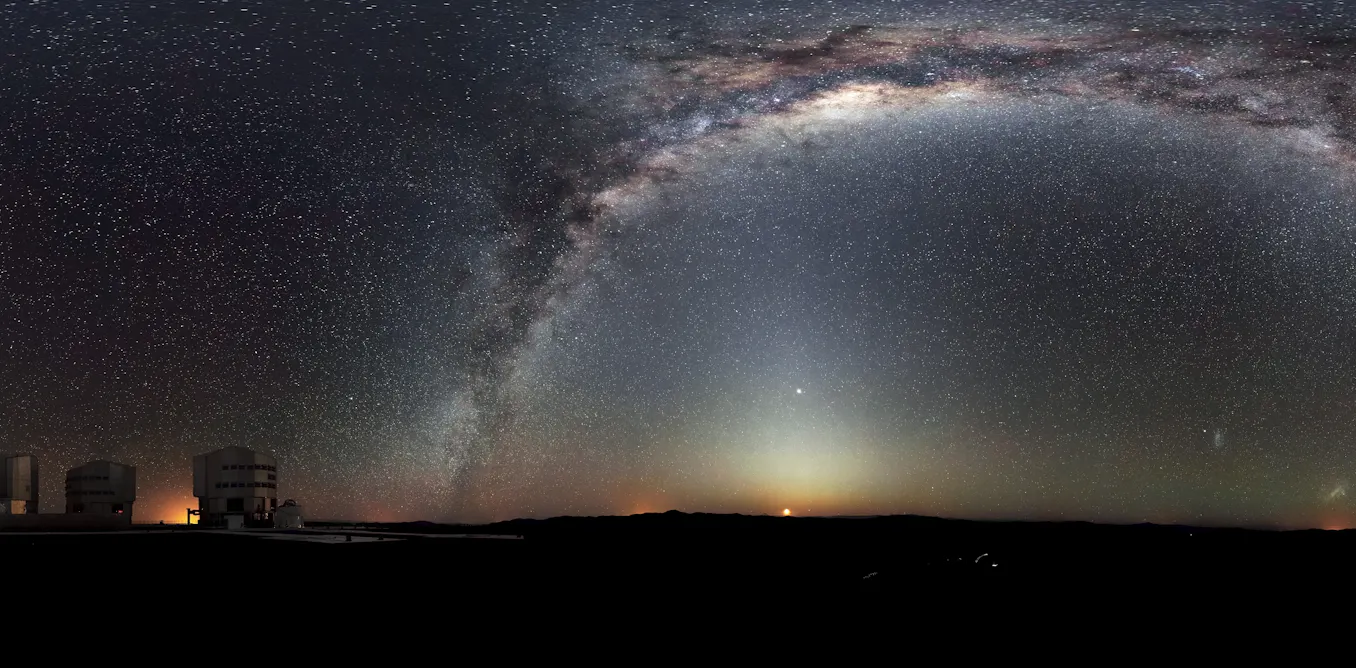
In a move that has drawn sharp criticism from the scientific community, the Australian government has decided not to renew the country's membership in the European Southern Observatory, effectively cutting off access to some of the world's most advanced telescopes just as humanity prepares for a renewed era of lunar exploration. The announcement, made over the weekend, ends Australia's participation in the ESO, which it joined in 2018, and comes at a time when Australian engineers and astronomers are playing pivotal roles in NASA's Artemis II mission, the first crewed flight around the Moon since the Apollo era.
The ESO, based in Garching, Germany, operates a network of world-class observatories, including the eight-meter Very Large Telescope array in Chile's Atacama Desert. According to a 2023 evaluation of Australia's involvement, the membership had significantly enhanced local astronomical skills and knowledge, while fostering industry collaborations worth millions of dollars. 'Australian astronomers will soon lose this access to some of the world’s most advanced technology,' noted experts in a recent analysis published by The Conversation. 'They will also lose access to the complex pathways that scientific collaboration affords Australia.'
This decision unfolds against the backdrop of NASA's Artemis II mission, launched earlier this year, which marks the farthest humans have traveled into space since 1972. Australian contributions to the mission include a team of engineers, technologists, and astronomers who developed a laser-based communication system. The Quantum Optical Ground Station at the Australian National University in Canberra has been instrumental in receiving high-definition video and imagery from the spacecraft, distributing it globally during the mission's lunar flyby.
Katherine Bennell-Pegg, an astronaut and space engineer named the 2026 Australian of the Year, embodies Australia's growing presence in space endeavors. Bennell-Pegg's selection highlights the nation's engineering prowess, even as funding challenges persist. The government's choice to exit the ESO is seen by critics as emblematic of broader inconsistencies in science policy. While Australia negotiates to join the European Union's Horizon Europe program for research funding and collaboration, it is simultaneously withdrawing from key international partnerships.
Australia's involvement in space dates back to the Apollo program, where tracking stations in Western Australia and other regions supported the 1969 Moon landing. 'Australian scientists, engineers and innovators produce excellent research and development,' according to the Conversation analysis. During that historic event, Neil Armstrong's 'small step' was made possible in part by Australian ground support, a legacy that continues with Artemis.
The ESO withdrawal means Australian researchers will no longer have privileged access to ESO data and facilities, which have been crucial for advancing fields like astrophysics and instrumentation. Since 2018, Australia's astronomical instrumentation program has been closely tied to ESO collaborations. Closing this 'research superhighway,' as experts describe it, could hinder future projects and diminish Australia's diplomatic ties in global science, particularly with Europe.
Brian Schmidt, the Australian Nobel laureate in Physics for 2011, co-authored the critical piece on the ESO decision. Schmidt, whose work on the accelerating expansion of the universe earned him the prize, emphasized the long-term costs. Research conducted in Australia contributed to that discovery, underscoring the country's potential when properly invested in. Yet, national research and development spending is declining annually, placing Australia behind international peers.
On the Global Innovation Index, Australia has slipped from 12th place in 2017 to 22nd in recent rankings. Similarly, its economic complexity rating—a measure of economic resilience—has fallen to 105th out of 145 nations, down from 86th in 2019 and 64th in 2003. These trends coincide with cuts to critical national infrastructure and research agencies over the past year, including reductions in funding for space and astronomy initiatives.
Proponents of the government's approach argue that resources should be directed toward immediate priorities, but critics contend this shortsightedness undermines innovation. 'Fundamental scientific research is a non-negotiable foundation for all kinds of innovation,' the experts wrote. In an era of geopolitical tensions and slow productivity growth, they warn that narrowing research to 'siloed projects' risks Australia's economic diversification and quality of life.
The timing of the ESO announcement is particularly stark, arriving as Artemis II astronauts orbit the Moon, testing systems for future landings. Australia's laser communication technology, born from ESO-linked programs, exemplifies how international ties fuel domestic success. Without renewal, future missions may lack similar Australian input, potentially sidelining the nation in the global space race.
First Nations peoples in Australia have observed the stars for millennia, contributing to a rich astronomical heritage that predates European settlement. This cultural depth, combined with modern achievements like the Nobel-winning cosmology research, positions Australia uniquely. However, federal budgets increasingly view science through a narrow lens, missing opportunities for broader impact.
As the world eyes a return to the lunar surface— with Artemis III slated for a crewed landing in 2026—Australia's policy choices could redefine its role. The government has not yet detailed alternative funding for telescopes or observatories, leaving astronomers concerned about a 'lack of vision' in science policy. Negotiations for Horizon Europe continue, offering potential collaboration, but the ESO exit signals a patchwork approach to investment.
Experts call for a 'unifying vision' that leverages space's inspirational power. 'We can be driven by the vision that space gives us: that we are all in it together on a tiny planet nestled amid the stars,' they urged. With productivity stagnating and global shocks exposing vulnerabilities, reinvesting in research could bolster resilience. For now, the decision to forgo ESO membership leaves Australian science at a crossroads, just as the Moon beckons humanity back.
The implications extend beyond astronomy to health, technology, and economy. History shows that such investments yield high returns, from Apollo-era innovations to today's quantum communications. As Australia reflects on its space legacy—from Apollo tracking to Artemis lasers—the path forward demands boldness amid fiscal caution.