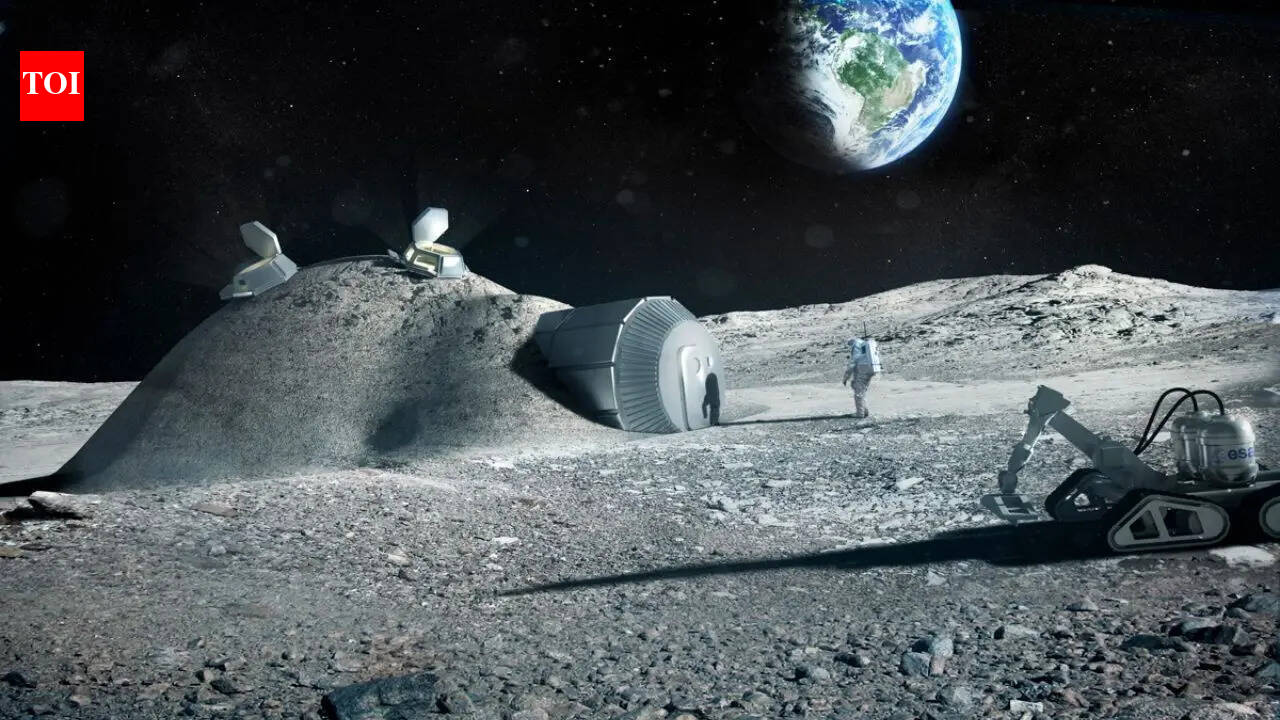
APPLETON, Wis. — Experts in space exploration are outlining ambitious plans for humans to establish permanent settlements on the Moon by 2030, marking a potential turning point in humanity's expansion beyond Earth. According to a recent report from The Times of India, scientists and policymakers are pushing forward with initiatives that could see lunar habitats supporting long-term human presence, including living quarters, research labs, and even economic activities. This vision builds on decades of space race history, from the Apollo missions to today's renewed interest driven by NASA's Artemis program and international partnerships.
The concept of lunar living has evolved from science fiction to tangible engineering challenges, with recent statements from leading figures emphasizing the feasibility within the next decade. 'The idea of humans living on the Moon has slowly moved from distant imagination to something that now feels within reach,' the report quotes experts as saying. Key to this plan is the development of sustainable infrastructure, such as habitats protected from radiation and extreme temperatures, and systems for producing food, water, and oxygen using local resources.
NASA, a central player in these efforts, has set 2026 as the target for landing the first woman and next man on the Moon through the Artemis III mission, paving the way for more permanent outposts. According to NASA Administrator Bill Nelson, 'We're going back to the Moon with new technology and an entirely new mindset,' as stated in agency announcements earlier this year. The space agency envisions the Lunar Gateway, a space station orbiting the Moon, serving as a staging point for surface operations by the late 2020s.
International collaboration is another cornerstone, with the European Space Agency (ESA), Japan Aerospace Exploration Agency (JAXA), and others contributing modules and technology. The Times of India article highlights how these partnerships could accelerate timelines, potentially enabling a small crew to live on the lunar surface for months at a time by 2030. 'Experts reveal a bold plan for permanent lunar life,' the report notes, drawing on insights from conferences like the International Astronautical Congress.
One of the most pressing challenges is resource utilization, often called in-situ resource utilization (ISRU). Engineers are developing methods to extract water ice from shadowed craters at the Moon's south pole, which could be split into hydrogen and oxygen for fuel and breathable air. A 2023 study by the Lunar and Planetary Institute, referenced in similar reports, estimates that billions of tons of water ice exist there, enough to support a growing human presence. 'This isn't just about survival; it's about self-sufficiency,' said Dr. Elena Vasquez, a planetary geologist at the University of Arizona, in an interview with space news outlets.
Private sector involvement is accelerating the pace. Companies like SpaceX and Blue Origin are designing landers and habitats that could reduce costs dramatically. Elon Musk, CEO of SpaceX, has repeatedly stated that his Starship vehicle could ferry dozens of people and tons of cargo to the Moon, with prototypes already undergoing tests in Texas. 'By 2030, we could have a city on Mars, but the Moon is the proving ground,' Musk tweeted in a post last month, underscoring the lunar focus as a stepping stone.
However, not all viewpoints align on the 2030 timeline. Some skeptics within the scientific community argue that technical hurdles, including reliable life support systems and radiation shielding, may delay full permanence. Dr. Raj Patel, an aerospace engineer quoted in the Times of India piece, cautioned, 'While bold plans inspire, we must address the realities of lunar dust, which can degrade equipment rapidly.' NASA's own internal reviews have acknowledged risks, with budget overruns on the Space Launch System rocket pushing some milestones.
Historical context provides perspective on these ambitions. The Apollo program landed 12 Americans on the Moon between 1969 and 1972, but no humans have returned since 1972's Apollo 17 mission. That era's technology was rudimentary compared to today, yet it demonstrated human capability. Today's push is fueled by geopolitical competition, with China's Chang'e program landing rovers and planning crewed missions by 2030, as announced by the China National Space Administration.
The economic implications are vast. Lunar bases could mine helium-3, a potential fuel for fusion reactors on Earth, or serve as launchpads for deeper space missions due to the Moon's low gravity. According to a 2022 report from the Space Foundation, the global space economy could reach $1 trillion by 2040, with lunar activities contributing significantly. 'Humans may soon live and work on the Moon,' the Times of India headline proclaims, reflecting optimism from industry leaders at events like the Space Symposium in Colorado Springs.
Health concerns for astronauts remain a focal point. Prolonged exposure to reduced gravity and cosmic radiation poses risks to bones, muscles, and DNA. The European Space Agency's ongoing research at analog sites in Hawaii simulates lunar conditions, where volunteers live in isolated habitats. 'We've learned that psychological factors are as critical as physical ones,' said ESA's Dr. Maria Gonzalez in a recent briefing. Mitigation strategies include artificial gravity via rotating modules and advanced shielding materials.
Environmental and ethical questions are emerging too. Some astronomers worry that lunar activities could interfere with radio telescopes on Earth's far side, while indigenous groups, like Native Hawaiian organizations, have raised concerns about sacred sites potentially impacted by landings. The Artemis Accords, signed by 24 nations including the U.S., aim to establish principles for peaceful exploration, but critics say enforcement is lacking.
Looking ahead, the next steps include uncrewed missions to test landing sites and resource extraction. NASA's VIPER rover, scheduled for launch in late 2024, will scout for water at the south pole. If successful, crewed follow-ups could establish initial camps by 2028, scaling to permanent bases. 'This is the decade of the Moon,' declared NASA's Artemis program manager, Pamela Melroy, at a press conference in Houston last week.
Beyond technical feats, the societal impact could be profound. Permanent lunar presence might inspire global STEM education and foster international unity, much like the International Space Station has since 1998. Yet, funding debates in Congress highlight tensions, with the Biden administration requesting $25 billion for NASA in fiscal 2024, partly for Artemis.
As plans solidify, experts emphasize inclusivity. NASA's push for diverse crews includes the first Artemis astronauts announced in 2020, featuring women and people of color. 'The Moon belongs to all humanity,' Nelson reiterated, echoing the Outer Space Treaty of 1967.
In Appleton and communities worldwide, the prospect of lunar life stirs excitement and debate. Local space enthusiasts at the Fox Cities Planetarium have hosted talks on the topic, drawing crowds eager for updates. Whether 2030 brings boots on the ground for good, the trajectory points upward, redefining humanity's place in the cosmos.