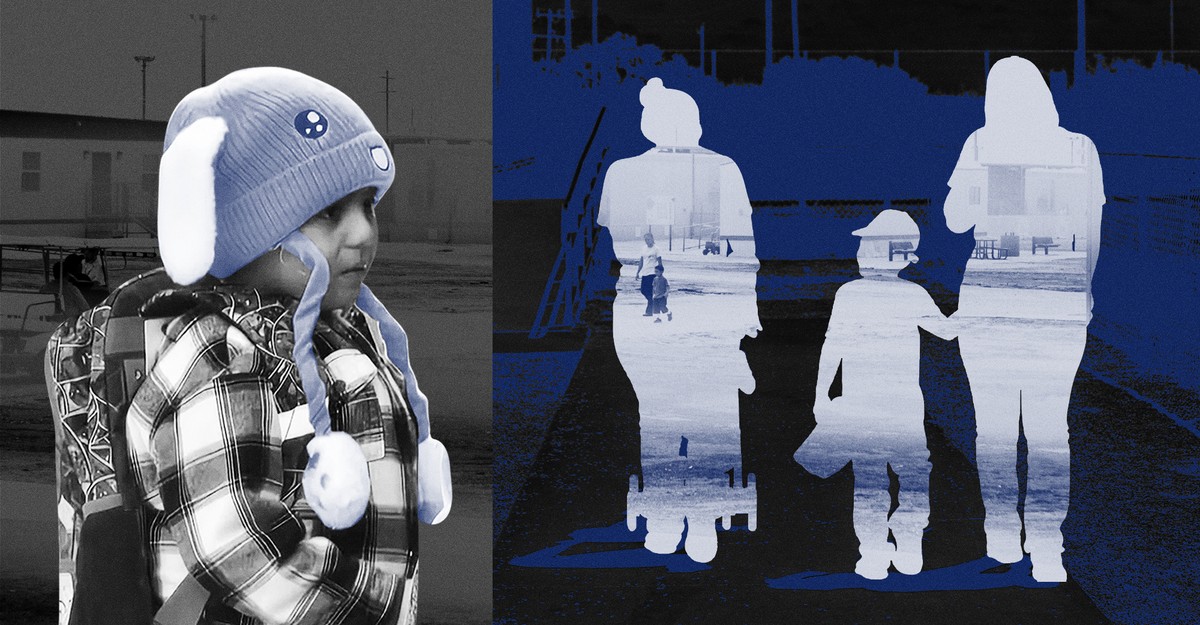
In January, a heartbreaking photo of 5-year-old Liam Ramos captured national attention, symbolizing the harsh realities of the Trump administration's mass-deportation efforts. The image showed the boy, wearing a blue bunny hat and clutching a Spider-Man backpack, with hunched shoulders and wide, scared eyes as Immigration and Customs Enforcement agents detained him and his father outside their home in a Minneapolis suburb. Just a week later, another photo emerged of Liam lying pale and lethargic on his father's lap at the Dilley Immigration Processing Center in South Texas, his eyes barely open. His mother reported to journalists that he had a fever, was vomiting, and refusing to eat, sparking outrage among those following the family's plight.
The Ramos family, who had arrived from Ecuador in 2024 and sought asylum, became ensnared in ICE's expanding sweeps targeting families with established lives in the U.S. Liam's brief detention at Dilley, about 70 miles south of San Antonio, highlighted the facility's role in what critics call a national experiment in family detention. Opened under the Obama administration in 2015 on a remote patch of Texas flatland, Dilley was designed as a more humane alternative to previous sites, featuring an open-air layout of trailers rather than prison-like cells. However, reports from families, lawyers, and inspections paint a picture of deteriorating conditions, especially since its reopening under President Trump in late 2024 after a brief closure by the Biden administration.
Family detention has a contentious history. The George W. Bush administration briefly used it as a temporary measure for asylum seekers crossing the border without plans. But ICE soon repurposed it as a deterrent, operating a facility in a former medium-security prison north of Austin where children and parents wore jumpsuits and were locked in cells up to 12 hours a day. That site closed in 2009 amid lawsuits revealing sick and malnourished children. In contrast, Dilley's 54-acre campus, operated by the private prison company CoreCivic, can hold up to 2,400 people in color- and animal-themed "neighborhoods" of trailers.
During a 2019 tour led by then-ICE acting director Matt Albence, now with GEO Group, reporters saw the intake process: families enter a locked sallyport for disease screening, followed by a 15-minute cool-down in an air-conditioned area resembling a school office. They then undergo a 12-hour intake including physical exams, showers, fingerprinting, and credible-fear interviews for asylum claims. Girls over 10 receive pregnancy tests. Detainees are assigned dorm rooms with double bunk beds for up to six families, and name tags in their preferred language. Amenities include daily recreation from 8 a.m. to 8 p.m., with options like karaoke, Hula-Hoops, and air hockey, as advertised by a reception sign reading "Recreation just for YOU!"
To prevent sexual harassment, only one parent from two-parent families is detained at Dilley at a time, with the other sent to an adult facility, sometimes out of state. Posters throughout the site detail how to report assaults. Each of the 20 housing trailers accommodates 120 people, with communal bathrooms at the ends—a design choice former ICE officials later called an unnecessary expense saver. The tour included an austere courtroom smelling of bleach, a rancid-smelling cafeteria, a salon for free haircuts, and a computer lab under a bilingual poster of E pluribus unum. A small day care offered two-hour slots for up to 15 children, though one visit found a single attendant handling three crying babies.
Despite these features, families have long described Dilley as emotionally crushing. Bright bedroom lights that stay on prevent sleep, and complaints abound about revolting food, foul water, and inadequate medical care. In 2016, a government advisory panel recommended ending family detention in favor of monitoring programs allowing asylum seekers to live and work in the U.S. while cases pend. The Trump administration rejected this twice, deeming detention necessary to deter crossings. Under Biden, the Department of Homeland Security closed Dilley in summer 2024, but Trump reopened it months later as part of a $45 billion expansion including Guantánamo Bay, military base tent cities, and converted warehouses.
CoreCivic's management revenue from ICE more than doubled between the fourth quarters of 2024 and 2025, thanks in part to Dilley's revival. In a 2025 earnings call, the company's then-CEO described it as "truly one of the most exciting periods" in his 32-year career. Today, the trailers show rust from floods and exceed their lifespan, though ICE added barriers this year to house both parents simultaneously. The population fluctuates between 900 and 1,400, including pregnant women and infants as young as two months, according to Faisal Al-Juburi, co-CEO of Raices, a nonprofit providing free legal aid to detainees.
Some at Dilley, like the Ramos family, have pending legal status applications or were arrested at court dates or ICE appointments. Access has tightened; ICE no longer offers journalist tours. After ProPublica published children's drawings and letters, guards reportedly confiscated crayons and paper. ProPublica reviewed 911 logs showing calls for toddlers struggling to breathe, a pregnant woman fainting, an elementary-school girl having seizures, and three alleged sexual assaults among detainees.
Democratic Rep. Joaquin Castro of Texas visited Dilley on February 20, 2026, and described families as "locked up like criminals and being treated like animals." He noted untreated cases of asthma and appendicitis among children, saying in a YouTube video, "There’s a lot of little, little kids who really probably don’t know how to process this experience." Castro has long criticized family detention and Trump's policies.
Lawyers from the National Center for Youth Law conduct periodic inspections under a 1997 federal court settlement setting minimum standards for child detention. Becky Wolozin, an NCYL attorney, said her team has interviewed children with severe conditions like Wolf-Hirschhorn syndrome and autism since the reopening. A measles outbreak occurred earlier this year. Wolozin noted that common illnesses like ear infections worsen due to sleep deprivation and malnutrition: "Kids have fevers for a frightening amount of time, and persistent coughs and headaches. We’re seeing that only after many, many visits to the medical wing, or even to the hospital, do they actually get treated with antibiotics."
In January 2026, an 18-month-old detainee was hospitalized for COVID, RSV, pneumonia, and bronchitis, then returned to Dilley where staff allegedly withheld prescribed medication until lawyers secured her release, per a federal lawsuit. A DHS spokesperson countered that the child received "proper treatment," including medications, and all detainees get "timely and appropriate medical care from the moment they enter ICE custody."
CoreCivic spokesperson Todd Brian stated the company doesn't "cut corners on care, staff or training, which meets, and in many cases exceeds, our government partners’ standards." He added that detainees receive three nutritious meals daily and access to registered nurses, nurse practitioners, and pediatric specialists. Brian called claims of poor maintenance "patently false," noting immediate activation of emergency services when needed.
Personal accounts underscore the toll. In a 2019 visit, a Mexican mother named Patricia said her teenage daughter refused to eat and attempted suicide: "I wouldn’t wish this on anyone." Honduran mother Cindy described her 8-year-old son Jostin as changed: "He acts like a small child. He speaks in a whisper, constantly asking for Mommy." Jostin vomited in the cafeteria and stopped eating. After release, 11-year-old Michael and his mother Kenia reported his violent meltdowns persisting for months; experts say detained children face overwhelming stress from witnessing parental fear.
The 2016 advisory panel unanimously concluded, "Detention is never in the best interest of children." Yet the Trump administration fights a 20-day limit on child detention from the 1997 settlement, arguing current laws suffice for safety. Average stays now reach 63 days, with one family held nearly five months, per Al-Juburi. Raices has freed some via habeas corpus, including Liam Ramos days after his photo went viral, though petitions are laborious and case-by-case.
Recent ICE court filings hail Dilley as a "model of regulatory compliance and humane care." DHS emphasizes access to education, meals, clean water, and supplies, all taxpayer-funded, and frames detention as a "choice" urging self-deportation. An anonymous former Dilley subcontractor, who quit this year citing financial stress but unable to stomach the conditions, described seeing constant crying and vomiting. "A lot of these kids have bags under their eyes, which is something that you don’t see with kids," he said. "They have worse bags than their parents." As legal battles continue, Dilley's story reflects broader debates over immigration enforcement, family separations, and child welfare in America's detention system.