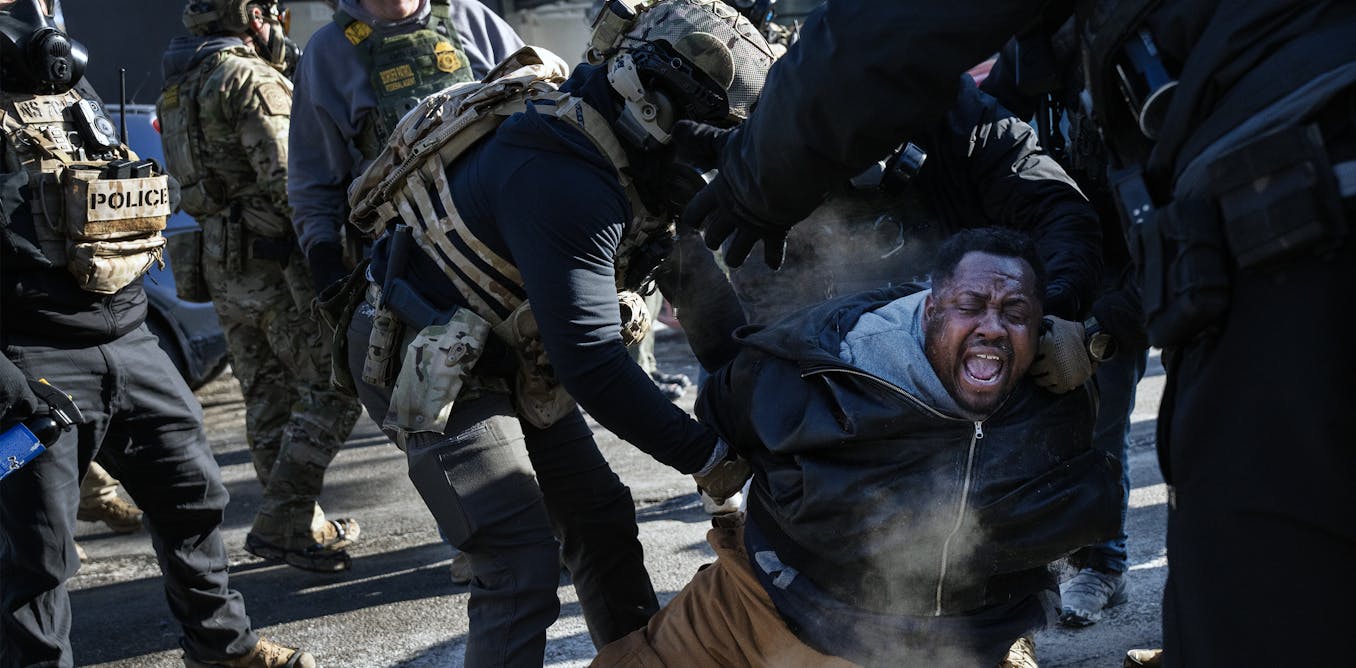
In the heart of Minneapolis, a federal immigration enforcement operation has sparked a fierce debate over the boundaries of constitutional rights, with civil rights advocates accusing U.S. Immigration and Customs Enforcement (ICE) and Border Patrol agents of multiple violations. Launched as Operation Metro Surge, the initiative has drawn lawsuits alleging infringements on the First, Second, Fourth, and 10th Amendments, raising questions about the federal government's role in local law enforcement. Legal scholars and historians warn that these actions represent a significant test for the U.S. Constitution's endurance amid aggressive federal tactics.
Operation Metro Surge, which deployed thousands of federal agents to Minnesota in late 2025, was ostensibly aimed at bolstering immigration enforcement in the wake of heightened protests. However, reports from the ground paint a picture of broader confrontations. According to historians Kevin Boyle and Kate Masur, writing for The Conversation, agents have been accused of "forcibly entering homes without a judicial warrant," arresting journalists covering demonstrations, and even killing U.S. citizens for noncompliance. "This is daily life in Minnesota," Boyle and Masur wrote, framing the operation as "a constitutional stress test."
The First Amendment concerns emerged prominently during protests in Minneapolis, a city still healing from the 2020 killing of George Floyd by a local police officer. Witnesses and legal observers reported that ICE and Border Patrol used excessive force and advanced surveillance against journalists and bystanders. Boyle and Masur noted that such actions "impede the rights to assemble, document and criticize government action," creating a chilling effect on free speech and press freedoms. One incident involved agents detaining legal observers who were monitoring enforcement activities, with agents reportedly asking them, “Have you not learned?” – a phrase that civil rights groups say underscores intimidation tactics.
Second Amendment issues came to a head with the fatal shooting of Alex Pretti, a legally armed Minneapolis resident, during an enforcement action. Pretti, who was carrying a firearm permitted under Minnesota law, was killed after what officials described as noncompliance. Highly placed administration officials initially claimed that Americans could not bring firearms to protests, a stance that contradicted the Trump administration's broader support for gun rights. Boyle and Masur highlighted this as a direct challenge to long-standing interpretations allowing concealed carry at such events in most states, including Minnesota.
Video footage circulating on social media has amplified allegations of Fourth Amendment violations, which protect against unreasonable searches and seizures. Reports detail agents entering private homes without warrants, stopping individuals based on appearance or accent, and seizing property arbitrarily. In one widely shared clip from a Minneapolis neighborhood, agents were seen detaining a family without apparent cause, leading to immediate outcry from the American Civil Liberties Union (ACLU). "Those are clear violations of the Fourth Amendment’s safeguards," Boyle and Masur argued, emphasizing that these protections were designed to curb arbitrary government power.
The 10th Amendment, which reserves powers to the states, forms the basis of several state-led lawsuits against the federal government. Minnesota officials have challenged the refusal to allow the state Bureau of Criminal Apprehension to investigate the deaths of Pretti and another citizen, Renee Good. Another suit contests federal pressure on local governments to assist in immigration enforcement, which state attorneys argue undermines federalism – the division of authority between state and federal levels. "These disputes implicate federalism itself," according to the historians, who described it as the foundation of the American system.
The operation's rollout followed a series of policy shifts under President Donald Trump. In late April 2025, Trump signed an executive order titled “Strengthening and Unleashing America’s Law Enforcement to Pursue Criminals and Protect Innocent Citizens,” which pledged to remove “handcuffs” on police forces. This came after the U.S. Department of Justice, led by Attorney General Pam Bondi, withdrew a proposed consent decree for Minneapolis policing in May 2025. The 2023 DOJ report had identified patterns of unconstitutional practices in the city, including unreasonable use of deadly force, racial profiling, and retaliation against journalists following Floyd's death.
Instead of oversight, the administration expanded federal enforcement. In August 2025, National Guard troops were deployed to Washington, D.C., to address crime, a move a federal judge later deemed legally questionable. Earlier that summer, similar forces were sent to Los Angeles amid immigration protests. By September 2025, Trump referred to American cities as potential “training grounds” for the military to confront the “enemy from within,” signaling an expansive view of executive authority.
Mass resignations from Minnesota's U.S. attorney's office, responsible for defending the federal government in these cases, have added to the turmoil. At least a dozen prosecutors stepped down, citing ethical concerns over representing what they saw as unconstitutional actions. State Attorney General Keith Ellison has vowed to pursue the lawsuits vigorously, stating in a recent press conference, “Minnesota will not stand idly by while federal overreach erodes our rights.”
Civil rights advocates, including those from the NAACP and local immigrant rights groups, have rallied in support of the legal challenges. They point to the rapid accumulation of alleged violations in one locale as unprecedented. “The consequences extend beyond any single demonstration,” Boyle and Masur wrote. “These rights are not peripheral to democracy. They are central to it.” Protests have continued in Minneapolis, with demonstrators calling for an end to Operation Metro Surge and a return to constitutional policing standards.
On the federal side, Department of Homeland Security spokesperson Tricia McLaughlin defended the operation, saying it was necessary to “secure our borders and communities from illegal activity.” Officials have not directly addressed the specific allegations but maintain that all actions comply with the law. In court filings, federal attorneys argue that the deployments are authorized under existing immigration statutes and do not infringe on constitutional protections.
Historical context underscores the stakes. Since 1994, federal oversight has been a key tool in reforming local police departments, from Newark to New Orleans, enforcing civil rights where municipalities fell short. In Minneapolis, the post-Floyd DOJ intervention promised accountability, but its reversal marked a retreat from such monitoring. Experts like Boyle and Masur describe this as a shift away from “constitutional policing,” which demands that government authority be justified, limited, and overseen.
As lawsuits progress through federal courts, outcomes could set precedents for executive power nationwide. A ruling in Minnesota's favor might curb similar operations elsewhere, while a federal victory could embolden further expansions. Legal analysts, including those from the Brennan Center for Justice, predict appeals could reach the Supreme Court, testing the balance between security and rights in an era of heightened tensions.
Beyond the legal battles, the human toll is evident. Families of Alex Pretti and Renee Good have spoken out, with Pretti's widow telling local media, “He was just exercising his rights, and now he's gone because of federal overreach.” Community leaders in Minneapolis, a diverse city with a large immigrant population, worry about eroded trust in law enforcement. The operation has reportedly led to a spike in fear among Latino and Somali communities, with some residents avoiding public gatherings.
What unfolds in Minnesota extends far beyond state lines, serving as a microcosm of national debates on immigration, policing, and federalism. As Boyle and Masur put it, “When, in the name of security, the executive branch directly challenges so many Bill of Rights protections at once, how much strain can the American legal system absorb?” With trials slated for early 2026, the nation watches to see if constitutional safeguards will hold firm or bend under pressure.