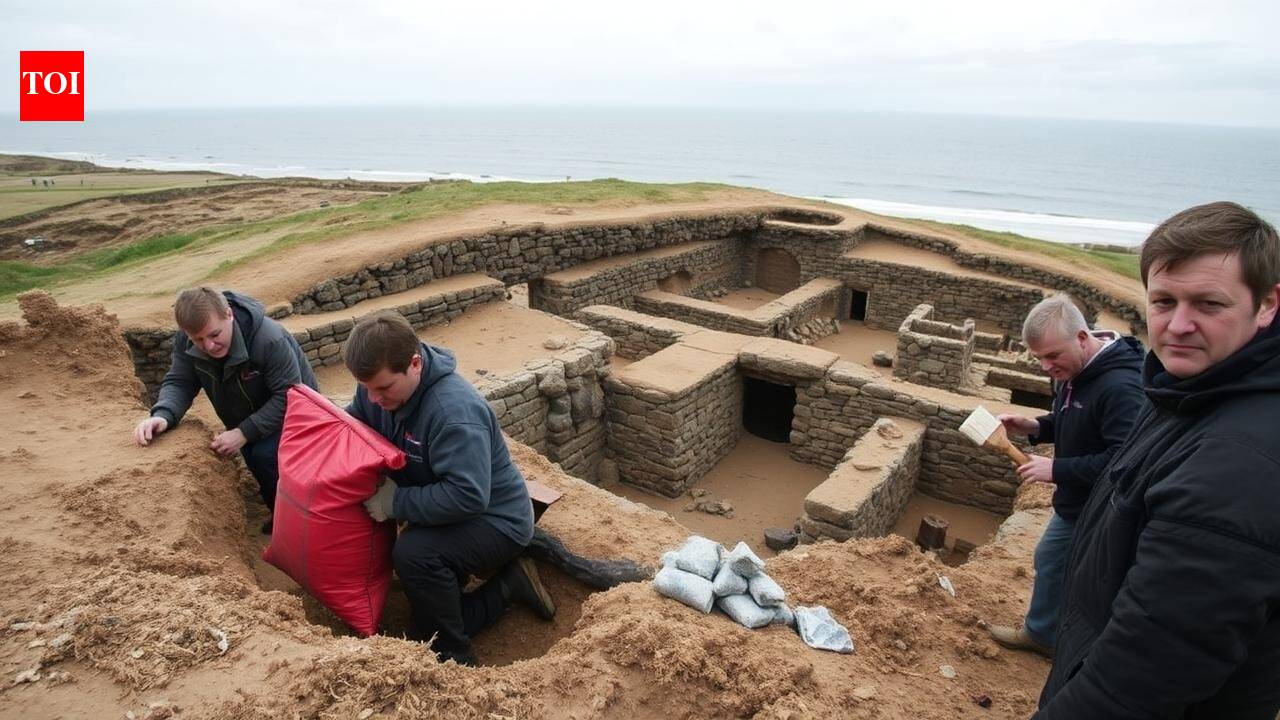
ORNEY ISLANDS, Scotland — In the winter of 1850, a fierce storm battered the rugged coastline of the Orkney Islands, stripping away layers of sand and revealing a long-buried secret from prehistoric times. Local landowner William Petrie, while surveying the damage along the Bay of Skaill, stumbled upon what would become one of the most remarkable archaeological finds in British history: Skara Brae, a remarkably preserved Neolithic village dating back over 5,000 years.
According to historical accounts reported by the Times of India, Petrie's accidental discovery exposed a cluster of stone-built houses that had remained hidden for millennia, protected by a protective layer of sand dunes. The site, located on the remote island of Mainland in the Orkney archipelago, offered an unprecedented glimpse into the daily lives of Neolithic people who inhabited the region from approximately 3100 to 2500 B.C. "It was like uncovering a time capsule," said archaeologist Dr. Jane Clarke, who has studied the site extensively, in a recent interview with Scottish Heritage officials.
The storm that uncovered Skara Brae was part of a series of severe weather events that year, which locals in the Orkney Islands still recall in folklore as one of the most destructive in the 19th century. Petrie, an Orcadian farmer and antiquarian with a keen interest in local history, was inspecting his property when he noticed the exposed stone structures. What began as a routine assessment quickly turned into an archaeological sensation, drawing the attention of scholars from across Europe.
Excavations at Skara Brae began shortly after the initial discovery, led by Petrie himself with assistance from early archaeologists. The village consists of eight clustered houses connected by passageways, all constructed from local flagstone without the use of mortar. Inside, artifacts such as carved stone furniture, bone tools, and pottery were found in situ, providing evidence of a sophisticated society that relied on farming, fishing, and hunting. "The preservation is extraordinary," noted Orkney Museums curator Michael Sharpe in a 2022 documentary. "It's as if the inhabitants just stepped out one day and never returned."
Skara Brae is often compared to more famous sites like Stonehenge or Pompeii due to its level of intactness. Unlike many Neolithic settlements that were built with wood or earth, the Orcadian village's stone construction and the overlying sand blanket allowed it to survive intact. According to the Times of India report, the discovery in 1850 highlighted how natural disasters can sometimes preserve rather than destroy history, turning a moment of devastation into a window on the past.
Further context comes from geological surveys of the Orkney Islands, which indicate that rising sea levels and shifting sands have long shaped the landscape. The Bay of Skaill, where Skara Brae lies, is particularly prone to erosion, a fact that both revealed the site and later threatened it. In the decades following 1850, additional storms occasionally exposed more artifacts, prompting ongoing conservation efforts by Historic Environment Scotland.
Experts disagree on some aspects of the village's abandonment. Some archaeologists, like those cited in a 2015 University of Edinburgh study, suggest a sudden sandstorm around 2500 B.C. forced the residents to flee, burying the settlement naturally. Others, including Dr. Clarke, argue for a more gradual decline linked to environmental changes, such as cooler temperatures during the Neolithic sub-Boreal period. "The evidence points to a community that was thriving until an abrupt event," Clarke said, emphasizing the lack of defensive structures that might indicate conflict.
The site's significance extends beyond its architecture. Artifacts recovered include grooved ware pottery, unique to Orkney, and intricately carved stone balls whose purpose remains a mystery. These items suggest trade networks reaching as far as mainland Scotland and possibly Ireland. "Skara Brae challenges our understanding of prehistoric Europe," reported archaeologist Colin Richards in his book Building the Great Stone Circles of the North. "It shows a level of craftsmanship and social organization we once thought impossible for that era."
In the years since its discovery, Skara Brae has become a UNESCO World Heritage Site, part of the larger Heart of Neolithic Orkney designation that includes the Standing Stones of Stenness and Maeshowe tomb. Visitor numbers have surged, with over 50,000 tourists annually pre-pandemic, according to Orkney Islands Council data. However, climate change poses new risks; rising sea levels could erode the shoreline, much like the 1850 storm that first revealed it.
Local Orcadians view the site with a mix of pride and protectiveness. "It's our history, buried in our backyard," said resident Fiona Linklater, whose family farm borders the Bay of Skaill, in an interview with BBC Scotland. Community-led initiatives, such as the Skara Brae Engagement Group formed in 2010, work with archaeologists to ensure that modern development doesn't encroach on the area.
Recent technological advances have revitalized research at Skara Brae. In 2023, ground-penetrating radar surveys uncovered potential extensions to the village, suggesting it may have been larger than previously thought. "We're only scratching the surface," said project lead Dr. Antonia Thomas from the University of the Highlands and Islands. These findings, reported in the Journal of Archaeological Science, could rewrite narratives about Neolithic population densities in northern Scotland.
The broader implications of Skara Brae's discovery resonate in contemporary discussions about climate and heritage. As storms become more frequent due to global warming, similar accidental finds are occurring worldwide—from submerged villages in the Mediterranean to eroded sites in the Pacific. "The 1850 storm was a wake-up call," noted environmental historian Dr. Sarah Munro in a Times of India feature. "It reminds us that nature both hides and reveals our past."
Conservation efforts are ramping up, with £2.5 million allocated by the Scottish government in 2024 for coastal defenses around Orkney's heritage sites. Officials from Historic Environment Scotland emphasize the need for international collaboration, given the site's global importance. "Skara Brae isn't just Scottish—it's a universal story of human resilience," said agency director Nicki MacRae.
Looking ahead, virtual reality reconstructions are allowing wider access to the site, especially after COVID-19 restrictions limited physical visits. A new exhibit at the onsite museum, opened in 2022, features 3D models of the houses, complete with simulated hearths and beds. "It's bringing the stones to life," enthused visitor guide Ewan Sinclair.
As the Orkney winds continue to whisper over the Bay of Skaill, Skara Brae stands as a testament to the enduring power of accidental discovery. From William Petrie's chance find in 1850 to today's high-tech explorations, the village continues to offer insights into a world long gone, urging us to protect the fragile threads connecting us to our ancestors.