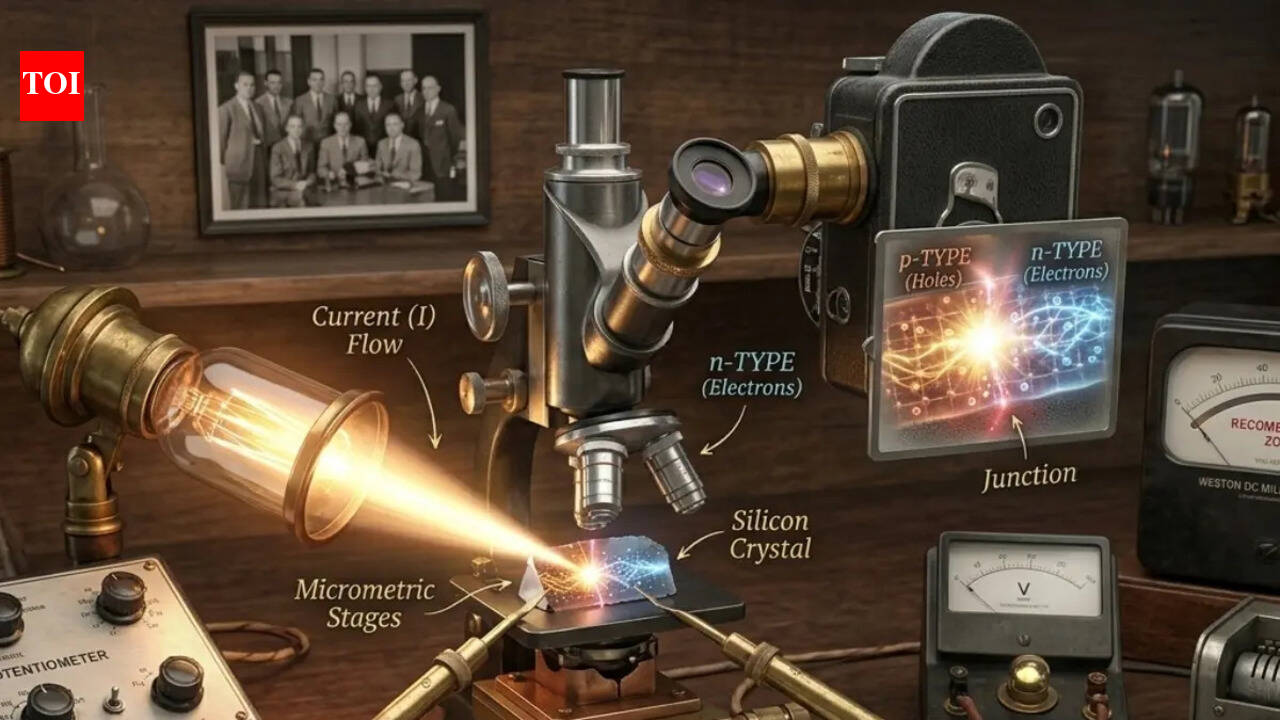
In 1940, a routine test on a fractured piece of silicon led scientist Russell Ohl to notice an unexpected electrical behavior that later proved essential to the development of modern electronics, according to a report from the Times of India Science Desk.
Ohl, working with silicon crystals at the time, observed what became known as the p-n junction effect after examining a cracked slab. The discovery occurred during an era when researchers were exploring materials for potential use in radio and early electronic devices.
According to the account, the silicon sample had split, creating two regions with different properties that allowed current to flow in one direction under light exposure. This photovoltaic response caught Ohl's attention and pointed to possibilities beyond simple conduction.
Details from the report describe the event as serendipitous, with the fracture revealing a hidden boundary inside the crystal. Officials and historians of technology have since credited this observation with laying groundwork for semiconductor components that followed in subsequent decades.
The Times of India summary notes that the finding helped build the foundation for devices ranging from early diodes to the transistors that powered the electronics revolution. No specific time of day or laboratory location beyond general references to silicon testing appears in the available account.
Background on the period shows scientists in the 1930s and 1940s were actively seeking reliable rectifiers for radar and communication systems. Ohl's work fit into that broader effort at institutions focused on materials research.
Reports indicate the p-n junction allowed controlled electron movement across the boundary created by the crack. This property later informed the design of solar cells and integrated circuits still in use today.
While the original Times of India piece frames the moment as a key turning point, it provides limited direct quotes from Ohl or contemporary witnesses. The summary instead emphasizes the long-term impact on electronics manufacturing.
Additional context from related historical records places the discovery amid growing interest in germanium and silicon as alternatives to vacuum tubes. The cracked slab experiment reportedly demonstrated a stable barrier that could be reproduced under controlled conditions.
Industry analysts have pointed out that without such early observations, the miniaturization of circuits in the 1950s and 1960s might have proceeded more slowly. The report stops short of claiming Ohl foresaw all future applications.
Further paragraphs in coverage often connect the 1940 finding to the first practical transistors developed at Bell Labs several years later. Officials involved in semiconductor history have described the p-n junction as a conceptual bridge between basic physics and applied engineering.
Today the effect remains central to photovoltaic panels and microchip fabrication worldwide. The original silicon test, though simple by modern standards, continues to be cited in accounts of how chance observations advanced technology.
According to the source, the story underscores how incremental experiments can yield outsized results when materials behave in unexpected ways. No conflicting details have surfaced in the single primary account examined.