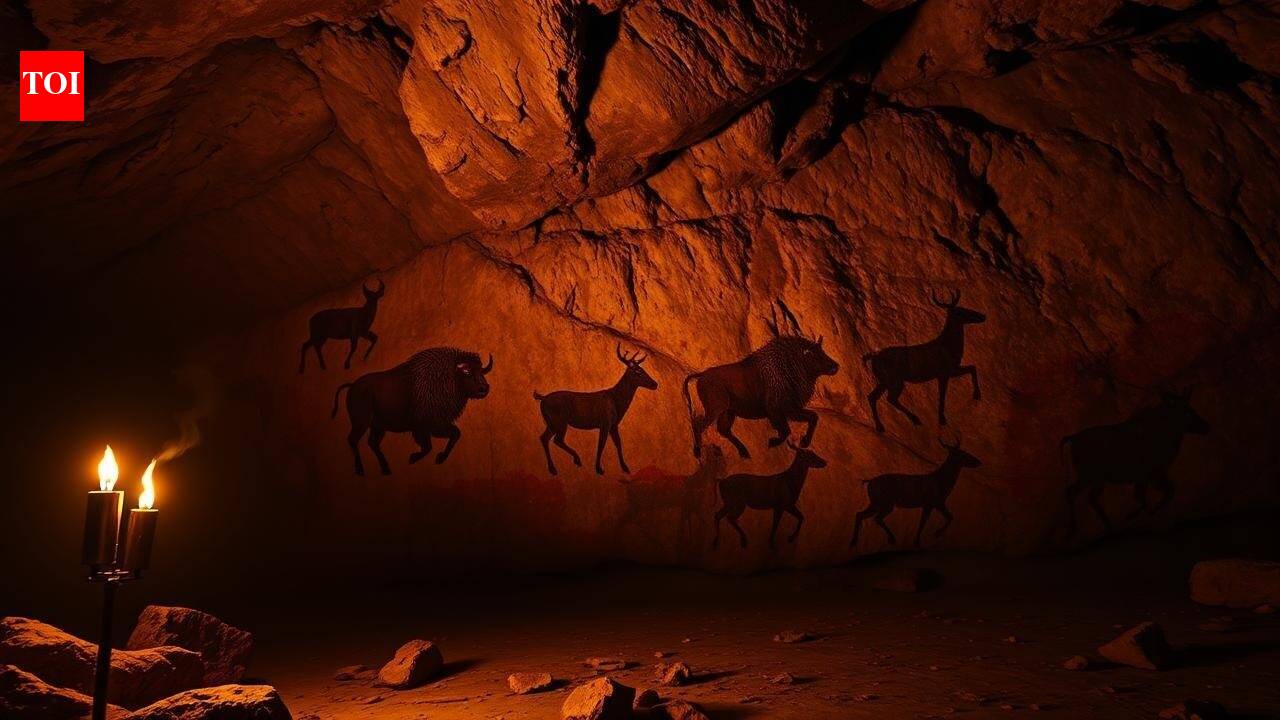
In the rolling hills of southwestern France, a chance encounter in September 1940 led to one of the most remarkable archaeological discoveries of the 20th century. Four teenagers, out on a routine adventure, followed their dog into a narrow opening in a hillside near the village of Montignac in the Dordogne region. What they uncovered inside was a hidden chamber adorned with vivid prehistoric paintings, preserved in near-perfect condition for millennia. According to reports from the Times of India, these artworks, dating back approximately 17,000 years to the Upper Paleolithic period, depicted a menagerie of Ice Age animals and symbols that have since captivated scientists, artists, and the public alike.
The cave, now known as Lascaux, was stumbled upon by 18-year-old Marcel Ravidat and his friends Georges Agnel, 17, Jacques Marsal, and Simon Coencas, all local youths from Montignac. The group had been exploring the countryside when their dog, named Robot, vanished into a rocky crevice partially obscured by a fallen tree. Curiosity drove them to widen the opening with their hands and a makeshift tool, squeezing through to emerge into a vast underground gallery. 'It was like stepping into another world,' Ravidat later recalled in interviews archived by historical societies, though initial reports from the era emphasized the sheer astonishment of the find.
Inside the cave, the teenagers found walls covered in over 600 paintings and engravings, executed in shades of red, black, and yellow using natural pigments like iron oxide and charcoal. Images of aurochs, horses, deer, and mythical creatures leaped out from the limestone surfaces, some up to five meters in length. The artwork's sophistication—evident in the dynamic poses and shading techniques—suggested a deep cultural and possibly ritualistic significance for the Magdalenian people who created them around 15,000 to 17,000 B.C., according to carbon dating analyses conducted in subsequent decades.
Word of the discovery spread quickly through the local community. The teenagers initially kept the site a secret, returning several times to explore its 250-meter length, which included chambers like the Great Hall of the Bulls and the Passageway. But by early October 1940, they confided in their schoolteacher, who alerted French prehistorian Henri Breuil. Breuil's examination confirmed the paintings' authenticity and antiquity, describing them as 'the Sistine Chapel of prehistory' in his 1942 report to the French Academy. This attribution underscored the site's unparalleled value, placing it alongside other famous caves like Altamira in Spain and Chauvet in France.
France was under Nazi occupation during World War II, which complicated the site's early management. German authorities showed interest in the cave for propaganda purposes, but French officials, led by the Ministry of Culture, managed to protect it. The cave was declared a national monument in 1941, and access was restricted to scholars and dignitaries. Visitors during the war included Pablo Picasso, who reportedly exclaimed upon seeing the paintings, 'We have invented nothing,' highlighting their timeless artistic merit.
Post-war, Lascaux became a symbol of human creativity and resilience. Opened to the public in 1948, it drew hundreds of thousands of tourists annually, boosting the local economy in the Dordogne. However, this popularity came at a cost. By the late 1950s, scientists noticed the paintings deteriorating due to carbon dioxide from human breath, humidity fluctuations, and fungal growth. A 1955 study by the French National Center for Scientific Research (CNRS) documented green spots appearing on the artwork, prompting urgent conservation efforts.
In 1963, authorities made the difficult decision to close Lascaux to the public to prevent further damage. 'The cave must be saved for future generations,' stated then-culture minister André Malraux in a public announcement. To satisfy public demand, a facsimile replica called Lascaux II was constructed nearby and opened in 1983, replicating about 90% of the original artwork using molds and pigments matched to the originals. This reproduction has welcomed over 15 million visitors, according to tourism records from the Dordogne regional council.
Archaeological research has continued unabated. Excavations in the 1950s revealed artifacts like lamps, tools, and bones, indicating the cave was used intermittently over thousands of years. Recent studies, including a 2018 analysis published in the journal Antiquity, used 3D scanning to map the cave's acoustics, suggesting the paintings may have been placed to enhance sound for rituals. Experts like Jean Clottes, a leading rock art specialist, have noted, 'Lascaux isn't just art; it's a window into the spiritual life of our ancestors.'
While the original Lascaux remains off-limits, a new initiative, Lascaux IV, opened in 2016 as an international center for cave art. This facility includes another precise replica and interactive exhibits, drawing on digital technology to simulate the experience of the 1940 discovery. Funding from the European Union and French government, totaling €25 million, supported its creation, as reported by the Ministry of Culture.
The story of Lascaux's discovery has inspired countless books, documentaries, and even school curricula worldwide. It exemplifies how serendipity can unearth profound insights into prehistory. Yet, debates persist among scholars about the paintings' exact purpose—whether hunting magic, shamanistic visions, or territorial markers. According to a 2020 review in Proceedings of the National Academy of Sciences, no single theory fully explains the diversity of motifs, with some researchers like David Lewis-Williams advocating for a neuropsychological approach linking them to altered states of consciousness.
Conservation challenges remain a focal point. In 2001, a bacterial outbreak threatened the cave, leading to a massive sterilization effort involving ultraviolet light and antibiotics. Officials from the International Council on Monuments and Sites (ICOMOS) monitored the recovery, reporting in 2005 that the artworks had stabilized. Today, a team of 12 specialists maintains the site year-round, controlling temperature and humidity to mimic Ice Age conditions.
Broader implications of Lascaux extend to global heritage preservation. The cave's inclusion on UNESCO's World Heritage List in 1979 alongside other prehistoric sites in the Vézère Valley emphasizes the need for international cooperation. Climate change poses new risks, with experts warning that rising groundwater could infiltrate the cave system. A 2022 report by the French Institute for Research and Development called for enhanced monitoring, stating, 'These irreplaceable treasures are vulnerable to modern threats we never anticipated.'
Looking ahead, ongoing DNA analysis of residues on the cave walls may reveal more about the artists' diets and environment. Projects like the Lascaux Research Program, funded by the CNRS, aim to integrate AI for pattern recognition in the artworks. As one curator at the site's museum put it, 'Every new technology brings us closer to understanding why our ancestors painted these masterpieces.'
The tale of four teenagers and a wayward dog continues to remind us of the hidden wonders beneath our feet. Lascaux stands not only as a testament to ancient ingenuity but as a call to protect our shared cultural legacy. In Montignac, locals still recount the story with pride, ensuring the 1940 discovery remains a living part of their heritage.