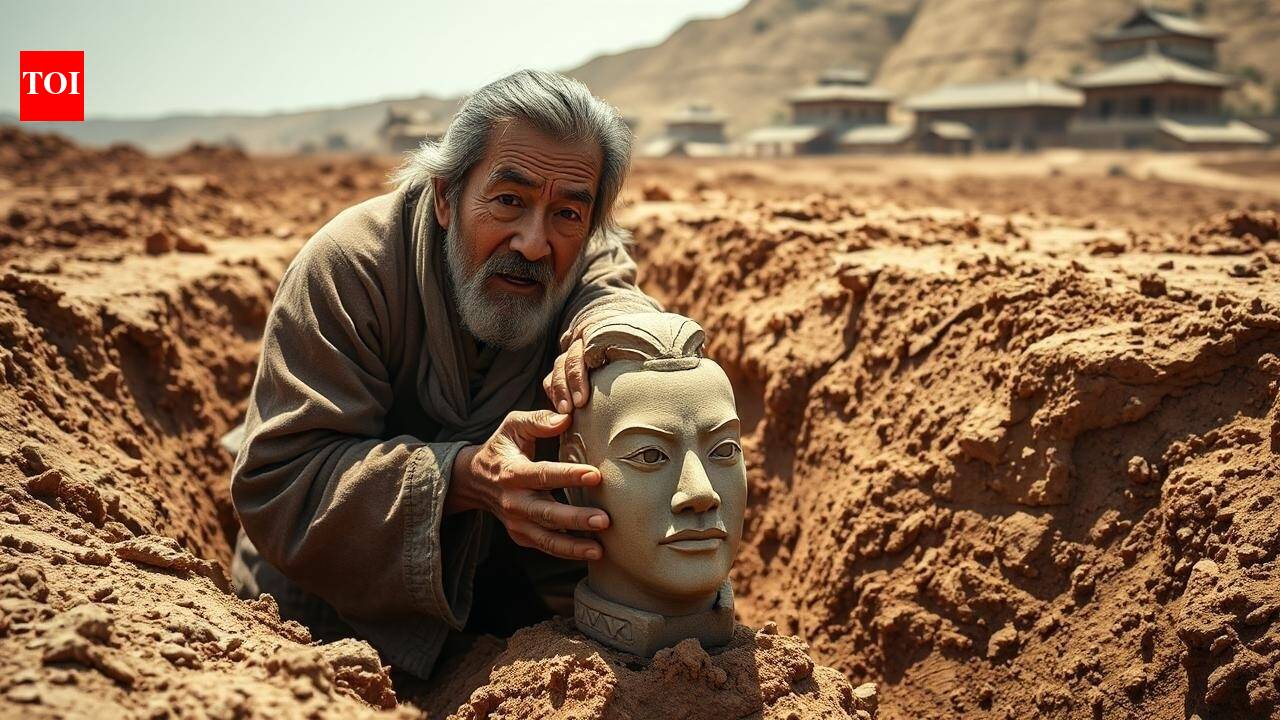
In the spring of 1974, amid a severe drought that gripped the rural countryside of Shaanxi province in China, a group of local farmers set out to dig a well in search of much-needed water. What they uncovered instead was one of the most astonishing archaeological discoveries of the 20th century: an vast underground army of life-sized terracotta warriors, standing guard over the tomb of China's first emperor, Qin Shi Huang. The find, which began as a chance strike against buried clay fragments, has since captivated the world, revealing insights into ancient Chinese military prowess, artistry, and imperial ambition.
The farmers, working in the Lintong district near the city of Xi'an, were led by a man named Yang Zhifa, according to accounts from the time. As they dug deeper into the parched earth, their shovels hit something hard and unyielding—shards of pottery that hinted at something far more significant than mere debris. "We thought we had found some broken pots at first," Yang reportedly recalled in later interviews, though initial reports from the scene described the excitement building as larger pieces emerged, shaped like human figures.
Word of the discovery quickly reached local authorities, who dispatched archaeologists to the site. What they found exceeded all expectations: three massive pits containing thousands of intricately crafted terracotta soldiers, horses, and chariots, all arranged in battle formation. According to experts from the Shaanxi Archaeological Institute, the army comprises over 8,000 soldiers, each uniquely sculpted with distinct facial features, hairstyles, and armor, suggesting they were modeled after real individuals from the emperor's era.
The Terracotta Army, as it came to be known, was constructed around 210 BC, shortly after the death of Qin Shi Huang, the ruthless unifier of China who founded the Qin Dynasty. Qin, who ruled from 221 to 210 BC, is credited with standardizing weights, measures, and currency across his vast empire, but he is also infamous for his authoritarian policies, including the construction of the early Great Wall and the suppression of intellectual dissent. The emperor's obsession with immortality led him to commission not just this subterranean army but an elaborate mausoleum complex believed to replicate his imperial palace and the known world, complete with rivers of mercury and constellations on the ceiling.
Archaeologists estimate that the pits cover an area of about 20,000 square meters, with Pit 1 alone housing more than 6,000 figures. The soldiers stand between 5 feet 11 inches and 6 feet 7 inches tall, armed with real bronze weapons that were remarkably preserved due to the airtight clay environment. "This is not just an army; it's a testament to the organizational genius of the Qin state," said Li Xiuzhen, a senior archaeologist at the Emperor Qin Shihuang's Mausoleum Site Museum, in a recent statement reflecting on the site's enduring mystery.
The discovery unfolded over several months in 1974, with excavations revealing additional artifacts, including acrobats, officials, and musicians—figures that suggest the army was part of a larger entourage meant to serve the emperor in the afterlife. Reports from the Times of India highlight how the initial well-digging during the drought turned into a national sensation, drawing international attention and prompting the Chinese government to protect the site as a UNESCO World Heritage landmark in 1987.
While the Terracotta Army's scale is awe-inspiring, its creation was no small feat. Historians believe it took some 700,000 laborers over 30 to 40 years to complete, using advanced techniques like modular assembly—heads, torsos, and limbs were fired separately and then joined. According to ancient texts like the Shiji by Sima Qian, written around 100 BC, Qin's tomb was surrounded by crossbows set to fire at intruders, and models of palaces and towers were burned to ash, though the main burial chamber remains unopened to this day due to concerns over preservation and potential traps.
Challenges in excavation have been numerous. Early digs in the 1970s faced political hurdles during China's Cultural Revolution, which had just begun to wane, but the site's importance helped shield it from destruction. Modern efforts involve sophisticated conservation methods, including 3D scanning and pigment analysis, as the original colors on the figures—vibrant reds, greens, and blues—have faded upon exposure to air. "The paint peels away almost immediately when uncovered," noted archaeologist Zhao Hu, emphasizing the delicate balance between revelation and ruin.
International collaboration has played a key role in studying the army. In the 1980s, German and Chinese teams worked together on restoration, while recent projects with institutions like the British Museum have focused on the metallurgy of the weapons. Some weapons still bear traces of chromium plating, a technique not replicated in the West until the 20th century, sparking debates about ancient Chinese technological superiority. "It's a reminder that history is full of surprises," said archaeologist Agnes Lin from the University of California, who has consulted on the site.
Not all aspects of the discovery are without controversy. While most sources agree on the basic timeline, some local accounts vary on the exact role of the farmers. Yang Zhifa and his brothers have been celebrated as heroes, even posing for photos with dignitaries like former U.S. President Barack Obama during his 2017 visit to the museum. However, reports from the era suggest that initial credit went more to officials, with the farmers' contributions downplayed amid the site's rapid nationalization.
The Terracotta Army has also illuminated broader historical narratives. Qin's unification ended the Warring States period, paving the way for imperial China, but his dynasty lasted only 15 years after his death, succumbing to rebellion. The army, meant to protect him eternally, instead symbolizes the fragility of power. Scholars like those at Peking University argue that the figures' realism reflects a merit-based military, contrasting with later dynasties' more stylized art.
Today, the site attracts over 9 million visitors annually, making it one of China's top tourist destinations. The Emperor Qin Shihuang's Mausoleum Site Museum, built in 1979, houses much of the collection, with ongoing excavations in four main pits and potential for more. Officials report that advanced geophysical surveys hint at undiscovered chambers, including the emperor's sarcophagus, rumored to be surrounded by liquid mercury simulating rivers.
Preservation efforts continue to evolve. In 2023, Chinese authorities announced new climate-controlled enclosures to combat pollution and tourism wear. International experts, including those from the Louvre, have praised the site's management, though concerns linger about over-commercialization. "We must balance access with protection," said museum director Wei Shaoming, underscoring the global responsibility to safeguard this cultural treasure.
The 1974 discovery not only rewrote textbooks on ancient China but also inspired countless books, films, and exhibitions worldwide. From the farmers' humble well to a symbol of human ingenuity, the Terracotta Army endures as a bridge between past and present, inviting endless questions about mortality, legacy, and the secrets still buried beneath Shaanxi's soil. As excavations proceed cautiously, the world watches, eager for the next chapter in this 2,000-year-old saga.