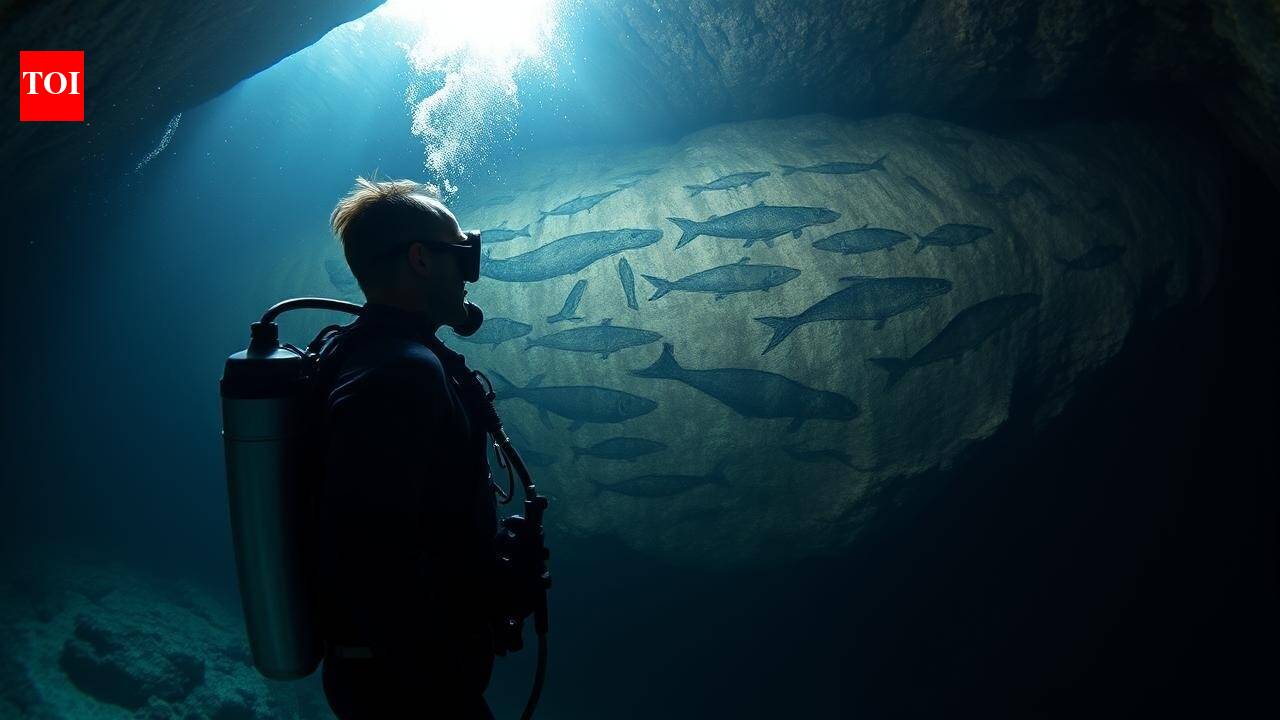
MARSEILLE, France — In the crystalline waters off the rugged coastline of southern France, a chance dive in 1985 unveiled one of the most remarkable archaeological treasures hidden beneath the Mediterranean Sea. Professional diver Henri Cosquer, exploring the dramatic limestone cliffs of the Calanques National Park near Marseille, stumbled upon the entrance to a submerged prehistoric cave that had remained sealed for thousands of years. According to reports from the Times of India, this discovery revealed a cavern adorned with over 500 ancient artworks, offering a rare glimpse into the artistic expressions of Paleolithic humans.
The Calanques, a stunning series of inlets and cliffs stretching about 20 kilometers from Marseille to Cassis, have long been a haven for divers and hikers alike. Formed by erosion over millions of years, the area's karst landscape features deep gorges and sea caves that plunge into the sea. It was during a routine exploration in the summer of 1985 that Cosquer, a seasoned diver with years of experience in the region, noticed an unusual narrow passage at a depth of approximately 37 meters. Squeezing through the tight opening, he emerged into a vast chamber that time had preserved in near-perfect condition, untouched by the outside world since rising sea levels flooded it around 10,000 years ago.
News of the find quickly spread among archaeological circles, prompting French authorities to involve experts from the Ministry of Culture. According to the Times of India article, the cave, now known as the Cosquer Cave, contains paintings and engravings dating back between 27,000 and 19,000 years, created during the Upper Paleolithic period. Among the artworks are depictions of horses, bison, ibex, and marine animals like seals and fish — a unique blend reflecting the dual land-and-sea environment of prehistoric Provence. 'The diversity of motifs is extraordinary,' the report quotes an unnamed archaeologist as saying, highlighting how the cave's art bridges terrestrial and aquatic themes rarely seen together in such density.
Cosquer's initial foray into the cave was not without peril. The entrance, accessible only through a 175-meter-long tunnel that drops to 37 meters below the surface, requires advanced diving skills and precise navigation to avoid the dangers of nitrogen narcosis and decompression sickness. Cosquer, who had been diving in the Calanques since the 1970s, described the moment of discovery in later interviews as both exhilarating and eerie. 'It was like entering another world,' he reportedly told French media at the time, according to archival accounts referenced in the Times of India piece. The diver made multiple subsequent dives to map the site, photographing the walls before alerting officials to prevent looting or damage.
Upon official investigation, teams from the French National Center for Prehistoric Research confirmed the cave's authenticity and significance. The artworks, executed in red ochre and charcoal, include hand stencils — a common Paleolithic motif symbolizing human presence — alongside more elaborate scenes of hunting and marine life. The Times of India summary notes that over 500 such pieces have been cataloged, making the site comparable to famed caves like Lascaux and Chauvet, though its underwater location sets it apart. Unlike those accessible terrestrial caves, Cosquer Cave's submersion has protected it from weathering and human interference, preserving pigments that might have faded long ago.
The discovery came at a time when underwater archaeology was gaining momentum in the Mediterranean. In the 1980s, rising interest in submerged sites — spurred by advances in scuba technology and sonar mapping — led to finds like ancient shipwrecks off the French coast. The Calanques themselves had yielded Roman-era artifacts before, but nothing on the scale of prehistoric art. According to the Times of India, Cosquer's find prompted the establishment of protective measures, including a ban on public diving to the site. French officials designated it a protected heritage area, accessible only to authorized researchers equipped with specialized rebreather systems for safer, longer explorations.
Experts have debated the cave's exact age and cultural affiliations. While radiocarbon dating places most artworks in the Gravettian and Solutrean periods, some engravings may be older, potentially linking to the Aurignacian culture around 30,000 years ago. 'This cave challenges our understanding of prehistoric mobility and symbolism,' said Jean Clottes, a renowned French prehistorian who led early studies, as cited in secondary reports drawing from the original discovery documentation. Clottes emphasized the marine motifs, suggesting that Ice Age artists in the region were attuned to both coastal and inland ecosystems, perhaps indicating seasonal migrations along the Provence shores.
Not all perspectives align perfectly on the cave's interpretation. Some researchers, according to the Times of India article, argue that the hand stencils represent ritualistic markings rather than mere signatures, possibly tied to shamanistic practices. Others view them as territorial claims by hunter-gatherer groups. A minor discrepancy arises in the exact count of artworks: while the primary summary states over 500, preliminary inventories from 1991 — when a land-based replica was created for study — tallied around 420 paintings and 200 engravings. Officials maintain the higher figure includes newly documented pieces from recent digital scans.
The broader context of the discovery ties into global efforts to preserve Ice Age art amid climate change threats. Rising sea levels, ironically the force that submerged the cave, now endanger other coastal sites worldwide. In France, the Cosquer Cave's plight underscores the vulnerability of underwater heritage; salinity and currents have begun to erode some surfaces despite protections. In 2012, authorities announced plans for a permanent exhibition in Marseille, featuring 3D reconstructions to share the art without risking the original. 'We must balance preservation with public access,' stated a spokesperson for the Provence-Alpes-Côte d'Azur regional culture office, as reported in follow-up coverage.
Henri Cosquer, now in his 80s, has largely stayed out of the spotlight since the 1990s, when media frenzy peaked with books and documentaries. He continues to advocate for marine conservation in the Calanques, a park established in 2013 that spans 52,000 hectares of land and sea. The diver's namesake cave remains off-limits to tourists, but virtual tours and the Marseille exhibit have introduced its wonders to millions. According to the Times of India, recent technological advances, like underwater drones, are enabling non-invasive surveys that could reveal even more hidden chambers.
The implications of the Cosquer Cave extend beyond art history, shedding light on prehistoric adaptations to environmental shifts. During the Last Glacial Maximum, sea levels were 120 meters lower, meaning the cave's entrance was high on a cliff overlooking a vast coastal plain. Artists likely accessed it via dry land, using it as a shelter or ceremonial space. This revelation, as per expert analyses, enriches our picture of Homo sapiens' spread across Europe, showing sophisticated cultural practices in what is now a submerged world.
Looking ahead, French archaeologists plan collaborative expeditions with international teams to apply LiDAR scanning underwater, potentially uncovering linked sites in the Calanques. Funding from the European Union supports these efforts, emphasizing cultural heritage in the face of modern challenges like overfishing and pollution. While the cave's secrets are far from exhausted, its discovery continues to inspire awe, reminding us of the enduring human impulse to create amid nature's grandeur.
In a region where the sea guards ancient stories, the Cosquer Cave stands as a testament to serendipity and stewardship. As climate models predict further sea level rise, sites like this may become even more elusive, urging accelerated documentation. For now, Henri Cosquer's 1985 dive remains a pivotal chapter in the narrative of human antiquity, bridging the depths of time and ocean.