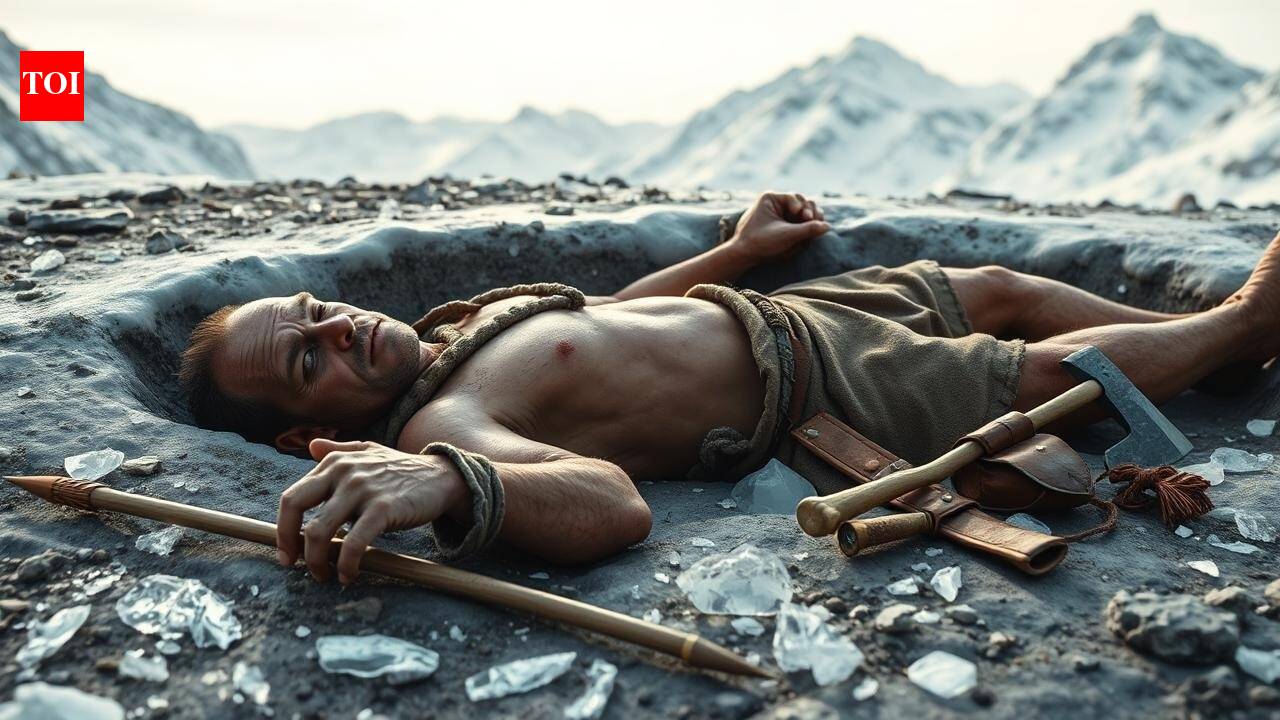
In the thin, crisp air of the Ötztal Alps, where the border between Austria and Italy snakes through ancient glaciers, a chance encounter three decades ago unearthed one of the most remarkable archaeological finds of the modern era. On September 19, 1991, two German hikers, Helmut and Erika Simon, were navigating a rugged shortcut across the Schnalstal glacier when they spotted an unusual dark shape protruding from the melting ice. What they initially mistook for a discarded doll or perhaps a modern accident victim turned out to be the frozen remains of a man who had been preserved for over 5,300 years, earning him the nickname Ötzi the Iceman.
According to a recent report by the Times of India, the discovery unfolded amid the sparse, echoing silence of the high-altitude terrain, broken only by the crunch of footsteps on ice. The Simons, experienced trekkers from Nuremberg, had veered off the main path near the 3,210-meter (10,530-foot) summit of the Fineilspitze peak to shorten their route. As the sun warmed the glacier, a brownish lump emerged from the receding snow—a torso clad in weathered leather, partially exposed. "We thought it was a mountaineer who had fallen and died recently," Helmut Simon later recounted in interviews, as cited in various accounts of the event. The couple alerted local authorities, who arrived the next day to confirm the remains were far from ordinary.
The body, quickly dubbed Ötzi after the Ötztal valley region, was meticulously extracted over several days by a team of experts from the University of Innsbruck and Italian authorities, given the site's location on the Italian side of the border. Forensic analysis revealed that the man, estimated to be between 40 and 50 years old at the time of death, had lived during the Copper Age, around 3300 BCE. His preservation in the ice had been near-perfect, offering scientists a rare window into prehistoric life. "This is not just a body; it's a time capsule," said Konrad Spindler, the lead archaeologist on the initial recovery team, in a statement reported by the Times of India. Spindler's work highlighted Ötzi's tattoos—over 60 simple lines and crosses inked into his skin, possibly for therapeutic or ritual purposes—and his array of artifacts, including a copper axe, a flint dagger, and a backpack frame made from wood and hide.
Further examination showed Ötzi had endured a harsh existence. Isotope analysis of his teeth and bones indicated he hailed from the South Tyrol region, roughly 50 miles from the discovery site, and had traveled extensively in the weeks before his death. His last meal, consumed about two hours prior to dying, consisted of ibex meat, einkorn wheat, and traces of wild goat, as determined by stomach content studies published in subsequent scientific papers. But the Iceman's end was violent: an arrowhead lodged in his shoulder from a copper-tipped arrow, suggesting he was killed in a skirmish or ambush. "The wound was fatal, piercing a major artery," explained Albert Zink, director of the Institute for Mummies and the Iceman at Eurac Research, in a 2023 update referenced in the Times of India article. Defensive wounds on his hands and cuts on his body supported theories of a confrontation, though the exact circumstances remain debated among experts.
The discovery's immediate aftermath was chaotic. Initial recovery efforts were hampered by the remote location and worsening weather, leading to the body's temporary storage in a wooden box before transport to a refrigerated facility in Innsbruck. Ownership disputes arose due to the border location, with Austria initially claiming the find until GPS coordinates confirmed it was 92 meters inside Italy. This jurisdictional tussle, resolved in Italy's favor in 1998, underscored the international stakes of such discoveries. Meanwhile, the Simons faced media frenzy; Helmut Simon himself returned to the site multiple times to document changes, tragically perishing in a fall there in 2004 at age 67.
Ötzi's artifacts provided invaluable context for the Chalcolithic period, a transitional era between the Stone and Bronze Ages marked by early metalworking. His axe, with a 99.7% pure copper blade, represented advanced craftsmanship for the time, sourced from ores in the Eastern Alps. Clothing analysis revealed a sophisticated outfit: a loincloth, leggings, shoes stuffed with grass for insulation, and a coat of stitched goat hide and sheep wool. "Ötzi was no primitive caveman; he was a skilled artisan and herder," noted South Tyrol Museum archaeologist Angelika Fleckinger in a Times of India-cited interview. Genetic studies, including a 2012 sequencing of his genome, showed he had dark skin, dark eyes, and was genetically closer to modern Sardinians than to most Europeans, with traces of Lyme disease and possible cardiovascular issues.
Since 1998, Ötzi has been housed at the South Tyrol Museum of Archaeology in Bolzano, Italy, where he lies in a custom -6°C (21°F) chamber viewable by the public. The museum attracts over 300,000 visitors annually, drawn to the transparent case revealing his leathery skin and frozen pose. Recent advancements, like 3D scanning and virtual reality reconstructions, have allowed non-invasive studies, including a 2022 CT scan that identified a previously undetected hand injury. "Technology is breathing new life into Ötzi's story," said museum director Patrizia Spadini, emphasizing how these tools help preserve the mummy without further disturbance.
Debates persist over Ötzi's final days. Some researchers, like those at the University of Vienna, propose he was fleeing enemies after a village dispute, based on pollen in his gut from lowland plants suggesting a recent descent from higher altitudes. Others, including Italian forensic experts, argue for a hunting accident gone wrong. A 2018 study in the Journal of Archaeological Science suggested the arrow wound might not have been immediately lethal, with Ötzi possibly succumbing to blood loss while climbing to escape. "We may never know the full truth, but each clue adds to the puzzle," Zink remarked, highlighting the ongoing interdisciplinary research involving botanists, geneticists, and anthropologists.
The Iceman's find has broader implications for climate science and preservation ethics. His emergence from the ice was hastened by warming temperatures, a trend that has since revealed other ancient remains in the Alps, including tools and animal bones. "Glacial archaeology is booming, but it's a race against melting," warned Lars Pilø, a glaciologist at the Oppland County Council in Norway, in a comparative report echoed by the Times of India. Ötzi's case has influenced protocols for handling such discoveries, emphasizing rapid response teams and international cooperation to prevent looting or damage.
Public fascination with Ötzi endures through books, documentaries, and even merchandise at the Bolzano museum. Erika Simon, now in her 80s, has shared her story in memoirs, describing the moment of discovery as "a brush with history that changed our lives forever." The event also sparked ethical discussions on repatriation and display, though as a pre-modern figure without direct descendants claiming him, he remains a global heritage icon.
Looking ahead, upcoming research includes metagenomic analysis of Ötzi's microbiome to understand ancient gut health and potential pathogens. Collaborations between Italian, Austrian, and German institutions aim to digitize his entire artifact collection, making it accessible worldwide. As climate change continues to expose Alpine secrets, Ötzi stands as a poignant reminder of humanity's deep past and the fragile balance of our planet's frozen archives. "He's not just an individual; he's a bridge to our ancestors," Fleckinger concluded, encapsulating the enduring legacy of that fateful hike in 1991.