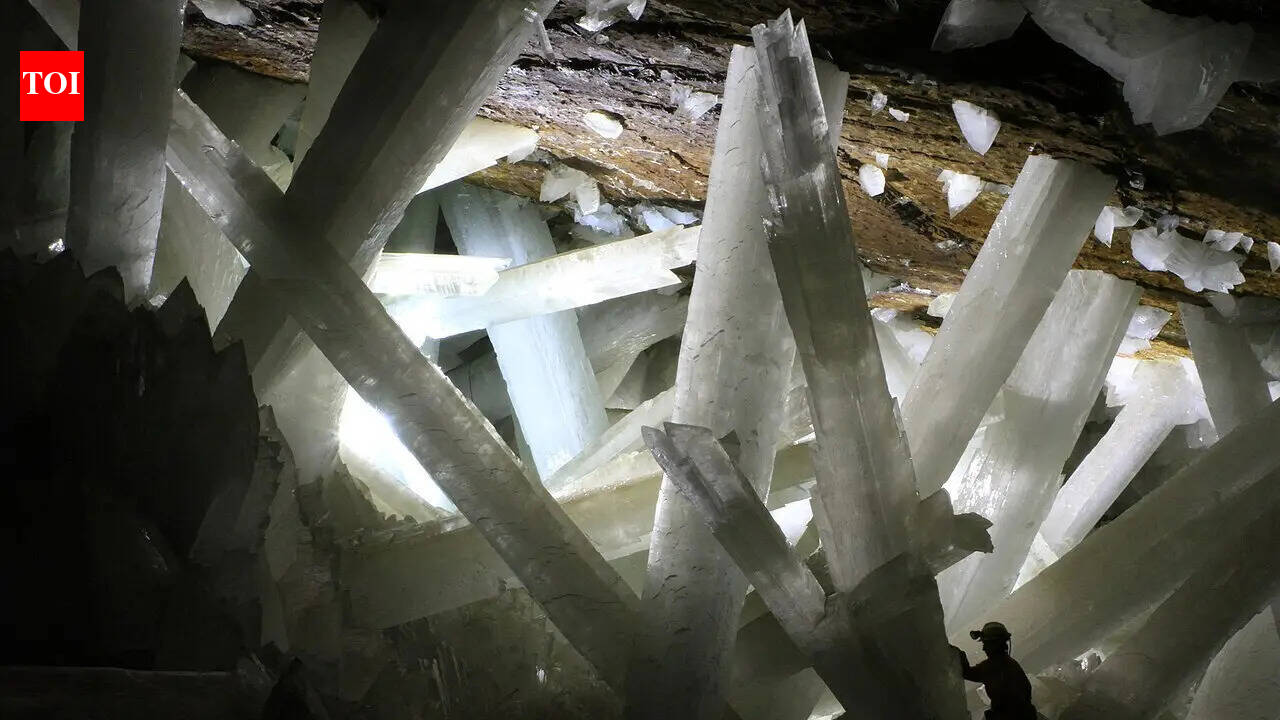
In the arid expanses of Chihuahua, Mexico, a routine mining operation in 2000 took an extraordinary turn when workers at the Naica silver mine accidentally breached a hidden chamber deep underground. What they uncovered was the Cave of the Crystals, a vast cavern at approximately 300 meters below the surface, filled with towering gypsum crystals that stretch up to 12 meters in length and weigh as much as 55 tons each. According to reports from the Times of India, this accidental discovery revealed a subterranean world that resembles a scene from another planet, with translucent selenite formations glowing under artificial lights.
The Naica mine, operated by the Mexican mining company Peñoles, has been a significant source of lead, zinc, and silver since the early 20th century. Miners were drilling exploratory shafts in search of new ore deposits when their equipment punctured the wall of the cave on April 12, 2000. "It was like entering a frozen palace," one unnamed miner recounted in early accounts shared with local media, though details from the workers remain sparse due to the site's remote location and the company's initial secrecy surrounding the find.
Upon entry, the team was met with a humid, sweltering environment where temperatures hover around 58 degrees Celsius (136 degrees Fahrenheit) and humidity exceeds 90 percent, conditions so extreme that unprotected visitors can only endure about 10 minutes inside without risking severe dehydration or heatstroke. The crystals, primarily composed of selenite—a clear variety of gypsum—formed over hundreds of thousands of years through the interaction of mineral-rich groundwater and the mine's hydrothermal systems. Geologists estimate that the largest crystals began growing around 500,000 years ago, during a period when the cave was submerged in warm, saturated waters.
News of the discovery spread slowly at first, with Peñoles confirming the find to scientific communities in late 2000. Dr. Rafael González, a geologist with the Mexican Institute of Geology, was among the first experts to visit the site. He described the cavern as "a unique geological phenomenon, unparalleled anywhere else on Earth," according to a 2001 report in the Journal of Geological Society of Mexico. The cave measures about 30 meters wide and 10 meters high, but its most striking feature is the forest of blade-like crystals that dominate the space, some as thick as tree trunks.
Scientific interest surged as researchers from institutions like the University of Arizona and NASA's Astrobiology Institute turned their attention to the cave. The extreme conditions mirror those hypothesized on other planets, such as Mars or Europa, prompting studies into extremophile microorganisms trapped within fluid inclusions in the crystals. According to a summary from the Times of India, the site revealed "ancient microorganisms," suggesting that life can persist in seemingly inhospitable environments. These microbes, some dating back over 50,000 years, offer clues to how life might survive in extraterrestrial subsurface oceans.
Access to the cave was tightly controlled from the outset. Peñoles, prioritizing mine safety and operations, limited visits to authorized personnel equipped with cooling suits and oxygen supplies. In 2006, the company temporarily sealed the entrance to prevent damage from mining activities, but not before international teams documented the site extensively. Photographer Wolfgang Wilde captured iconic images of the crystals, which later appeared in National Geographic, highlighting their otherworldly beauty. "The light refracts through the selenite like a prism, creating rainbows in the heat," Wilde said in an interview with Discovery Channel.
Despite the wonder, challenges abound. The high humidity and heat have made long-term exploration difficult, and ongoing mining has raised concerns about the cave's preservation. Environmental groups, including Mexico's National Commission for Protected Natural Areas, have called for the site to be designated a UNESCO World Heritage location. "This is a natural treasure that must be protected for future generations," said María Elena Ortiz, a conservationist with the commission, in a 2010 statement to Reuters. However, Peñoles maintains that the cave's location within an active mine complicates such efforts, with company spokesperson Javier López noting, "Our priority is the safety of our workers while respecting the site's scientific value."
Background on the Naica deposit reveals a history of surprises. Discovered in 1794, the mine has produced billions in minerals, but its geothermal activity—fueled by magma chambers deep below—creates unique conditions for crystal growth. Prior to 2000, smaller crystal chambers were known, but nothing approached the scale of the Cave of the Crystals. Hydrologists explain that rising groundwater levels in the 1980s, due to pumping for mining, flooded the cave and halted crystal growth, preserving the formations in their current state. If the water table were to drop again, experts warn, the crystals could begin dissolving.
Multiple expeditions have yielded divergent findings on the cave's ecology. A 2008 study led by Dr. Penelope Boston of the New Mexico Institute of Mining and Technology identified diverse bacterial communities within the crystals, some potentially novel species. "These organisms are like time capsules, showing us life's resilience," Boston reported in a paper published in Astrobiology. Conversely, a French team from the University of Marseille in 2010 found fewer viable microbes, attributing discrepancies to sampling methods. "Our analysis suggests the populations are more dormant than active," lead researcher Dr. Didier Néraudeau said, highlighting the challenges of working in such an environment.
The discovery has also inspired artistic and cultural reflections. In Mexico, the cave has been likened to mythical underground realms in indigenous lore, with Tarahumara communities nearby viewing it as a sacred site. A 2015 documentary, "The Crystal Cave," produced by the BBC, brought global attention, featuring footage from permitted dives into nearby water-filled chambers. Director Tessa Dwyer emphasized, "It's not just science; it's a reminder of Earth's hidden wonders." Yet, tourism remains off-limits, with virtual reality tours emerging as an alternative through collaborations with Google Earth.
Broader implications extend to climate science and resource extraction. The crystals' formation ties to past climate shifts, with isotopic analysis revealing fluctuations in regional temperatures over millennia. Mining experts note that similar hydrothermal systems worldwide could harbor undiscovered sites, but environmental regulations are tightening. In Mexico, a 2022 law mandates impact assessments for geological heritage, potentially influencing Naica's future. Peñoles has invested in sustainable practices, including crystal monitoring stations installed in 2018.
Looking ahead, researchers hope for expanded access. A joint Mexican-U.S. project announced in 2023 aims to map the cave using drones and non-invasive tech, avoiding the need for human entry. "Technology will unlock secrets without risking the site," said project coordinator Dr. Luis Espinoza of UNAM. Meanwhile, the Cave of the Crystals continues to captivate, a testament to the surprises lurking beneath our feet. As mining operations evolve, the balance between extraction and preservation remains a key watchpoint for scientists and policymakers alike.
The story of this accidental breakthrough underscores the intersection of industry and discovery. In Chihuahua's rugged terrain, where silver veins have drawn prospectors for centuries, the 2000 find added a chapter of awe to the region's mining legacy. With ongoing studies, the cave's crystals—silent giants in the Earth's core—promise to illuminate not just geological history, but the very possibilities of life beyond our world.