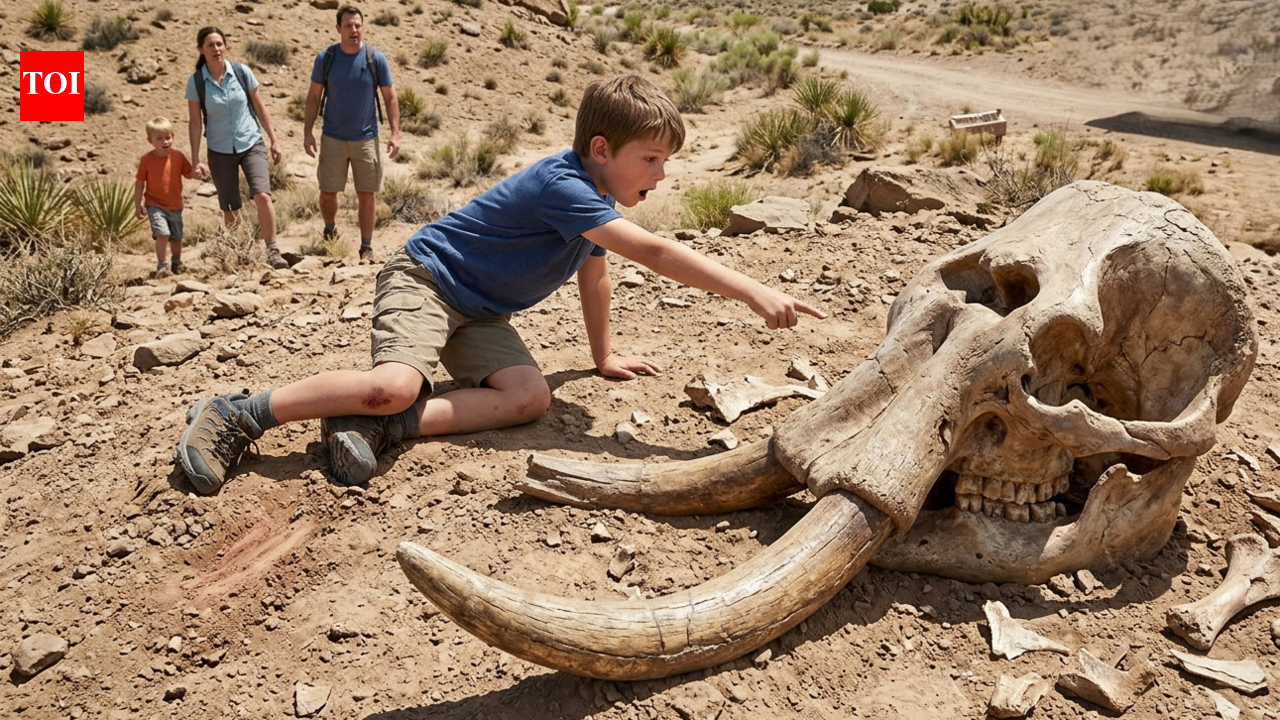
In the vast, sun-baked expanses of the New Mexico desert, an unexpected stumble by a young boy unearthed a treasure from deep in Earth's prehistoric past. On a family outing in November 2016, nine-year-old Jude Sparks tripped over what appeared to be scattered bone fragments while exploring the arid landscape near the town of Truth or Consequences. What began as a minor mishap quickly transformed into a groundbreaking scientific discovery: the fragments were part of a remarkably preserved 1.2 million-year-old skull belonging to a stegomastodon, an extinct relative of modern elephants.
According to reports from the Times of India, Jude's accidental find set off a chain of events that drew paleontologists to the site. The boy, out hiking with his family during a Thanksgiving break, noticed the unusual bones protruding from the sandy soil. 'I thought it was just a rock at first, but when I picked it up, it felt different,' Jude later recounted in interviews shared by local New Mexico news outlets. His curiosity prompted him to show the pieces to his parents, who recognized their potential significance and contacted experts at the New Mexico Museum of Natural History and Science.
The stegomastodon, a massive proboscidean mammal that roamed North America during the Pleistocene epoch, stood up to 10 feet tall at the shoulder and weighed several tons. This species, known scientifically as Stegomastodon fricki, featured distinctive cone-shaped teeth adapted for grinding tough vegetation, setting it apart from its more famous cousin, the woolly mammoth. The skull discovered by Jude measures approximately 3 feet in length and shows well-preserved features, including the animal's elongated tusks and robust jaw structure, offering scientists a rare glimpse into the fauna of ancient American Southwest.
Paleontologists who arrived at the site shortly after the family's report were astonished by the completeness of the find. 'This is one of the most intact stegomastodon skulls we've encountered in decades,' said Dr. Spencer Lucas, curator of paleontology at the New Mexico Museum of Natural History, in a statement to the press. The team carefully excavated the area over several weeks, uncovering not only the skull but also associated vertebrae and limb bones, suggesting the animal may have died in a shallow water body, preserving its remains through sediment burial.
The location of the discovery, in the southern part of New Mexico's Sierra County, lies within a region rich in fossil deposits from the Pleistocene period, which spanned from about 2.6 million to 11,700 years ago. This era, often called the Ice Age, saw dramatic climate shifts that influenced the migration and evolution of large mammals across the continent. According to geological surveys, the desert floor where Jude stumbled preserves layers of sediment from ancient lakes and rivers, ideal for fossilization. Similar finds in the area have included bones of dire wolves, saber-toothed cats, and early horses, painting a picture of a diverse ecosystem teeming with megafauna.
Jude's role in the discovery highlights the serendipitous nature of paleontological work, where amateur finds often lead to major breakthroughs. The Sparks family, originally from Colorado but vacationing in New Mexico, had no prior experience in fossil hunting. Jude's father, Jerry Sparks, described the moment to reporters: 'We were just out enjoying the fresh air, and next thing you know, our son hands us what turns out to be a piece of history.' The museum staff praised the family's quick action in reporting the find, noting that improper handling could have damaged the fragile bones.
Following the initial excavation, the skull was transported to the museum's laboratory in Albuquerque for cleaning and analysis. Experts used advanced techniques, including CT scanning and 3D modeling, to study the specimen without invasive procedures. Preliminary dating, conducted via radiometric methods on surrounding sediments, confirmed the skull's age at around 1.2 million years, placing it in the early Pleistocene. This timeline aligns with other regional fossils, suggesting stegomastodons inhabited the area during a warmer interglacial period before the onset of more severe ice ages.
The discovery has sparked interest among researchers studying the evolutionary links between stegomastodons and modern elephants. Unlike the trunked proboscideans of today, stegomastodons had shorter trunks and more primitive dental structures, as evidenced by the skull's enamel patterns. Dr. Gary Morgan, a visiting paleontologist from the Florida Museum of Natural History, commented on the find's value: 'This specimen could help us understand how these giants adapted to changing environments in North America.' He noted that while mastodons and mammoths are better known, stegomastodons represent a lesser-studied branch that diverged millions of years earlier.
Local communities in New Mexico have embraced the story, with the museum planning a special exhibit featuring the skull once conservation is complete. Officials at the Bureau of Land Management, which oversees much of the fossil-rich public lands, emphasized the importance of public involvement in such discoveries. 'Finds like this remind us of the scientific wealth beneath our feet,' said agency spokesperson Maria Torres. The event also underscores ongoing efforts to educate visitors about fossil protection laws, as unauthorized collection can lead to fines or loss of irreplaceable artifacts.
Beyond the immediate excitement, the stegomastodon skull contributes to broader debates in paleontology about megafaunal extinction. Around 12,000 years ago, many large mammals vanished from the Americas, possibly due to a combination of climate change, human hunting, and habitat loss. This 1.2 million-year-old find predates those events by over a million years, offering a baseline for tracking population dynamics. Researchers hope DNA analysis, if viable from the bones, could reveal genetic diversity in ancient herds.
In the years since 2016, Jude Sparks has grown into a teenager passionate about science, often visiting the museum to learn more about his discovery. The story of his trip has inspired educational programs aimed at children, encouraging outdoor exploration with an eye toward natural history. As one teacher involved in the outreach said, 'It's proof that anyone can make a difference in science, no matter how small the start.'
Looking ahead, scientists anticipate publishing detailed findings in peer-reviewed journals, potentially reshaping timelines for proboscidean evolution in the Americas. Collaborations with international teams could compare this skull to specimens from Mexico and South America, where related species thrived. For now, the artifact rests securely in Albuquerque, a testament to how a child's curiosity in the desert can illuminate the distant past.
The broader implications extend to conservation, as New Mexico's fossil sites face threats from development and erosion. Advocacy groups are pushing for expanded protected areas, citing discoveries like this as reasons to preserve the landscape. While the stegomastodon itself is long gone, its legacy endures through such serendipitous revelations, bridging the gap between everyday adventures and the wonders of prehistory.