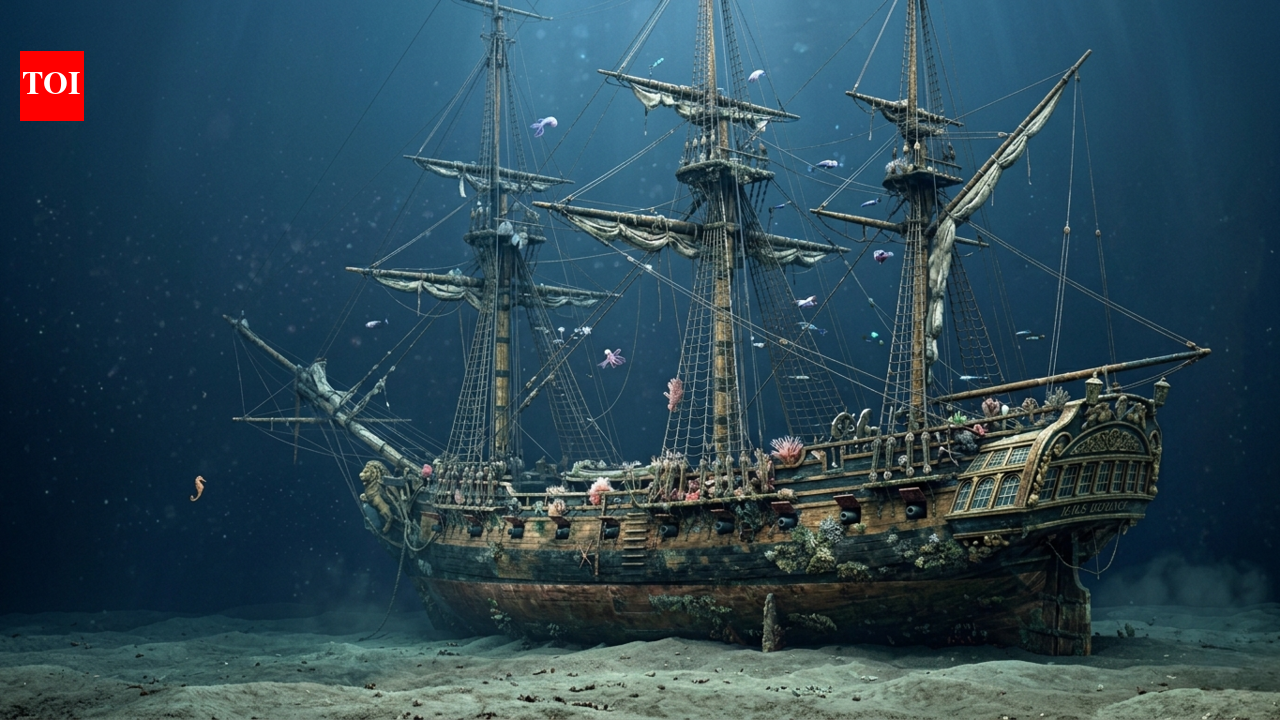
APPLETON, Wis. — In the chilly depths of Lake Ontario, a routine survey in 2017 unearthed a remarkable relic from the past: a 19th-century sailing ship remarkably preserved, as if frozen in time on the lakebed. The discovery, made by a team of researchers conducting underwater mapping, has captivated historians and maritime experts, offering fresh insights into the perilous era of Great Lakes shipping.
According to a report from the Times of India, the survey team detected an anomaly during a sonar scan as part of broader efforts to chart the lake's underwater topography. What they found was the intact hull of a ghost ship, dating back to the late 1800s, lying in about 300 feet of water near the New York shoreline. The vessel, identified preliminarily as a wooden schooner, appeared undisturbed by the passage of over a century, its wooden structure holding firm against the sediment and currents that typically ravage such wrecks.
The find came during the Lake Ontario Coastal Mapping and Analysis Project, a collaborative effort involving the National Oceanic and Atmospheric Administration (NOAA) and other agencies. "We were mapping the lakebed for environmental and navigational purposes when the sonar pinged something unusual," said a project spokesperson, as quoted in related coverage. The anomaly prompted a closer investigation using remotely operated vehicles (ROVs), which captured high-resolution images revealing the ship's masts still upright and cargo holds seemingly sealed.
Historians believe the ship may be the George A. Marsh, a three-masted schooner built in 1881 in Toledo, Ohio. Launched during the height of the grain trade boom on the Great Lakes, the vessel measured 170 feet in length and was designed to haul lumber and other bulk goods between ports in Michigan, New York, and Canada. According to maritime records cited in the Times of India article, the George A. Marsh met its end on June 21, 1917, after a collision with the steel steamer Themistocles in heavy fog off Sodus Point, New York.
The collision was a tragic but common occurrence in the early 20th century, when wooden sailing ships like the Marsh vied for space with faster, iron-hulled steamers on busy shipping lanes. Eyewitness accounts from the time, preserved in U.S. Coast Guard archives, describe the Marsh taking on water rapidly after the impact, with its crew of 12 abandoning ship in lifeboats. Miraculously, no lives were lost, though the steamer Themistocles sustained only minor damage and continued its voyage to Montreal.
"This wreck is a time capsule," noted Daniel Basta, director of NOAA's Office of National Marine Sanctuaries, in a statement following the discovery. "It provides an unparalleled view into the daily life of sailors on the Great Lakes during the transition from sail to steam." Images from the ROV showed artifacts such as preserved ropes, anchors, and possibly remnants of the ship's cargo—rumored to include coal or timber—still in place, untouched by looters or natural decay.
The Great Lakes have long been a graveyard for ships, with an estimated 6,000 wrecks scattered across their floors, earning the region the nickname "Shipwreck Alley." Lake Ontario alone accounts for hundreds of these losses, many from storms, collisions, or mechanical failures. The George A. Marsh's preservation is attributed to the lake's cold, low-oxygen waters, which slow bacterial decomposition. Similar intact finds, like the Griffon from 1679, have been sought for centuries, but the 2017 discovery stands out for its clarity and accessibility.
Experts from the Great Lakes Historical Society have weighed in on the significance. "Discoveries like this rewrite small chapters of history," said society curator Emily Thompson in an interview with regional outlets. "We can now verify details about the ship's final voyage and perhaps recover personal effects that tell us more about the crew." The team plans to cross-reference the wreck's features with archival photos and blueprints of the Marsh, which was valued at $25,000 at the time of its sinking—equivalent to about $500,000 today.
Not all details are confirmed, however. While the Times of India report highlights the ship's "frozen in time" state, some underwater archaeologists caution that further dives are needed to rule out other possibilities. "It could be a similar vessel from the era, but the location matches the reported sinking site of the Marsh," said a NOAA archaeologist, speaking on condition of anonymity pending official identification. Divergent opinions exist among local historians; one theory posits the wreck might belong to the brigantine Water Witch, lost in 1892, though coordinates favor the Marsh.
The survey that led to the find was part of a larger initiative launched in 2016 to update nautical charts and assess coastal erosion. Funded by a $1.2 million grant from the U.S. Department of Commerce, the project employed multibeam sonar and side-scan technology to cover over 1,000 square miles of the lakebed. Team members, including hydrographers from NOAA's Great Lakes Environmental Research Laboratory in Ann Arbor, Michigan, described the moment of discovery as serendipitous amid routine data collection.
Broader context underscores the dangers of Great Lakes navigation in the 19th and early 20th centuries. Between 1870 and 1920, more than 1,500 vessels sank in the region, claiming thousands of lives. The shift to steel ships and improved lighthouses reduced incidents, but collisions remained a hazard. The Themistocles, built in 1916 in Lorain, Ohio, exemplified the new era of bulk carriers that outpaced traditional schooners like the Marsh.
Since the 2017 announcement, interest has surged among divers and preservationists. The site, located approximately 10 miles offshore in 300 feet of water, is protected under the Abandoned Shipwreck Act of 1987, prohibiting unauthorized salvage. NOAA officials have emphasized non-invasive study, using 3D modeling to create virtual reconstructions shared with museums. "This isn't about treasure hunting; it's about education and remembrance," Basta added.
Local communities along Lake Ontario's southern shore, from Oswego to Rochester, have embraced the story. The Sodus Bay Historical Society hosted a lecture series in 2018, drawing crowds eager for tales of the "ghost ship." Fishermen and recreational boaters report occasional sonar echoes from the area, fueling folklore of haunted waters—a nod to the lake's storied past, including legends of the Flying Dutchman-like apparitions sighted during storms.
Looking ahead, the discovery could influence ongoing efforts to designate parts of the Great Lakes as national marine sanctuaries. Proponents argue that protected wrecks like the George A. Marsh preserve cultural heritage while boosting eco-tourism. A proposed Thunder Bay National Marine Sanctuary in Lake Huron already safeguards 200 shipwrecks; similar status for Ontario could follow. Researchers anticipate returning in summer 2024 with advanced submersibles for more detailed surveys.
As the layers of silt are virtually peeled back through technology, the ghost ship continues to whisper secrets of a bygone maritime world. For now, it rests silently, a testament to human endeavor and the enduring mysteries beneath the waves of Lake Ontario.