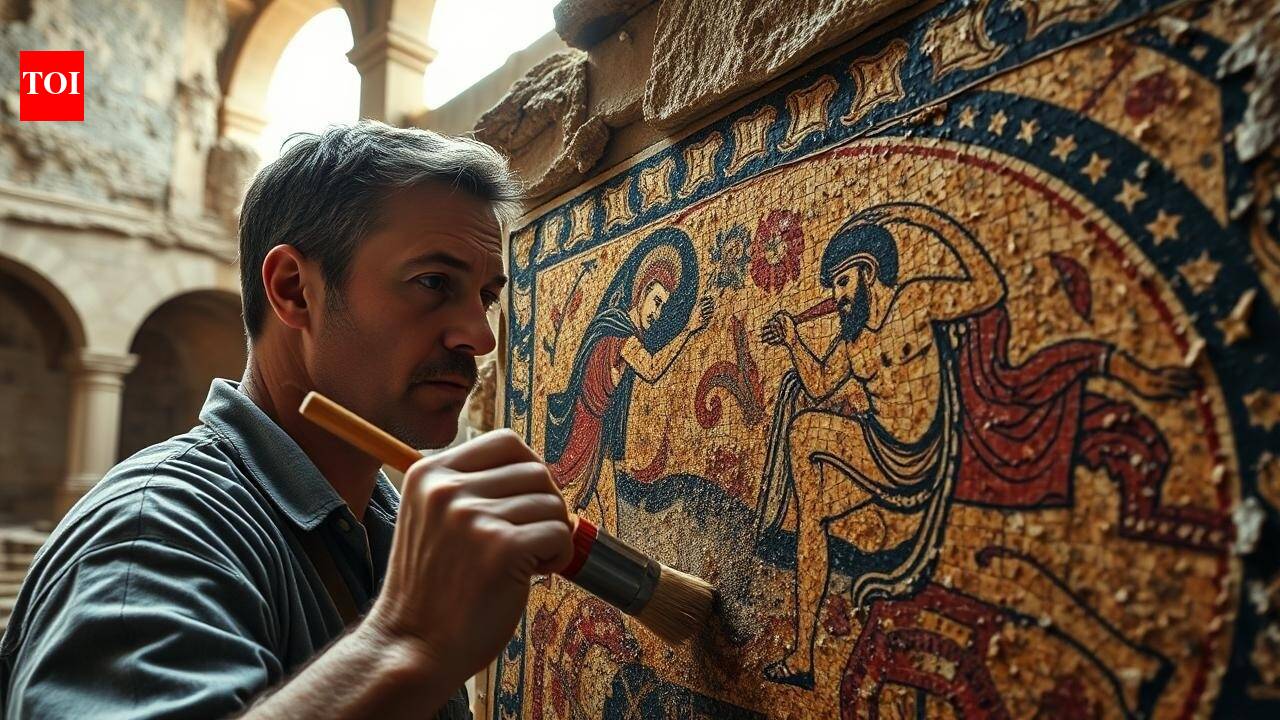
In the quiet countryside of Rutland, United Kingdom, a chance discovery during the height of the 2020 COVID-19 lockdown has brought to light a remarkable piece of ancient history. A farmer's son, out for a walk across a familiar field, spotted unusual fragments scattered on the ground, leading to the unearthing of a 1,600-year-old Roman mosaic. The find, which dates back to around the 4th century, offers a glimpse into the Roman occupation of Britain and has captivated archaeologists and historians alike.
The discovery occurred in early 2020, as much of the world was under strict lockdown measures to curb the spread of the pandemic. With schools closed and daily routines upended, many families turned to local walks for exercise and distraction. According to reports from the Times of India, the young boy, whose identity has not been publicly disclosed in available accounts, was accompanying his father on their family farm in Rutland when he noticed the irregular pieces protruding from the soil. What began as a simple observation quickly escalated into a major archaeological event.
Rutland, a landlocked county in the East Midlands region of England known for its rolling hills and agricultural heritage, has long been a site of historical interest. The area was part of the Roman province of Britannia, settled by invaders from across the English Channel starting in 43 AD. Roman villas, roads, and artifacts have been found throughout the region, but this mosaic stands out for its preservation and artistic detail. Experts believe it may have been part of a larger villa complex, though excavations are ongoing to confirm the full extent of the site.
The fragments the boy spotted were colorful tesserae—small tiles made of stone, glass, or ceramic—that hinted at something extraordinary beneath the surface. His father, a local farmer, immediately recognized the potential significance and contacted authorities. According to the Times of India article, "During the 2020 lockdown, a farmer's son stumbled upon an extraordinary 1,600-year-old Roman mosaic in Rutland, UK, revealing a hidden world of history." This initial report underscores how everyday activities during extraordinary times can lead to profound revelations.
Archaeologists from the Museum of London Archaeology (MOLA) were swiftly called in to assess the site. Over the following months, despite lockdown restrictions, a careful excavation was conducted. The mosaic, measuring approximately 4 meters by 3 meters, features intricate designs typical of late Roman artistry, including geometric patterns and possibly figurative elements depicting mythological scenes. While full details of the imagery remain under study, preliminary assessments suggest it portrays elements of Roman mythology or local deities, providing insight into the cultural fusion of Roman and indigenous British traditions.
Dr. Sophie Jackson, a senior archaeologist with MOLA, described the find as "a window into the daily lives of Roman Britons." In statements reported by various outlets, she noted, "This mosaic is exceptionally well-preserved, given its age, and its discovery in such an unexpected way highlights how history is often right under our feet." The team's work involved meticulous documentation, using ground-penetrating radar to map the surrounding area without disturbing the soil excessively during the pandemic.
The lockdown context added a layer of uniqueness to the story. With travel restricted and public gatherings banned, the excavation proceeded with a small, socially distanced crew. Local residents, including the farmer and his family, played a crucial role in securing the site. The boy's father recounted in interviews how the find brought a sense of excitement to their isolated days. "We were just trying to make the most of being outdoors," he said, according to local reports. "Never did we imagine it would lead to something like this."
Historical context places the mosaic in the late Roman period, around 300-400 AD, when Christianity was beginning to spread but pagan traditions still held sway in rural areas like Rutland. The region was home to several Roman villas, serving as country estates for wealthy administrators. Comparable mosaics have been found at sites like the Fishbourne Roman Palace in West Sussex and the Corinium Museum in Cirencester, but this one in Rutland is notable for its serendipitous discovery by a child.
Experts emphasize the importance of public involvement in archaeology. "Amateur finds like this are invaluable," said Dr. John Pearce, a Roman Britain specialist at King's College London. "They remind us that heritage preservation relies on vigilance from everyone, not just professionals." Pearce added that the mosaic could shed light on trade networks, as the materials used—possibly imported glass and pigments—indicate connections to the broader Roman Empire.
Following the initial unearthing, the artifact was carefully lifted and transported to a conservation lab. There, specialists worked to clean and reassemble the pieces, a process that can take years. According to MOLA reports, the mosaic is now undergoing analysis to determine its exact dating through techniques like thermoluminescence. Public access has been limited due to ongoing conservation, but virtual tours and updates have been shared online to engage the community.
The discovery has sparked interest beyond academic circles. Local officials in Rutland see it as a boost for tourism and education. "This could become a cornerstone of our county's heritage," said Rutland County Council spokesperson Emma Smith. "We're planning exhibits and school programs to bring Roman history alive for the next generation." Funding for further digs has been secured from the Heritage Lottery Fund, aiming to explore the villa site fully by 2025.
Not all perspectives are uniformly optimistic. Some archaeologists caution against overhyping the find without complete context. "While impressive, we must wait for the full excavation to understand its significance," noted Dr. Alice Hanson, an independent historian. "Rutland has yielded Roman artifacts before, but this one's story is still unfolding." Such measured views highlight the iterative nature of archaeological work, where initial excitement gives way to rigorous verification.
On a broader scale, the mosaic's unearthing coincides with renewed interest in Roman Britain amid global reflections on empire and colonialism. Exhibitions at the British Museum and other institutions have drawn parallels between ancient migrations and modern debates. This find, discovered by a young boy during a time of global crisis, symbolizes resilience and the enduring layers of human history.
Looking ahead, plans are underway to display the mosaic at a local museum, potentially the Rutland County Museum in Oakham. Community workshops on archaeology are slated for next year, encouraging more eyes on the landscape. The farmer's family, now guardians of a slice of antiquity, continue their daily work on the land, forever changed by that lockdown stroll.
As the world emerges from the shadows of 2020, stories like this remind us of the unexpected treasures hidden in plain sight. The Roman mosaic from Rutland not only enriches our understanding of the past but also underscores the power of curiosity in uncovering it.