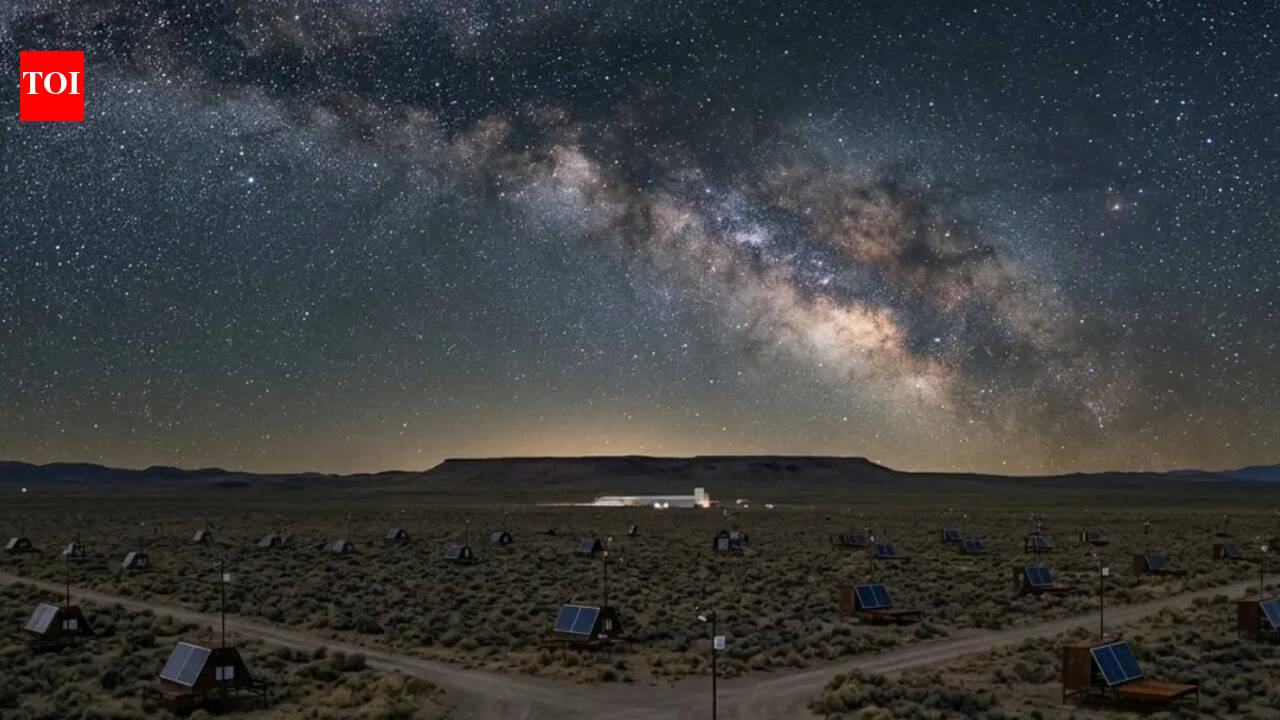
In the vast expanse of the Utah desert, where the night sky stretches endlessly, scientists stumbled upon one of the most enigmatic signals in cosmic history back in 2021. Researchers operating the Telescope Array, a sprawling network of detectors spread across 700 square kilometers in Millard County, captured a burst of energy that defied explanation. Dubbed the Amaterasu particle after the Japanese sun goddess, this ultra-high-energy cosmic ray arrived with a staggering 2.4 x 10^20 electron volts (eV) of energy—making it the second most powerful ever recorded, surpassed only by the legendary Oh-My-God particle detected three decades earlier.
The detection occurred on May 27, 2021, when the particle slammed into Earth's atmosphere, triggering a shower of secondary particles that lit up the array's sensors. According to reports from the Telescope Array collaboration, the event was unlike anything observed in recent years. "This particle is an absolute monster," said John Matthews, a physicist at the University of Utah and co-spokesperson for the project, in a statement released shortly after the find. The energy level, equivalent to a baseball thrown at 100 kilometers per hour, raised immediate questions about its origins, as no known astrophysical process within our galaxy or nearby universe could account for such ferocity.
Cosmic rays, those invisible bullets from space, have puzzled astronomers since their discovery over a century ago. First identified in 1912 by Victor Hess during a balloon flight, they range from low-energy protons ejected by the sun to the ultra-high-energy variety that pack the punch of Amaterasu. Most cosmic rays originate from supernovae or active galactic nuclei, but particles exceeding the GZK cutoff—a theoretical limit of about 5 x 10^19 eV imposed by interactions with cosmic microwave background radiation—should be exceedingly rare. The Oh-My-God particle, detected in 1991 by the Fly's Eye detector also in Utah, clocked in at 3 x 10^20 eV and similarly baffled scientists, earning its name from the sheer astonishment it provoked.
The Amaterasu event echoed that sense of wonder but added a layer of modern intrigue. Unlike lower-energy rays, which can often be traced to sources like distant quasars, Amaterasu's trajectory pointed to an empty patch of sky in the constellation Aquarius. "We looked in the direction it came from, and there's nothing there—no bright stars, no galaxies, nothing," explained Toshihiro Fujii, another Telescope Array researcher, in an interview with scientific outlets following the detection. This untraceability has fueled speculation, with some experts suggesting the particle might have traveled from beyond our local supercluster, defying the GZK limit through unknown mechanisms.
The Telescope Array, established in 2008, is designed precisely to hunt these cosmic enigmas. Comprising 507 detector stations that measure air showers—cascades of particles produced when cosmic rays collide with atmospheric nuclei—it has logged thousands of events since inception. Yet Amaterasu stood out for its intensity. According to a paper published in the journal Science in November 2023, the particle's energy was calculated based on the fluorescence light emitted by the air shower, a method refined over years of observation. The array's location in the arid West Desert of Utah was chosen for its low light pollution and stable weather, allowing uninterrupted data collection under the stars.
Historical context underscores the rarity of such detections. The Oh-My-God particle, formally known as the 1991 event, prompted a reevaluation of cosmic ray physics and led to the construction of larger arrays like the Pierre Auger Observatory in Argentina. That southern hemisphere facility, operational since 2004, has detected over 30 ultra-high-energy cosmic rays but none matching Amaterasu's power. "Events like this remind us how little we know about the universe's most extreme accelerators," noted Alan Watson, emeritus professor at the University of Leeds and a pioneer in cosmic ray research, in a commentary on the find. Watson, who contributed to early Fly's Eye work, highlighted how Amaterasu challenges models of particle acceleration in black hole environments or gamma-ray bursts.
Not all perspectives align on the implications. While some astronomers point to extragalactic origins, others propose more exotic explanations. A minority view, floated in theoretical physics circles, suggests Amaterasu could be evidence of new physics beyond the Standard Model—perhaps top-down mechanisms where supermassive particles decay into high-energy protons. "It's possible we're seeing signatures of dark matter annihilation or even string theory effects," posited theoretical physicist Jonathan Feng of the University of California, Irvine, in a 2023 discussion panel. However, Feng cautioned that such ideas remain speculative, pending more data. Mainstream researchers, including the Telescope Array team, emphasize that conventional astrophysical sources, though strained, are the leading hypothesis.
The detection process itself was a feat of technology and timing. On that May evening, the array's counters registered an air shower spanning several kilometers, with the particle's path reconstructed through timing differences across stations. Data analysis, involving machine learning algorithms to filter noise, confirmed the energy within weeks. "The precision of our instruments allowed us to pinpoint this event with confidence," stated Matthews in the collaboration's announcement. Cross-verification with satellite data from NASA's Fermi Gamma-ray Space Telescope showed no corresponding bursts, further deepening the mystery.
Utah's role in cosmic ray science dates back to the 1960s with early balloon experiments, but the state's vast, remote landscapes make it ideal for ground-based arrays. The Telescope Array benefits from collaborations with institutions like the University of Tokyo and Japan's Institute for Cosmic Ray Research, reflecting international efforts to map the cosmic ray sky. In 2021 alone, the array detected over 100 ultra-high-energy events, but Amaterasu's profile—its isolated arrival and immense power—elevated it to headline status in scientific journals worldwide.
Beyond the science, the discovery carries broader implications for particle physics. Experiments like the Large Hadron Collider at CERN simulate cosmic ray collisions at energies far below Amaterasu's, underscoring the limits of terrestrial accelerators. "These natural events give us free data that we couldn't replicate in a lab," observed R. J. Wilkes, a physicist at the University of Washington involved in related neutrino detection. Wilkes noted that understanding Amaterasu could inform searches for cosmic neutrinos, which might reveal the same hidden accelerators.
Challenges persist in tracing such particles. The galactic magnetic field scatters their paths, making back-tracing akin to following a bullet through fog. Ongoing upgrades to the Telescope Array, including expanded fluorescence detectors, aim to capture more events for statistical power. Meanwhile, the Pierre Auger Observatory reported in 2022 a cluster of high-energy rays from a similar sky region, though not as energetic as Amaterasu. "If we find more like this, we might map a new population of sources," said Auger spokesperson Bruce Dawson in a recent update.
As researchers delve deeper, the Amaterasu mystery encapsulates humanity's quest to unravel the universe's violent underbelly. Detected amid a year marked by global challenges, including the ongoing pandemic, it offered a reminder of cosmic scales dwarfing earthly concerns. The Telescope Array team continues monitoring, with plans for a 2024 data release that could include follow-up events. "We're just scratching the surface," Fujii remarked, encapsulating the blend of humility and excitement driving the field.
In the end, Amaterasu stands as a beacon of the unknown, urging scientists to push boundaries. Whether born from a distant blazar or something more profound, its legacy will shape future explorations—from enhanced arrays to space-based detectors. For now, it remains one of the strongest cosmic ray mysteries ever recorded, a silent testament to the universe's enduring secrets.