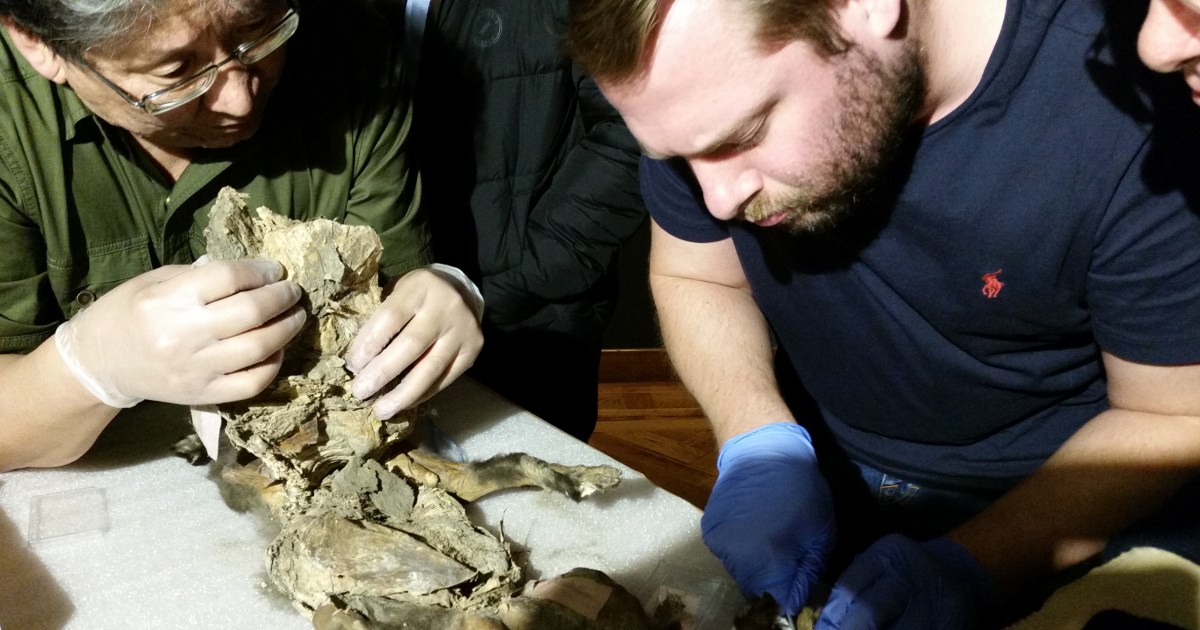
APPLETON, Wis. — Scientists have unlocked a frozen snapshot of the Ice Age by peering into the stomach of a mummified wolf pup discovered in the Siberian permafrost, where they found preserved DNA from a woolly rhinoceros that roamed more than 14,000 years ago.
The remarkable find, detailed in a study published Wednesday in the journal Genome Biology and Evolution, marks the first time researchers have reconstructed an entire genome from an Ice Age animal consumed by another Ice Age predator. The wolf pup, one of two ancient females unearthed in Russia's remote tundra, had ingested a chunk of meat from the long-extinct woolly rhinoceros, a massive, shaggy-coated beast akin to today's white rhinoceros but adapted to frigid Pleistocene conditions.
"This is the first time an entire genome has been reconstructed from an Ice Age animal that was inside another Ice Age animal," said Camilo Chacón-Duque, an evolutionary biologist at Uppsala University in Sweden and a co-author of the study. "It’s a high quality, high resolution genome."
The woolly rhinoceros in question met its end around 14,400 years ago, mere centuries before the species vanished from the fossil record, providing what Chacón-Duque described as "by far the youngest woolly rhinoceros that has been sequenced — with youngest, I mean the closest to the extinction of the species." This timing offers a crucial glimpse into the genetic health of the population on the brink of oblivion.
The two wolf pups, dubbed the "Tumat puppies" after the nearby Tumat River, were discovered by ivory hunters scouring the Siberian landscape for mammoth tusks. The first pup was found about 15 years ago, with the second surfacing four years later, just six feet away from its companion. Both were remarkably preserved, their tiny bodies frozen in time, still bearing milk teeth that indicated they were only about nine weeks old at the time of death.
According to a previous study published last year in Quaternary Research, the pups were likely littermates, sharing certain DNA traits that pointed to a close familial bond. Researchers, including Anne Kathrine Wiborg Runge, a co-author on that paper, suggested that the puppies perished in a sudden catastrophe, possibly a permafrost thaw triggering a landslide that buried them in ice and snow, or the collapse of their den.
"They died at a fairly young age — at about nine weeks," Runge said. "They still had their milk teeth."
Their discovery site, near an ancient human butchering ground where woolly mammoths had been processed, initially raised questions about whether the pups might have been early domesticated dogs scavenging human leftovers. However, no traces of mammoth DNA appeared in their stomachs, ruling out that connection. Instead, analysis revealed that one pup's final meal included flesh from the woolly rhinoceros, while the other had consumed a bird — evidenced by feathers preserved in the permafrost — along with some rhinoceros meat.
Nathan Wales, a senior lecturer in archaeology at the University of York in the United Kingdom and a co-author on the earlier wolf study, described the preservation process as akin to an instant deep freeze. "They’re getting immediately buried and frozen in a freezer — a deep freeze — for 14,000 years," Wales said.
In the new research, Chacón-Duque focused on sequencing the DNA from a particularly resilient piece of rhinoceros flesh found in the first pup's stomach. "This piece has been lying around essentially in the stomach for many, many years," Runge noted. "It’s just incredible."
Complete woolly rhinoceros genomes are scarce, but the team compared their sequence to two others from specimens dating back 18,000 and 49,000 years. The results painted a picture of a robust population: no signs of inbreeding or deleterious mutations that might have signaled impending doom.
"They’re not finding signs that the population is just collapsing and that’s odd, given that the species goes extinct," said Wales, who specializes in ancient DNA but was not involved in the genome study.
This genetic vitality has reignited debates among evolutionary biologists about what felled the woolly rhinoceros. For decades, experts have weighed human hunting against climate change as the primary culprit. The new data tilts toward environmental factors, suggesting the species was thriving genetically until a rapid warming event disrupted its cold-adapted world.
Just a few hundred years after this rhinoceros's death, the Northern Hemisphere entered a sudden warming phase that hastened the end of the Ice Age. "All these things will act in synergy to probably make the final demise of the species," Chacón-Duque explained. "But we definitely think that climate change is the key factor." He added that the thaw might have enabled human expansion into the rhinoceros's habitat, potentially introducing diseases, but emphasized climate as the dominant force.
Mick Westbury, an associate professor of evolutionary biology at the Technical University of Denmark who has studied ancient rhinos but did not participate in this research, found the climate change hypothesis plausible. However, he cautioned that ancient DNA interpretations can be tricky, and genetic health might not reveal underlying vulnerabilities that manifest over generations.
"Genomics alone sometimes doesn’t sell the whole picture," Westbury said. He noted that the woolly rhinoceros could have been on a precarious path even if this individual's genes appeared fine.
The woolly rhinoceros, with its two horns and thick fur suited for subzero temperatures, once roamed vast swaths of Eurasia, from Spain to Korea, during the Pleistocene epoch, which spanned from about 2.6 million to 11,700 years ago. Standing up to 6 feet at the shoulder and weighing as much as 6,000 pounds, it was a herbivore that grazed on tough tundra grasses. Fossil evidence shows the species persisted through multiple glacial cycles but couldn't survive the post-Ice Age thaw, which transformed grasslands into forests and bogs unsuited to its needs.
Human impact, too, looms large in extinction theories. Archaeological sites reveal that early hunters targeted megafauna like mammoths and rhinos for their hides, meat, and horns. Yet the absence of genetic decline in this late specimen challenges the idea of overhunting as the sole driver, supporting a combined stressor model where warming habitats and encroaching humans proved fatal.
The Tumat puppies themselves offer broader insights into Ice Age ecology. As wild wolves rather than dogs, they highlight the predatory dynamics of the mammoth steppe, a now-lost landscape of grasses and herbs that sustained herds of massive herbivores. The pups' youth and proximity suggest a family unit caught in an environmental mishap, preserved by the very permafrost that is now melting due to modern climate change, ironically exposing more such treasures — and threats.
Runge and her colleagues' earlier work on the wolves underscored the pups' vulnerability: small, dependent on their mother, and ill-equipped for disaster. The lack of scavenger marks on their bodies indicates rapid burial, sealing them away from decay.
As permafrost thaws across Siberia today, scientists worry about the release of ancient pathogens and methane, but discoveries like the Tumat puppies provide invaluable data. The sequenced rhinoceros genome, deposited in public databases, will aid future research into de-extinction efforts or understanding adaptations in modern rhinos facing habitat loss.
Westbury drew parallels to contemporary conservation challenges. "The woolly rhino, according to this result, didn’t look terribly vulnerable to extinction," he said. "Just because a living species on the surface looks OK genetically doesn’t mean it’s not vulnerable."
This lesson resonates amid the sixth mass extinction, driven largely by human-induced climate shifts. Species like the northern white rhino, down to just two individuals, echo the woolly rhino's fate, prompting calls for urgent action on emissions and habitat protection.
Chacón-Duque and his team plan further analyses of the wolf DNA to explore their lineage and the broader predator-prey web of the Ice Age. Meanwhile, the Siberian permafrost continues to yield secrets, from saber-toothed cats to human artifacts, reminding us of a world profoundly altered — and the urgency of preserving what remains.
The study authors hope their work will inform not just paleontology but policy, underscoring how abrupt climate shifts can topple even seemingly resilient giants. As Wales put it, the puppies' story is one of preservation against the odds, a frozen testament to a time when the earth warmed once before, with consequences that reshaped life on the planet.