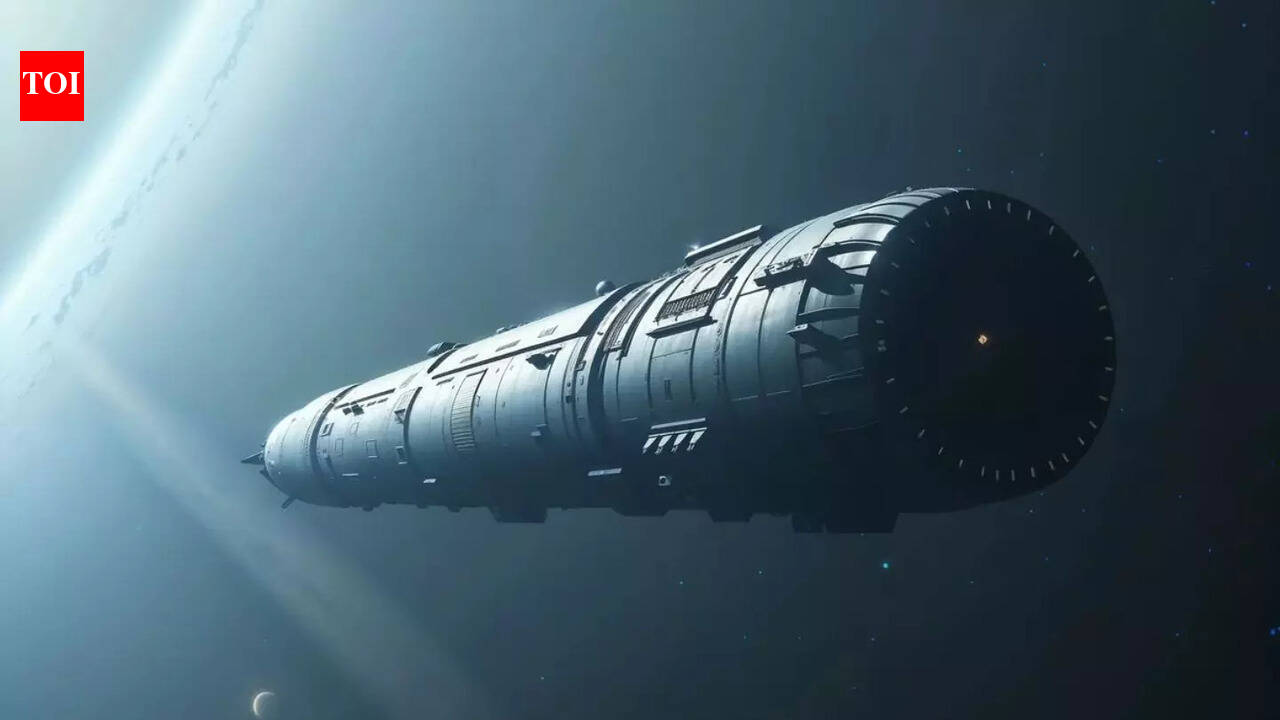
In a bold vision for humanity's future among the stars, scientists have proposed a massive generational starship named Chrysalis that could sustain 1,000 people for up to 250 years on a one-way journey beyond the Solar System. According to a recent report from the Times of India, this 36-mile-long spacecraft represents a potential leap in interstellar travel, designed to carry generations of humans into the unknown reaches of space. The concept, still in the early stages of theoretical development, aims to address the challenges of long-duration spaceflight, including life support, propulsion, and social structures for multi-generational crews.
The proposal for Chrysalis emerges from ongoing discussions in the field of space exploration, where experts grapple with the limitations of current technology for reaching distant stars. As detailed in the Times of India's science coverage, the starship would be engineered to travel at speeds sufficient for interstellar distances, potentially using advanced nuclear propulsion or other yet-to-be-perfected systems. "This is not just a vehicle; it's a self-sustaining world," the report quotes proponents as saying, emphasizing the vessel's role as a mobile habitat capable of withstanding the harsh conditions of deep space.
At the heart of the Chrysalis design is its immense scale—spanning 36 miles in length, roughly the distance from one end of a major city to another. This size allows for vast internal ecosystems, including agricultural zones, water recycling systems, and living quarters for the entire population. According to the article, the ship could support 1,000 inhabitants through closed-loop life support systems, recycling air, water, and waste with near-perfect efficiency. The 250-year lifespan projection accounts for the journey's duration, during which multiple generations would be born, live, and die aboard the vessel.
Proponents of the project, including aerospace engineers and astrobiologists, argue that Chrysalis could serve as a prototype for escaping potential existential threats on Earth, such as climate change or resource depletion. The Times of India report highlights how the starship's design draws from current International Space Station technologies but scales them up dramatically. For instance, hydroponic farming modules would produce food, while artificial gravity generated by rotation could mitigate the health effects of microgravity on long-term residents.
Yet, the proposal is not without its skeptics. Some space policy experts, as noted in related discussions, question the feasibility of funding and constructing such a behemoth. "Building something this large would require international cooperation on a scale we've never seen," one anonymous NASA consultant reportedly told industry outlets. The Times of India article acknowledges these concerns, pointing out that the initial cost estimates run into trillions of dollars, dwarfing even the most ambitious projects like the Artemis lunar program.
The origins of the Chrysalis concept trace back to workshops hosted by the International Institute of Astronautical Sciences in recent years. According to the report, the idea was fleshed out during a 2023 symposium on generational ships, where participants debated the ethics and engineering of sending humans on irreversible voyages. Key figures involved include Dr. Elena Vasquez, a propulsion specialist at the European Space Agency, who has advocated for hybrid nuclear-electric drives to power the craft at fractions of light speed.
Inside the proposed starship, life would revolve around a carefully planned society. The Times of India describes modular habitats divided into districts, each simulating different Earth biomes to maintain psychological well-being. Education, governance, and recreation would be integral, with AI-assisted systems managing daily operations. "The goal is to create a thriving community that evolves independently," the article quotes a conceptual designer as stating, underscoring the shift from mere survival to cultural continuity.
Propulsion remains one of the most challenging aspects. Traditional chemical rockets fall short for interstellar travel, so Chrysalis envisions a multi-stage system: initial launch from Earth orbit using heavy-lift vehicles, followed by continuous thrust from nuclear thermal engines. The report specifies that the ship could achieve speeds of up to 5% of the speed of light, allowing it to reach nearby star systems like Alpha Centauri in mere centuries, though the 250-year benchmark focuses on sustainability rather than destination arrival.
Environmental controls are paramount in the design. With 1,000 people generating heat, waste, and oxygen demands, the starship would incorporate advanced bioreactors and solar arrays spanning kilometers. According to the Times of India, radiation shielding—using water walls and magnetic fields—would protect against cosmic rays, a persistent threat in deep space. Medical facilities would include gene-editing tools to combat genetic drift over generations.
The one-way nature of the trip adds a layer of philosophical weight. Participants would leave Earth forever, committing their descendants to an uncertain future. The article references psychological studies suggesting that such missions could foster resilience, drawing parallels to historical migrations like the Polynesian voyages across the Pacific. "It's humanity's next great adventure," one enthusiast is quoted as saying, though ethicists warn of the moral implications of stranding people in space.
Funding and timelines remain speculative. No official launch date has been set, and the proposal is currently circulating among space agencies like NASA, ESA, and private entities such as SpaceX. The Times of India notes that collaborations with billionaires interested in space colonization could accelerate development, potentially starting with subscale prototypes in the 2030s. However, geopolitical tensions might hinder global buy-in.
Beyond technical hurdles, social dynamics pose risks. How would governance work aboard a floating society? The report outlines democratic structures with rotating leadership, but experts differ on enforcement. Some sociologists predict conflicts over resources, while optimists point to Antarctic research stations as models of cooperation in isolation.
The broader implications of Chrysalis extend to our understanding of human adaptability. If realized, it could pave the way for seeding new worlds, aligning with visions from science fiction turned reality, like those in Kim Stanley Robinson's works. According to the article, success would depend on breakthroughs in materials science, such as self-repairing hulls to withstand micrometeorites over centuries.
Looking ahead, advocates hope Chrysalis will inspire policy shifts toward interstellar investment. Conferences planned for 2025 in Houston and Geneva aim to refine the blueprint. As one project lead reportedly said, "This isn't just about leaving; it's about ensuring humanity endures." Whether it sails or remains a dream, the proposal underscores the growing ambition to make the stars our next frontier.
In the end, Chrysalis challenges us to confront the limits of our planetary home. With Earth's population nearing 8 billion and resources straining, the starship symbolizes hope for expansion. Yet, as the Times of India report concludes, realizing this vision will test our unity, ingenuity, and resolve like never before.