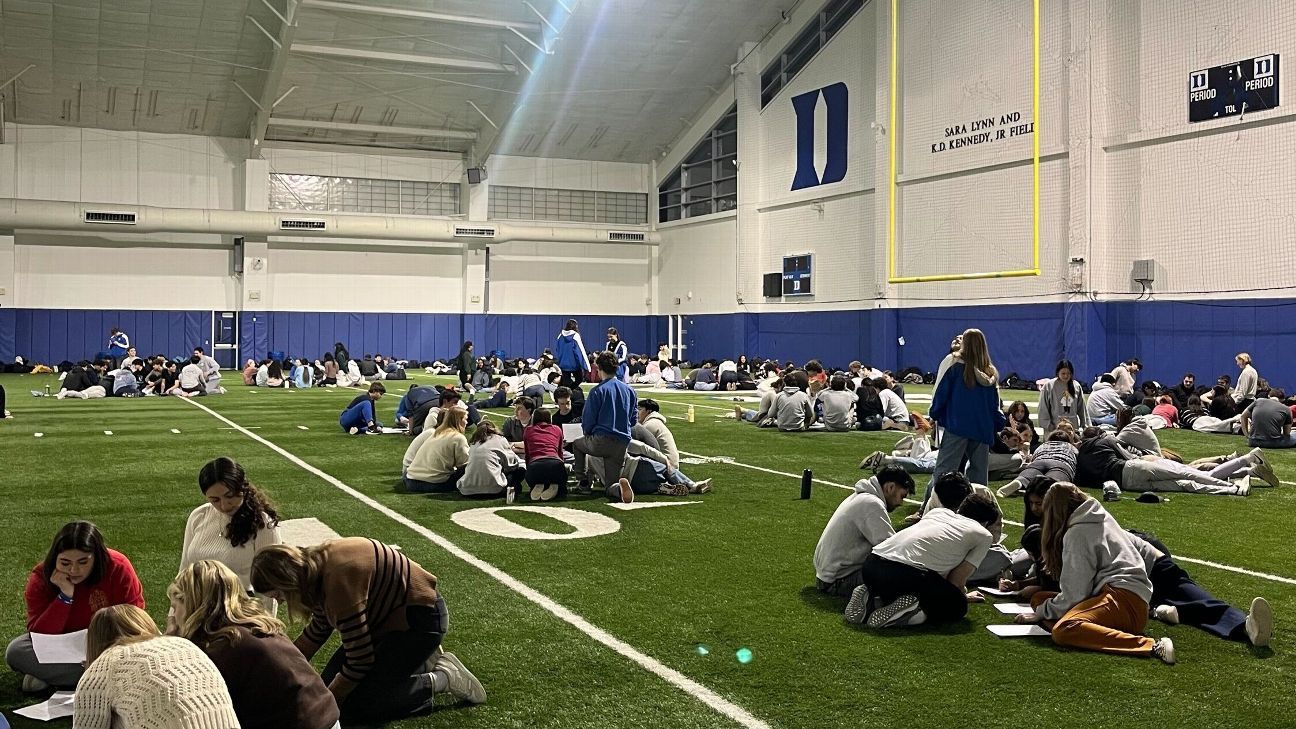
On February 23, hundreds of Duke University students gathered on the turf of Pascal Field House in Durham, North Carolina, to tackle what might be the most unconventional exam of their college careers. Spread out in groups under the open sky, they pored over an 80-question test that wouldn't affect their GPAs but could determine their prime spots in the front rows of the Cameron Crazies student section at Cameron Indoor Stadium. This was the annual Krzyzewskiville ordering test, a grueling rite of passage for the most devoted fans aiming to secure black tent status in the legendary tenting village known as Krzyzewskiville.
Krzyzewskiville, a tradition dating back to the mid-to-late 1980s, transforms the area outside Cameron Indoor into a makeshift campground during basketball season, where students camp out for weeks to earn seats for big games. Black tents represent the pinnacle of commitment, requiring two members on duty during the day and 10 at night throughout the tenting period. In return, these tents vie for the best positions in line for the final home game against rival North Carolina, scheduled for Saturday. Positioning is decided by points accumulated through attendance at other Duke sporting events, spirit awards for creative tent names and decorations, and performance on the ordering test.
The test, now in its less-than-a-decade history, serves as a key evaluator of fandom depth. "We really want to reward the most passionate students with the best spots in the student section," said Aidan McCarthy, co-head Line Monitor, the administrative body overseeing Krzyzewskiville. "So that means those that are willing to study up, know their Duke basketball history, know their team super well, we think this test is a good evaluation of that and it helps [those students] get a better spot in line."
This year's exam spanned 20 pages and six sections: awards and achievements, Coach Scheyer, history and general knowledge, the brotherhood, the 2025-26 season, and miscellaneous. Questions ranged from staples like Duke's career leaders in statistics and National Player of the Year winners to hyper-specific queries that tested obscure knowledge. For example, one question asked: "In the Sweet 16 episode of the Neal Begovich Big Dance Exclusive last year, what was the first quote Kon Knueppel used when impersonating Scheyer?" According to line monitors, the median score on that page was just 6.67%, the lowest of the test, with no tent answering it correctly.
Creating such a challenging exam requires secrecy and vigilance against cheating. Only four line monitors—the two co-heads and two co-vice presidents—draft the questions, keeping them under wraps until test day. During the hour-long session, proctors patrol the field, collecting phones, Apple Watches, and other devices into plastic bags. "We ask people with long hair to maybe put it behind their ears so that we can see that they're not using any earpieces," McCarthy explained. There's even a plan for detecting Bluetooth devices.
Social media often inspires the trickiest questions, with line monitors scouring online content for timely material. One query focused on freshman Isaiah Evans' burner Instagram account: "Who does he follow on that account?" By the time the test was finalized, Evans followed only two people, a change that occurred hours before distribution. "We ended up reviewing our test, making sure everything looks good before we actually send it out, and we double-check and suddenly notice that he's only following two people," McCarthy said. "And we were wondering, are tenters going to know this? Are they going to know that it changed on a whim just hours before the test?"
Preparation is possible but demanding. Past tests provide clues, as formats repeat for fill-in-the-blank tables and statistical queries. Ryan Su, a senior biomedical engineering major in the tent "Pirates of the Sarribbean," described their 20-page study guide, which assigned topics to members for comprehensive coverage. "It's harder in the sense [that] it is more random, but I definitely enjoy it way more than studying for my normal classes," said Raul Ng Tang, the tent's captain and a senior electrical and computer engineering major.
The test's game theory element adds tension: incorrect answers deduct points, discouraging guesses. Daniel Chang, another "Pirates" member, recalled skipping a question about which side of the court Cam Reddish hit a game-winner in December 2019, despite familiarity with the video, due to uncertainty. Other examples included: "Duke broke a Guinness World Record last week for the largest game of knockout. Who sponsored the event? How many people participated? Who held the previous record? What was the previous record?" worth four points total.
Scores reflected the difficulty. The median among black tenters was 43.2%, down from 58.01% in 2023-24 and 51.99% in 2024-25, even as top scores rose—from 77.13% to 78.45% to a record 79.1% this year. "There's some tents that have clearly really locked in before this, studied what they need to know and know a lot," said co-head Line Monitor Claire Raney. "There's also a bunch of tents that just don't really care to study and are just happy to get into the game at any point in the line, so you see some lower scores there. And then I think there's a good amount of tents that just study what they know will be on it and then kind of just hope for the best on the other sections."
"Pirates of the Sarribben" scored 72%, second-highest, positioning them well for pirate-themed front-row antics against North Carolina. Co-vice president of tenting Carlie Scheer noted that while random questions—like where Cam Boozer's girlfriend works (answer: her Instagram bio)—catch many off guard, preparation covers much ground. "We follow a similar question format," Scheer said. "Obviously you're not going to be prepared for the random questions we ask... but the [fill in the blank] tables, questions like that, you can definitely prepare for a lot of the questions on the test if you just look at previous ones."
Senior Ryan Su paused at Question 68: "Which player scored the 67th point in the game vs. Texas Tech?" "I don't know if anyone can get [that question]," he said.
To gauge the test's toughness, ESPN's Ryan McGee, a Tobacco Road native, attempted it without prior study while flying from Bristol, Connecticut. Waiving the penalty for wrong answers, McGee scored 32.2%—below the median but respectable for an outsider. He excelled in history sections, citing his 1980s and '90s Triangle upbringing, but faltered on current details like "What is the name of the gym that Cam Boozer's girlfriend works at?"
"I would have foolishly guessed that I would have known, like, 80%, because I thought perhaps it would lean more into history," McGee said. "When we got to the current stuff that only a student would know... I could feel myself losing the edge. But also, I'm betting not a lot of current students know who Mike Gminski and Jeff Mullins are." He predicted struggles in the 2025-26 season section, joking about post-game Fireball bottles obscuring memories of players like Maliq Brown.
McGee's experience underscores the test's blend of eras: from program legends to freshman social media quirks. For future takers, advice varies. Chang suggested dividing content by specialties, Ng Tang emphasized loving Duke basketball, and co-vice president Afraaz Malick urged: "I would start early." Scheer highlighted reviewing prior tests for recurring themes.
As Duke prepares for its rivalry clash with North Carolina, the ordering test's outcomes will shape the Cameron Crazies' front lines, amplifying the electric atmosphere inside the 9,314-seat arena. With black tents earning their spots through such devotion, Krzyzewskiville continues to embody Duke's basketball culture—intense, historical, and unyieldingly passionate. The results not only reward study but foster a community where fandom is both competition and celebration, ensuring the Blue Devils' student section remains one of college basketball's most formidable forces.