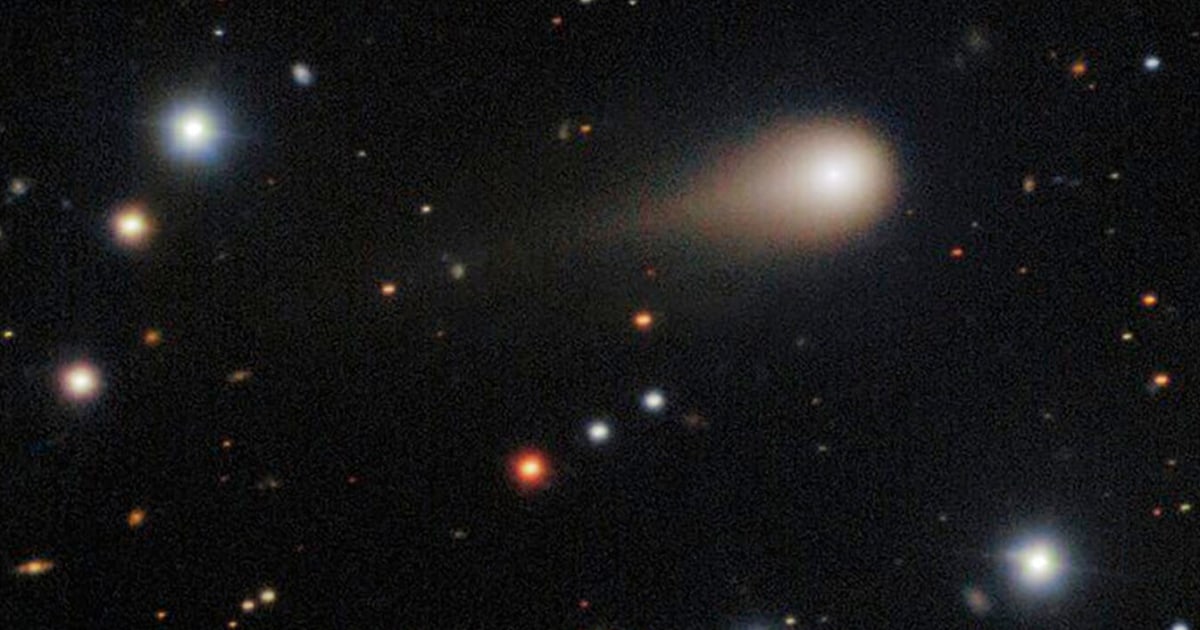
A mysterious interstellar comet known as 3I/ATLAS has captivated astronomers and space enthusiasts as it makes a rare journey through our solar system, leaving behind a trail of stunning images captured by spacecraft and telescopes from around the world.
Discovered in July by the Asteroid Terrestrial-Impact Last Alert System (ATLAS) in Rio Hurtado, Chile, the comet is only the third confirmed object to originate from outside our solar system, following the enigmatic cigar-shaped 'Oumuamua in 2017 and comet 2I/Borisov in 2019. At the time of its detection, 3I/ATLAS was approximately 420 million miles from Earth, prompting immediate interest from global space agencies eager to study this galactic visitor.
The ATLAS system, a NASA-funded network of telescopes located in Hawaii, Chile, and South Africa, is primarily designed to detect potentially hazardous asteroids. However, its vigilance uncovered this interstellar wanderer, which has since been tracked meticulously as it hurtles toward the inner solar system. The comet reached its closest approach to the sun, or perihelion, at the end of October, and it is scheduled to pass by Earth on December 19, maintaining a safe distance of about 170 million miles.
Early observations provided intriguing insights into the comet's composition. From August 7 to August 15, NASA's SPHEREx observatory—short for Spectro-Photometer for the History of the Universe, Epoch of Reionization and Ices Explorer—studied 3I/ATLAS when it was roughly 290 million miles from the sun. According to NASA reports, these observations revealed the comet's coma, a hazy envelope of gas and dust surrounding its icy nucleus, which contained an abundance of water ice and carbon dioxide, chemically similar to comets native to our solar system.
In late August, the Gemini South telescope in Chile captured some of the most detailed images available at the time, released in September. These photos depicted an extended coma of dust and gas around the nucleus, with astronomers noting that the comet appeared increasingly active as it neared the sun. The images showed a lengthy tail that seemed more elongated than in prior sightings, suggesting heightened outgassing from the warming nucleus.
By October, the European Space Agency (ESA) contributed significant data through its ExoMars Trace Gas Orbiter, a joint mission with Russia's Federal Space Agency. The spacecraft observed the comet for about a week starting on October 1, when 3I/ATLAS was approximately 18.6 million miles away. The resulting images portrayed the comet as a fuzzy white dot against a starry backdrop, offering a clear view of its motion through space.
NASA's contributions have been equally robust, with a series of photos released after delays due to a government shutdown. These images, taken from late September through mid-October by various missions, generally showed the comet as an illuminated dot, though some captured its faint, elongated tail as a smudge. Among the observers were the Polarimeter to Unify the Corona and Heliosphere (PUNCH) satellites, the Solar and Heliospheric Observatory (SOHO), the Lucy space probe, the Mars Atmosphere and Volatile EvolutioN (MAVEN) mission, and even the Perseverance rover on Mars' surface.
More recently, on Thursday, NASA's Hubble Space Telescope provided fresh glimpses of the comet when it was about 178 million miles from Earth. Hubble's instruments recorded 3I/ATLAS as a luminous point amid streaking background stars, highlighting its rapid movement. NASA stated that it plans to collect additional data in the coming months as the comet exits the solar system, aiming to deepen understanding of its trajectory and properties.
The ESA's Jupiter Icy Moons Explorer (Juice) spacecraft, en route to study Jupiter and its large moons, also encountered the comet closely. Juice flew within about 41 million miles of 3I/ATLAS on November 4, capturing images that revealed a glowing halo around the coma and suggested the presence of two distinct tails. The plasma tail, composed of ionized gas, extended toward the top of the frame, while the dust tail, made of gas, dust, and tiny particles, stretched to the lower left.
These dual tails are a common feature in active comets, but their visibility in an interstellar object adds to the fascination. The ESA anticipates retrieving more data from Juice's instruments in February, which could provide further details on the comet's behavior and composition as it recedes from the sun.
The influx of images has built a comprehensive visual record of 3I/ATLAS's passage, fostering widespread intrigue despite assurances from scientists that there is no evidence of alien technology, countering speculative online theories. This comet's visit underscores the rarity of interstellar objects in our solar system, with each discovery offering a window into the broader galaxy.
Background on previous interstellar visitors provides context for the excitement surrounding 3I/ATLAS. 'Oumuamua, detected in 2017, puzzled researchers with its unusual shape and non-gravitational acceleration, leading to debates about its origins—possibly a fragment from a distant star system or even a natural hydrogen iceberg, according to various studies. Comet 2I/Borisov, spotted in 2019, was more comet-like, exhibiting typical outgassing and a composition rich in familiar volatiles.
In comparison, 3I/ATLAS aligns more closely with Borisov in its chemistry, as per SPHEREx data, suggesting that interstellar comets may share formation processes with those in our own solar system. Yet, its path—hyperbolic orbit unbound by the sun's gravity—confirms its extraterrestrial origin, originating from the vast Oort Cloud of another star or interstellar space.
Astronomers emphasize the scientific value of these observations. The data from multiple missions not only refines models of comet evolution but also enhances detection capabilities for future interstellar intruders. As 3I/ATLAS continues its outbound journey, passing Mars and heading toward the outer solar system, it serves as a reminder of our cosmic neighborhood's interconnectedness with the galaxy at large.
Looking ahead, space agencies like NASA and ESA plan continued monitoring, potentially yielding discoveries about the comet's size—estimated at a few kilometers across—and its potential to shed light on the early universe's chemistry. While the comet poses no threat, its passage has united global efforts in a shared pursuit of knowledge, with images continuing to inspire public wonder about the stars beyond our own.