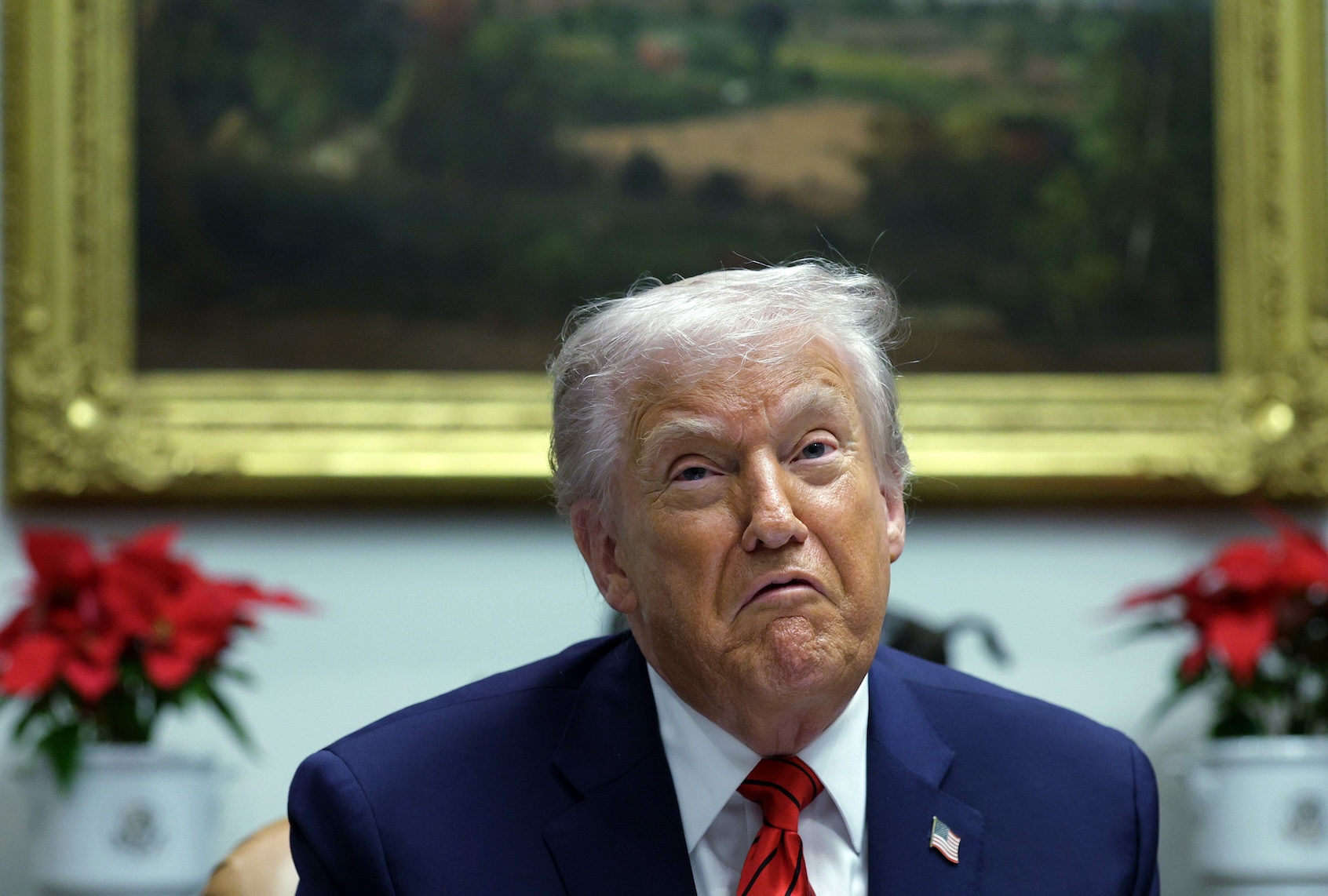
WASHINGTON — President Donald Trump's recent address to the nation on the ongoing war with Iran drew widespread attention last week, but observers noted a subdued tone in his delivery as he promised an end to the conflict "very shortly." The speech, delivered amid escalating tensions in the Strait of Hormuz and rising oil prices, highlighted the administration's challenges in maintaining public support for military actions that began earlier this year. According to reports, Trump's appearance, marked by heavy makeup, conveyed fatigue as he alternated between assurances of victory and threats of further escalation against Iran.
The address came at the end of a tumultuous week for the president. On the morning of the speech, Trump attended oral arguments at the Supreme Court in Washington, D.C., where the court heard a case challenging birthright citizenship under the 14th Amendment. The president's presence was seen by some as an attempt to influence the justices, though he reportedly left the courtroom after just 13 minutes of arguments defending the citizenship guarantee. Legal analysts noted that even the court's conservative majority appeared skeptical of overturning the long-standing constitutional provision, which has been in place since 1868.
Following the speech, oil prices surged, with Brent crude rising more than 5% in after-hours trading, according to market data from the New York Mercantile Exchange. Investors expressed growing concerns over disruptions in the Strait of Hormuz, a critical chokepoint for global oil shipments. The stock market reflected similar unease, with the Dow Jones Industrial Average dropping 300 points the next day. These economic ripples were attributed by analysts to the prolonged conflict, which Trump initiated in January 2026 with airstrikes on Iranian nuclear facilities.
In a move that caught Washington by surprise, Trump fired Attorney General Pam Bondi on Thursday, April 3, 2026. White House officials cited internal disagreements, though sources close to the administration indicated frustration over Bondi's failure to pursue high-profile indictments against critics such as Sen. Adam Schiff, D-Calif., New York Attorney General Letitia James, and former FBI Director James Comey. Bondi had opened investigations into these figures, but federal courts repeatedly dismissed cases for lack of evidence, adhering to due process requirements.
The firing occurred as the administration sought to pivot public attention from the war to domestic issues. Over the weekend, the White House largely avoided questions about a downed U.S. fighter jet in Iranian airspace on Saturday, April 4. The incident, which prompted a tense rescue operation, was not publicly acknowledged by Trump until Sunday evening, after both Air Force servicemen were safely recovered. In a Truth Social post, the president claimed credit for the successful mission, stating, "Great job by our brave pilots and rescuers — America is stronger than ever!"
During the same period, Trump used his social media platform to focus on other topics, posting complaints about ABC News and The New York Times, sharing what he described as favorable polls, and reiterating slogans about immigration. On Sunday, he wrote, "The fake news is trying to downplay our wins — but the people know the truth!" This shift came amid reports of internal discussions about additional cabinet dismissals, though no further actions have been confirmed.
Efforts to redirect focus intensified around the Supreme Court case on birthright citizenship. As arguments unfolded on Wednesday, April 2, White House Deputy Chief of Staff Stephen Miller took to X, formerly Twitter, calling the 14th Amendment "the gravest and most preposterous of all constitutional abominations." President Trump echoed the sentiment on Truth Social, labeling the amendment "STUPID." Sen. Mike Lee, R-Utah, tweeted, "The Constitution isn’t a national suicide pact," urging the court to reconsider the provision.
The following day, after indications that the court might uphold birthright citizenship, Trump posted on Truth Social, "Kangaroo Court!!!” alongside a Fox News video clip arguing that the practice represents a "constitutional wrong." Coverage of the case varied by outlet: While Fox News emphasized the potential threats to national identity, major networks like CNN and MSNBC highlighted the justices' apparent reluctance to upend precedent, with one justice reportedly questioning the administration's legal basis during arguments.
Despite these pushes, media attention remained dominated by the Iran conflict. Headlines on Thursday focused on the oil price spike, with The Wall Street Journal reporting that global supply fears could push gasoline prices above $5 per gallon in the U.S. by summer. The downed jet incident also garnered significant coverage, with Pentagon officials confirming the pilots' safe return but declining to detail the circumstances of the crash, citing operational security.
Parallel to the court battle, the administration has promoted the SAVE Act, a bill aimed at requiring proof of citizenship for voter registration. Introduced in Congress last month, the legislation has stalled, with Trump issuing threats to Republicans who hesitate to advance it. Proponents, including Sen. Lee, argue it prevents fraud, though critics like New York Times columnist Jamelle Bouie have described it as less about elections and more about reinforcing divisions based on "race, religion and nationality." Bouie wrote last month, "It’s about pushing the president’s belief that the only legitimate citizens are ‘a particular caste and class of Americans, defined by race, religion and nationality and united by their devotion to Trump.’”
Recent polling underscores the challenges. A CNN survey released on April 5 showed Trump's overall approval rating at 36%, with 64% of voters disapproving of his performance — a 10-point increase from the previous year. Even among GOP-leaning voters, 32% expressed disapproval of his economic handling, though his approval within the Republican base remains at 80%. Gallup polls indicate that election integrity concerns rank low among Republican priorities, overshadowed by issues like inflation and foreign policy.
Sen. Lee's attempts to boost the SAVE Act included a viral X post on April 4 featuring an AI-generated meme depicting a hypothetical administration under California Gov. Gavin Newsom, with diverse figures in key roles. The post, which misspelled Rep. Jasmine Crockett's name and used an incorrect image for New York City Mayor Zohran Mamdani, drew engagement but little substantive debate on the bill. An amendment to the SAVE Act targeting transgender healthcare access also failed to generate widespread support, according to social media analytics from the What's Resonating newsletter.
The war's toll extends beyond economics. Reports from the region detail civilian impacts, including strikes on schools in western Iran, though Iranian state media claims these were deliberate, a charge denied by the Pentagon. U.S. military officials report progress in degrading Iran's capabilities, but independent analysts, citing satellite imagery, suggest stalemates in key areas. Oil disruptions have already cost the global economy an estimated $50 billion since January, per the International Energy Agency.
As the conflict enters its fourth month, questions swirl about its sustainability. Trump's initial justification — preventing nuclear proliferation — has evolved into broader aims, including regime change, according to administration briefings. Critics in Congress, including some Republicans, have called for de-escalation, while allies like Sen. Lindsey Graham, R-S.C., urge continued pressure. The president's focus on domestic grievances appears aimed at shoring up his base, but with midterm elections approaching in November, the interplay between war and politics could define his lame-duck term.
Looking ahead, the Supreme Court's decision on birthright citizenship is expected by late June, potentially reshaping immigration debates. On the SAVE Act, House Speaker Mike Johnson has promised a vote, but Senate hurdles remain. Meanwhile, diplomats report quiet talks with European allies on Iran sanctions, though Trump has dismissed multilateral approaches as "weak." As oil prices fluctuate and rescue operations underscore the human cost, the administration faces mounting pressure to deliver on its promises of a swift resolution.