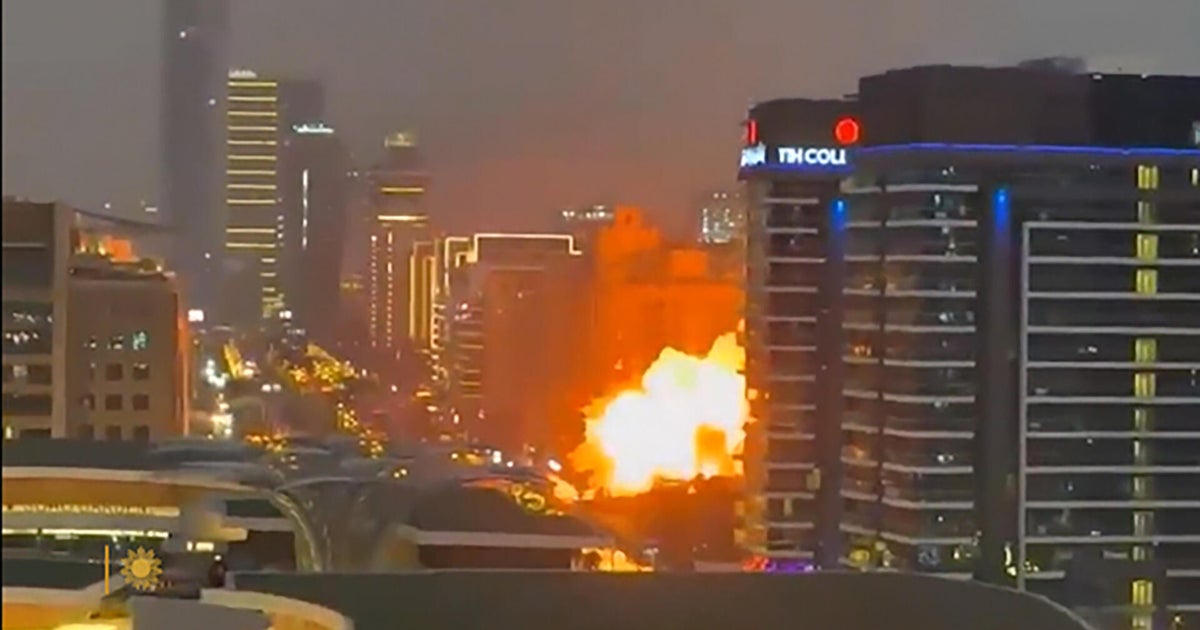
TEHRAN, Iran — In a dramatic escalation of tensions in the Middle East, Iran launched a series of retaliatory missile strikes against U.S. and Israeli military installations late Sunday, hours after joint American-Israeli airstrikes killed Iran's Supreme Leader, Ayatollah Ali Khamenei. The strikes, which targeted what Iranian officials described as 'aggressor bases' in the region, marked one of the most direct confrontations between Iran and its adversaries in decades.
According to reports from CBS News, the initial U.S.-Israeli operation unfolded on Saturday morning, involving precision airstrikes on an array of high-value targets across Iran, including nuclear facilities and command centers in Tehran and Natanz. The operation, codenamed 'Operation Dawn Shield' by anonymous U.S. military sources, reportedly aimed to neutralize Iran's nuclear program and leadership amid rising fears of imminent weaponization. Ayatollah Khamenei, who had led Iran since 1989, was confirmed dead in the strikes, with Iranian state media broadcasting images of the rubble-strewn site of his residence in northern Tehran.
'This was a necessary action to prevent a nuclear catastrophe,' said a senior U.S. official speaking on condition of anonymity to CBS News. The official emphasized that the strikes were intelligence-driven, based on satellite imagery and human sources indicating Khamenei was personally overseeing uranium enrichment efforts. Israeli Prime Minister Benjamin Netanyahu, in a televised address from Jerusalem, echoed the sentiment, stating, 'We acted in self-defense against a regime that has threatened our existence for years. The death of Khamenei is a blow to terrorism, not an act of aggression.'
Iran's response came swiftly. By Sunday evening, the Islamic Revolutionary Guard Corps (IRGC) fired over 200 ballistic missiles toward U.S. bases in Iraq and Israeli airfields near the Golan Heights. Iranian Supreme National Security Council spokesman Ali Shamkhani announced the retaliation in a fiery speech broadcast on state television. 'The blood of our leader will not go unavenged,' Shamkhani declared. 'The Great Satan and the Zionist entity will pay dearly for this assassination.' Early reports indicated at least 15 U.S. personnel injured at Al Asad Airbase in Iraq, though no fatalities were confirmed.
The backdrop to this explosive exchange traces back to heightened hostilities following the October 7, 2023, Hamas attacks on Israel, which Iran-backed groups supported. Proxy conflicts in Yemen, Lebanon, and Syria had already strained relations, with U.S. forces conducting defensive strikes against Houthi militants in the Red Sea. Intelligence analysts had warned of Iran's accelerating nuclear activities, with the International Atomic Energy Agency reporting in June that Tehran was enriching uranium to near-weapons-grade levels at the Fordow facility.
Witnesses in Tehran described scenes of chaos following the Saturday strikes. 'The sky lit up like daylight, and then the explosions shook the ground,' recounted Reza Ahmadi, a 45-year-old shopkeeper near the Supreme Leader's compound, in an interview with international media. 'People are in shock; Khamenei was like a father to the revolution.' Funerary processions began Sunday afternoon, drawing millions to Tehran's streets despite air raid sirens, as mourners chanted anti-American slogans.
From the U.S. perspective, the operation was portrayed as a preemptive measure. Pentagon spokesperson John Kirby, during a briefing in Washington, detailed that F-35 stealth fighters from the USS Abraham Lincoln carrier group, supported by Israeli F-15s, executed the mission with minimal collateral damage. 'Our focus was on leadership and infrastructure, not civilians,' Kirby said. However, Iranian officials contested this, claiming over 50 civilian deaths, including family members of IRGC commanders, and accusing the U.S. of using cluster munitions banned under international law.
Israeli sources provided a differing account of the Iranian retaliation. The Israel Defense Forces (IDF) reported intercepting 85% of incoming missiles using the Iron Dome and Arrow systems, with strikes hitting an empty hangar at Ramat David Airbase. 'Iran's response was expected but ineffective,' said IDF spokesperson Brig. Gen. Ran Kochav. 'We remain vigilant.' In contrast, Hezbollah, Iran's ally in Lebanon, claimed responsibility for simultaneous rocket barrages from the border, escalating fears of a multi-front war.
International reactions poured in as the dust settled. United Nations Secretary-General Antonio Guterres condemned the violence, calling for an emergency Security Council meeting. 'This cycle of retaliation threatens global stability,' Guterres said in a statement from New York. European leaders, including German Chancellor Olaf Scholz, urged de-escalation, while Russia and China voiced strong support for Iran, with Moscow's Foreign Ministry labeling the strikes 'state terrorism.'
Behind the scenes, diplomatic channels buzzed with activity. U.S. Secretary of State Antony Blinken held virtual talks with counterparts in Brussels, emphasizing that the strikes were not aimed at regime change but at curbing nuclear threats. Iranian Foreign Minister Hossein Amir-Abdollahian, in a phone call with Qatari mediators, reportedly warned of further actions if U.S. forces did not withdraw from the region. Analysts noted that Khamenei's death creates a power vacuum, with potential successors like President Ebrahim Raisi or IRGC chief Hossein Salami vying for influence.
The economic fallout was immediate. Oil prices surged 15% to over $100 per barrel on Monday, as traders feared disruptions in the Strait of Hormuz, through which 20% of global oil flows. Shipping companies rerouted vessels away from the Persian Gulf, and stock markets in Tel Aviv and New York dipped amid uncertainty. In Appleton, Wisconsin, local gas stations reported price hikes, with residents like retiree Martha Jenkins expressing concern: 'This feels like it's coming too close to home with these energy costs.'
Experts offered varied interpretations of the events. At the Brookings Institution, Middle East analyst Suzanne Maloney described the strikes as a 'high-stakes gamble' by the U.S. and Israel. 'Khamenei's elimination removes a symbol of defiance but risks radicalizing Iran's hardliners,' she said in a CBS News interview. Conversely, former CIA director Leon Panetta cautioned that Iran's retaliation could draw in more actors, potentially leading to a broader conflict. 'We've seen this movie before; it doesn't end well,' Panetta remarked.
As the situation evolves, military movements suggest ongoing tensions. U.S. B-52 bombers were repositioned to Diego Garcia in the Indian Ocean, while Iran mobilized naval forces in the Gulf. Israeli intelligence reportedly uncovered plots for cyber attacks on Western infrastructure, prompting heightened alerts. With Khamenei's succession unclear, Tehran's streets remain a tinderbox of grief and resolve.
The implications extend far beyond the region. For the U.S., the strikes represent a bold departure from the Biden administration's preference for diplomacy, possibly influencing midterm elections with debates over foreign policy. In Israel, Netanyahu's government faces domestic protests but gains from portraying strength against Iran. For Iran, the loss of its paramount leader could either unify the nation or fracture its theocratic structure, with clerics in Qom already convening to select a replacement.
Looking ahead, world leaders brace for what comes next. Will Iran's retaliation provoke further U.S. involvement, or could backchannel talks avert all-out war? As one anonymous European diplomat put it, 'The Middle East is at a crossroads; one wrong turn, and we're all affected.' For now, the world watches warily as the echoes of Saturday's strikes reverberate across the globe.