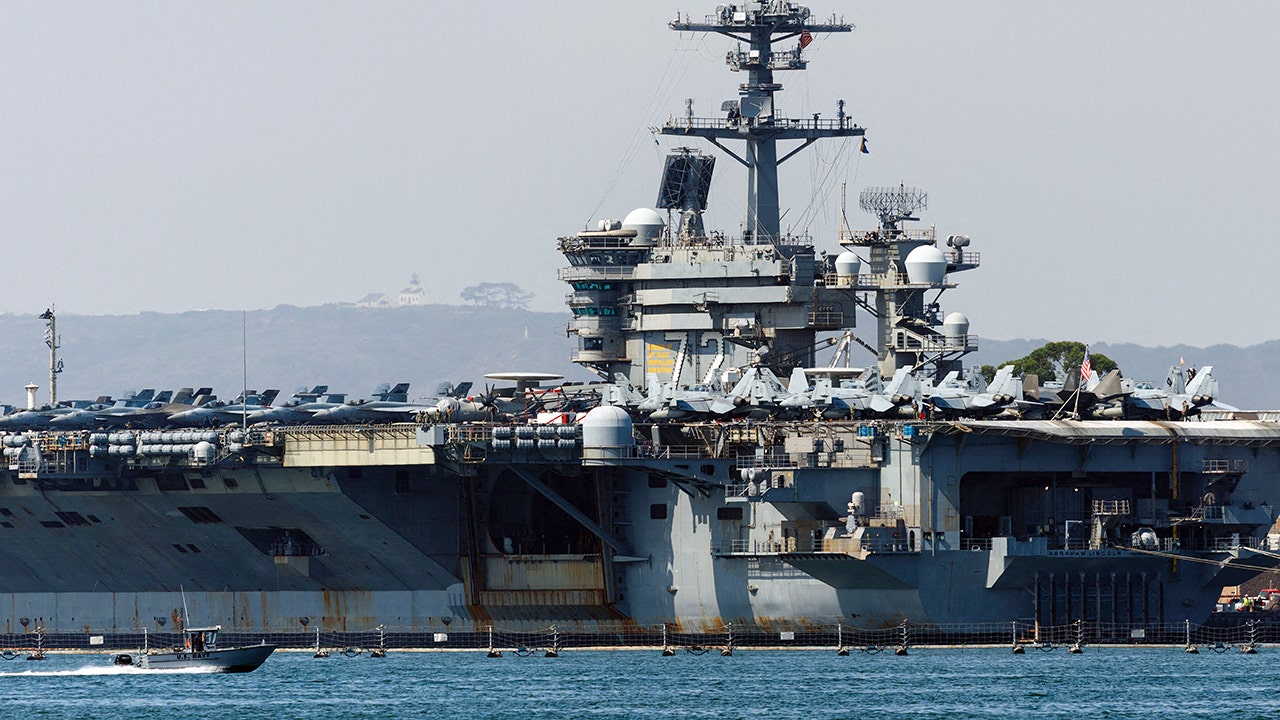
In a tense encounter over the Arabian Sea, the U.S. military shot down an Iranian drone that approached a Navy aircraft carrier, prompting conflicting accounts from American and Iranian officials. The incident, which occurred on Tuesday, involved the USS Abraham Lincoln, a Nimitz-class nuclear-powered carrier transiting international waters approximately 500 miles from Iran's southern coast. According to U.S. Central Command, the unmanned Iranian Shahed-139 drone maneuvered aggressively toward the ship despite efforts by American forces to de-escalate the situation.
Capt. Tim Hawkins, a spokesman for CENTCOM, described the event in detail, stating that the drone "unnecessarily maneuvered toward the ship." He added that it "continued to fly toward the ship despite de-escalatory measures taken by U.S. forces operating in international waters." In response, an F-35C fighter jet launched from the Abraham Lincoln engaged and shot down the drone in what the U.S. military characterized as an act of self-defense to protect the carrier and its personnel. No U.S. service members were injured, and no equipment was damaged during the confrontation, Hawkins confirmed.
Iranian media, however, presented a starkly different narrative. The Tasnim News Agency, which is affiliated with Iran's Islamic Revolutionary Guard Corps (IRGC), reported that the drone was on a "routine and lawful mission over international waters," conducting surveillance and imaging duties. Citing an anonymous source, the agency claimed the IRGC-operated drone successfully transmitted reconnaissance photos to its command center before losing communication. The source emphasized that the mission was standard procedure and not intended to provoke any aggression.
The USS Abraham Lincoln's presence in the region adds layers of context to the incident. The carrier, recently photographed sailing in the Pacific Ocean in August 2024, was deployed to the Middle East following statements from President Donald Trump last week. Trump had announced that "a massive Armada is heading to Iran," signaling an escalation in U.S. military posture amid ongoing tensions with Tehran. The Abraham Lincoln, homeported at Naval Air Station North Island in San Diego, California, is equipped with advanced aircraft like the F/A-18F Super Hornet and F-35C, which are critical for operations in volatile areas such as the Arabian Sea.
This drone shootdown is not an isolated event in the broader U.S.-Iran maritime frictions. Just hours after the incident involving the Abraham Lincoln, IRGC forces reportedly harassed a U.S.-flagged, U.S.-crewed merchant vessel in the Strait of Hormuz. Hawkins noted that the merchant ship was "lawfully transiting the international sea passage" when it encountered the interference. Such actions echo previous episodes of Iranian gunboats attempting to board oil tankers, including an unsuccessful bid reported in recent weeks as the U.S. bolsters its military presence in the area.
The Arabian Sea, a vital artery for global oil shipments, has long been a hotspot for confrontations between U.S. naval forces and Iranian assets. The Strait of Hormuz, through which about 20% of the world's oil passes, remains particularly sensitive. U.S. officials have repeatedly accused Iran of using drones and fast boats to threaten commercial and military shipping, while Tehran maintains that its actions are defensive responses to perceived American aggression in the region.
White House Press Secretary Karoline Leavitt addressed the incident during an appearance on Fox News' "America Reports," though she focused more broadly on the administration's foreign policy moves, including a new trade deal with India. Leavitt did not delve into specifics of the drone event but underscored the U.S. commitment to protecting its assets abroad. The administration's deployment of the Abraham Lincoln strike group aligns with efforts to deter Iranian provocations, officials said.
From the Iranian perspective, the Tasnim report portrays the U.S. action as an unprovoked attack on a legitimate operation. The source told the agency that the drone's mission was purely for reconnaissance, capturing images of the surrounding waters without any hostile intent. This claim contrasts sharply with the U.S. assertion of an "aggressive approach with unclear intent," highlighting the divergent interpretations of the same event.
Experts on Middle East security have noted that such incidents could spiral if not managed carefully. The IRGC, designated a terrorist organization by the U.S., operates a fleet of drones like the Shahed-139, which are known for their low-cost, high-endurance surveillance capabilities. These unmanned aerial vehicles have been used in various conflicts, including support for proxy groups in Yemen and Syria, according to U.S. intelligence assessments.
The timing of the shootdown comes amid heightened U.S.-Iran tensions, exacerbated by Iran's nuclear program and regional proxy activities. President Trump's recent rhetoric about a naval armada underscores a strategy of maximum pressure, reminiscent of his first term when similar deployments were used to counter Iranian threats. The Abraham Lincoln's transit through the Arabian Sea places it within striking distance of key Iranian coastal facilities, though U.S. officials insist operations remain in international airspace and waters.
In the separate Strait of Hormuz episode, the IRGC's harassment of the merchant vessel involved close approaches by fast-attack craft, a tactic Iran has employed to assert control over the waterway. The U.S.-flagged ship, whose name was not disclosed, continued its journey without incident, but the event prompted warnings from CENTCOM about the risks to international navigation. Such harassment has increased in frequency, with U.S. Navy reports indicating over a dozen similar encounters in the past year.
As the U.S. Navy continues its patrols, the implications of the drone incident extend beyond the immediate parties involved. Allies like India, with whom the U.S. is negotiating a new trade deal, have expressed concerns over disruptions in the Indian Ocean region. The Arabian Sea's stability is crucial for global trade routes, and any escalation could drive up energy prices worldwide.
Looking ahead, both sides appear to be signaling restraint while maintaining their positions. U.S. forces emphasized the self-defense nature of the shootdown, while Iranian media framed it as an infringement on sovereign rights in international spaces. Diplomatic channels remain open, but with the Abraham Lincoln in position and IRGC assets active, the risk of miscalculation persists.
The incident underscores the fragile balance in the Middle East, where routine missions can quickly turn confrontational. As investigations continue, both Washington and Tehran will likely use the event to bolster their narratives in the ongoing geopolitical chess game. For now, the seas remain calm, but the undercurrents of tension run deep.