By Michael Thompson
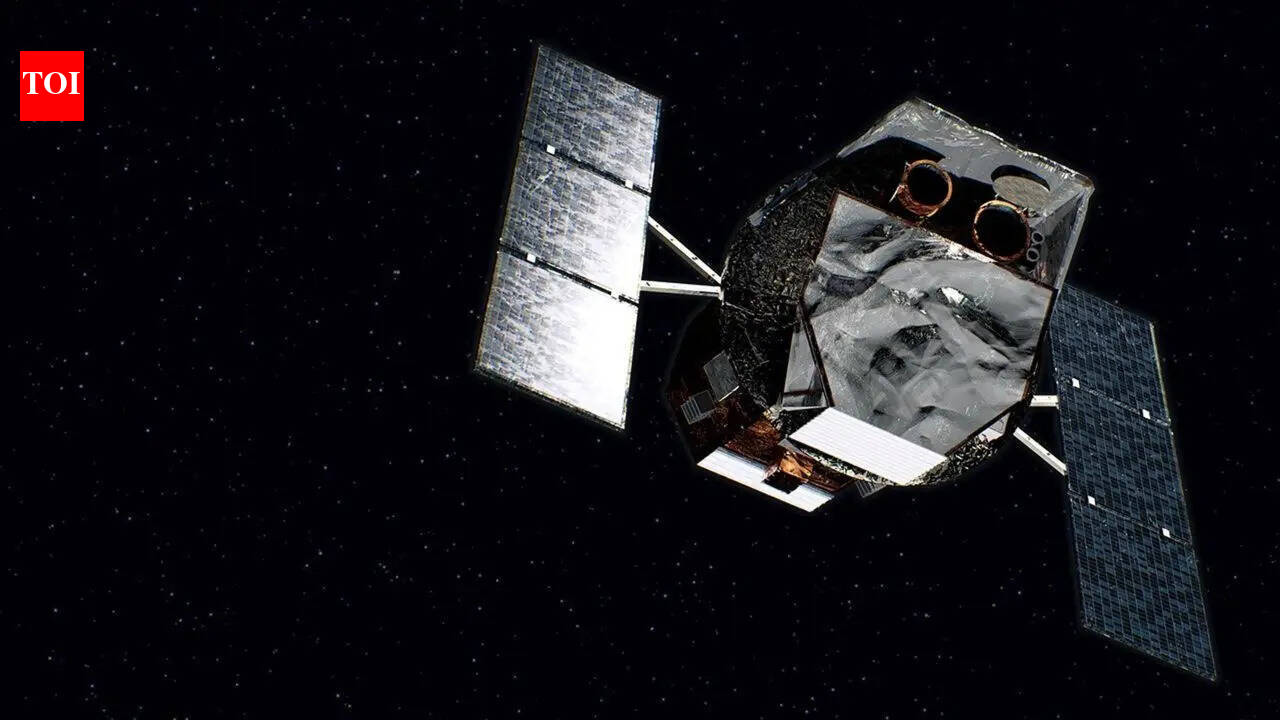
WASHINGTON — A high-stakes drama is unfolding in the skies above Earth as one of NASA's prized space telescopes teeters on the brink of an uncontrolled re-entry, prompting an urgent rescue mission by the space agency. According to reports from the Times of India, the spacecraft, described as one of NASA's most important assets, faces a 90 percent risk of plummeting back to the planet in a potentially hazardous maneuver. The situation has captured the attention of scientists and space enthusiasts worldwide, with NASA engineers racing against time to avert disaster.
The trouble began when the telescope became trapped in what experts are calling a 'death spiral,' a precarious orbit that is gradually decaying due to atmospheric drag. This unnamed spacecraft, vital for groundbreaking observations of distant galaxies and cosmic phenomena, has been operational for years, contributing immensely to our understanding of the universe. Sources indicate that the spiral was triggered by a combination of fuel depletion and orbital perturbations, leaving the satellite unable to maintain its altitude.
NASA officials have confirmed the severity of the issue, stating that without intervention, the telescope could re-enter Earth's atmosphere within the coming months. 'We are dealing with a critical situation where the spacecraft's orbit is unstable,' said a spokesperson from NASA's Goddard Space Flight Center, as reported in international science news outlets. The agency has mobilized a team of propulsion specialists and orbital mechanics experts to devise a plan that could involve firing remaining thrusters to boost the satellite into a safer trajectory.
Background on the telescope reveals it was launched in the early 2000s as part of NASA's ongoing efforts to expand humanity's cosmic horizons. Weighing approximately 12 tons and equipped with advanced infrared and ultraviolet sensors, it has captured images that have led to discoveries about exoplanets and black holes. However, like many satellites in low Earth orbit, it has been subject to the relentless pull of atmospheric friction, which has now accelerated its descent.
The rescue plan, still in its preliminary stages, reportedly involves a complex series of maneuvers. Engineers are considering using the spacecraft's auxiliary propulsion system, which was designed for fine adjustments but could provide the necessary delta-v to raise its perigee. According to the Times of India article, the operation carries its own risks, including the possibility of further destabilizing the already spinning satellite if the thrusters misfire.
International partners are also weighing in on the crisis. The European Space Agency (ESA) has offered technical support, drawing from their experience with similar incidents involving the Rosetta mission's Philae lander. 'Collaboration is key in space operations,' an ESA official remarked, emphasizing the shared stakes in preserving scientific assets. Meanwhile, Russia's Roscosmos has expressed concerns about potential debris fallout, given the spacecraft's trajectory could intersect with populated regions.
Debris from uncontrolled re-entries has been a growing worry in recent years. In 2020, parts of a Chinese Long March 5B rocket survived re-entry and landed in the Indian Ocean, prompting global calls for better space traffic management. NASA's current predicament echoes that event, with experts estimating that up to 30 percent of the telescope could survive atmospheric burn-up, scattering fragments over a wide swath of land or sea.
To mitigate this, NASA is coordinating with the U.S. Space Command to track the satellite's path in real-time. The Joint Space Operations Center at Vandenberg Space Force Base in California is providing orbital data, updated every few hours. 'Our models show a 90 percent probability of re-entry by late summer,' according to a Space Command briefing obtained by science reporters.
Scientists who have relied on the telescope's data are voicing their apprehension. Dr. Elena Vasquez, an astrophysicist at the University of Chicago, said in a recent interview, 'This instrument has been our window to the stars; losing it would set back research by decades.' Her team has paused ongoing projects dependent on the telescope's observations, shifting to ground-based alternatives like the Atacama Large Millimeter/submillimeter Array in Chile.
The broader context of space debris adds urgency to the rescue. With over 36,000 pieces of trackable orbital junk circling Earth, according to the European Space Agency, incidents like this highlight the need for de-orbiting technologies. NASA's own guidelines mandate that satellites be disposed of responsibly at end-of-life, but unforeseen issues like the death spiral complicate compliance.
Critics within the space community argue that better planning could have prevented this. A report from the Union of Concerned Scientists last year pointed out that many aging satellites lack sufficient fuel reserves for controlled de-orbits. 'This is a wake-up call,' said Laura Grego, a senior scientist at the organization. 'We need international standards to avoid turning low Earth orbit into a junkyard.'
Despite the challenges, optimism persists among NASA's ranks. The agency has a track record of improvisation, as seen in the 1990 Hubble Space Telescope repair mission, where astronauts fixed a flawed mirror in orbit. This time, however, the operation would be remote, relying on ground commands sent from the Mission Operations Center in Houston, Texas.
Looking ahead, the implications of a successful rescue could be profound. Not only would it save invaluable hardware, but it might also extend the telescope's lifespan by several years, allowing for continued data collection on pressing questions like dark matter distribution. Conversely, failure could lead to enhanced regulations on satellite design, pushing for more robust end-of-life propulsion systems.
As the world watches, NASA continues to update its status reports on its official website. The next critical window for thruster activation is scheduled within the next 48 hours, weather and orbital conditions permitting. For now, the fate of this celestial observer hangs in the balance, a reminder of the fragile boundary between exploration and peril in space.
In Appleton, local astronomy clubs are organizing viewing events to track the satellite's path, turning a potential tragedy into a teachable moment. 'It's a chance to appreciate how interconnected our activities on Earth are with the cosmos,' said club president Mark Reilly. As developments unfold, the scientific community holds its breath, hoping for a plot twist that keeps the stars in sight.