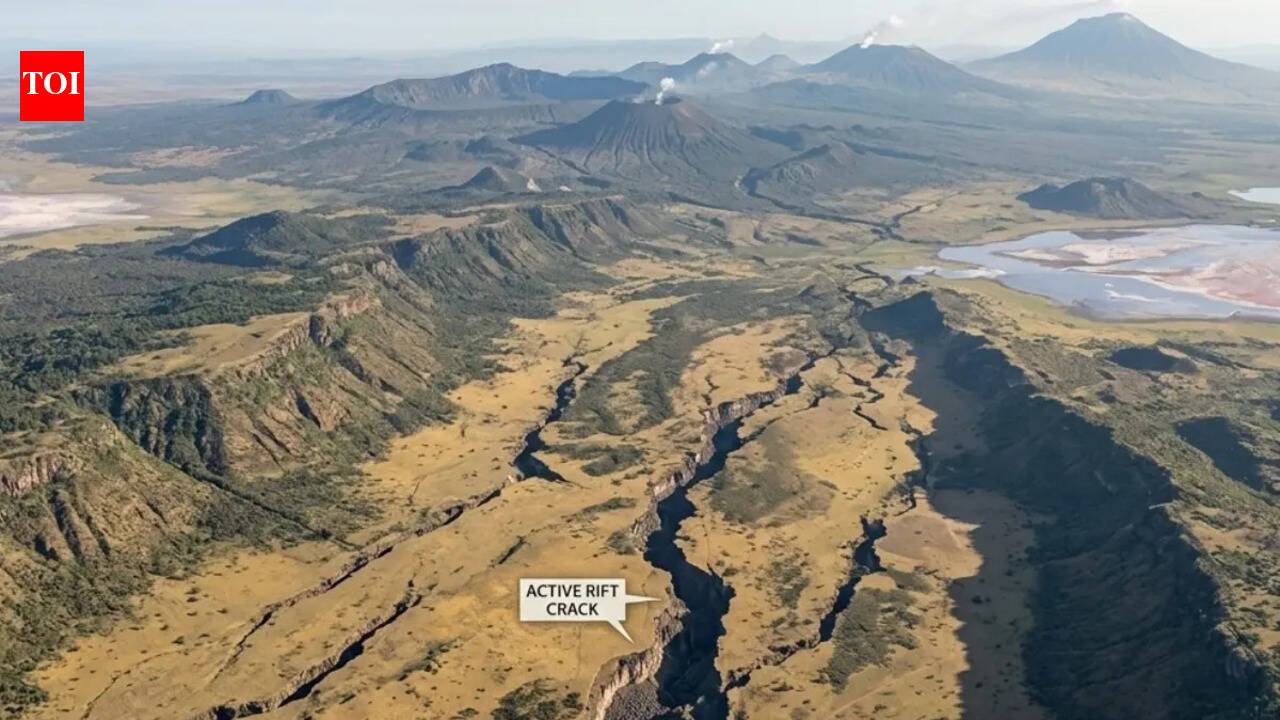
In a groundbreaking revelation that could reshape our understanding of continental drift, a new scientific study has found that the East African Rift is expanding at a rate far quicker than previously anticipated, potentially leading to the formation of a new ocean basin within our lifetimes. Researchers from the University of Leeds, led by geologist Dr. Emma Watts, announced their findings this week in the journal Nature Geoscience, based on satellite data and seismic analysis spanning the past decade. The rift, which stretches over 3,000 kilometers from the Afar region in Ethiopia to Mozambique, is reportedly accelerating due to an upwelling of hot mantle material beneath the continent.
According to the study, the rift's widening rate has increased from an average of 5 millimeters per year to nearly 15 millimeters annually in recent years, a pace that exceeds models developed in the 20th century. "This acceleration suggests that the forces driving Africa's breakup are more dynamic than we thought," Dr. Watts said in a press release from the university. "What was once a slow geological process might now be unfolding at a human timescale, with profound implications for the region's geography and ecology."
The East African Rift System has long been recognized as one of the few active continental rifts on Earth, where the African plate is slowly splitting into two: the Nubian plate to the west and the Somalian plate to the east. Discovered in the early 1900s by British geologist John Walter Gregory during an expedition in Ethiopia, the rift's formation dates back about 22 million years, driven by tectonic forces that could eventually separate the continent into a new landmass resembling Madagascar.
But the latest research, which utilized data from the European Space Agency's Sentinel-1 satellites, indicates that volcanic activity and magma intrusions are fueling this unexpected speedup. In the Afar Depression, where the rift meets the Red Sea and Gulf of Aden, ground deformation has been measured at up to 2 centimeters per year in some spots. "The mantle plume beneath the rift is hotter and more vigorous than expected, pushing the plates apart like a geological zipper," explained co-author Dr. Khalid Al-Harbi from the King Abdullah University of Science and Technology in Saudi Arabia.
Local experts in East Africa have noted visible signs of this activity. In Kenya's Rift Valley, earthquakes have become more frequent, with over 200 seismic events recorded in the past year alone, according to the Kenya Geological Survey. "Communities around Lake Turkana are feeling the ground shift more often," said Dr. Agnes Mwikali, a seismologist at the University of Nairobi. "It's not just science fiction; the earth is literally moving under our feet."
The study's implications extend beyond geology to human evolution and modern societies. The rift zone is home to some of the earliest hominid fossils, including those of Australopithecus afarensis, discovered in Ethiopia's Hadar region in 1974. Scientists speculate that the rift's activity may have influenced early human migration patterns by creating barriers and new habitats. "If the rift continues to accelerate, it could alter migration routes for wildlife and people alike, potentially exacerbating climate challenges in an already vulnerable region," Dr. Watts added.
However, not all experts agree on the rift's pace or future trajectory. A separate analysis by researchers at the Istituto Nazionale di Geofisica e Vulcanologia in Italy, published last month in Earth and Planetary Science Letters, suggests the acceleration might be localized to the northern rift segments and not indicative of continent-wide breakup. "While the Afar data is compelling, broader plate motion models show inconsistencies," said lead Italian researcher Dr. Luca Bianchi. "We need more long-term observations to confirm if this is a temporary surge or a permanent shift."
In Ethiopia, where the rift's northern arm is most active, government officials are monitoring the situation closely. The Ethiopian Ministry of Water and Energy reported in a statement that they have allocated $5 million for rift-related hazard assessments, including early warning systems for volcanic eruptions. "Our priority is protecting lives and infrastructure," said ministry spokesperson Tadesse Getachew. Recent eruptions at Erta Ale volcano, one of the world's most active, have displaced hundreds of residents in the Danakil Depression since 2022.
Further south, in Tanzania, the rift's influence is evident in the formation of the East African Rift lakes, such as Lake Tanganyika, the world's second-deepest freshwater body at 1,470 meters. Tour guides and locals in Arusha report increased geothermal activity, with hot springs bubbling more vigorously. "Tourists come for the wildlife, but now they're asking about the ground cracking," said safari operator Jamal Nkosi. "It's changing how we see the land."
The acceleration could have economic ramifications as well. The rift zone holds vast mineral resources, including rare earth elements critical for renewable energy technologies. According to a 2023 report by the African Union, accelerated rifting might expose new deposits but also heighten risks for mining operations in countries like Uganda and Zambia. "Investors are watching closely; this could be a double-edged sword," noted economist Dr. Fatima Okello from the University of Cape Town.
Climate scientists are also weighing in, linking the rift's activity to broader environmental changes. Enhanced volcanic emissions from the region could contribute to atmospheric CO2 levels, potentially influencing global warming patterns. A study from the Potsdam Institute for Climate Impact Research estimates that rift-related degassing might add 0.1% to annual global emissions if the pace continues. "It's a reminder that Earth's internal dynamics interact with surface climate in ways we're only beginning to understand," said institute director Prof. Hans Joachim Schellnhuber.
Looking ahead, international collaboration is key. The study calls for expanded monitoring networks, including more seismic stations and GPS arrays across the 10 countries the rift traverses: Djibouti, Eritrea, Ethiopia, Kenya, Tanzania, Uganda, Rwanda, Burundi, Zambia, and Malawi. Funding from the European Research Council has been pledged for a five-year project starting in 2025, aiming to model the rift's evolution with greater precision.
As Africa potentially gives birth to a new ocean—dubbed the Afar Ocean by some geologists—the world watches a rare geological drama unfold. What began as a slow tectonic whisper has grown into a roar, challenging long-held assumptions and urging preparedness. For the millions living along this fault line, the ground beneath them is not just history in the making but a call to adapt.
In the words of Dr. Watts, "This isn't just about plates drifting; it's about how our planet reinvents itself, and how we must reinvent our responses." With ongoing research and vigilance, scientists hope to demystify the rift's secrets before it redraws the map of Africa forever.