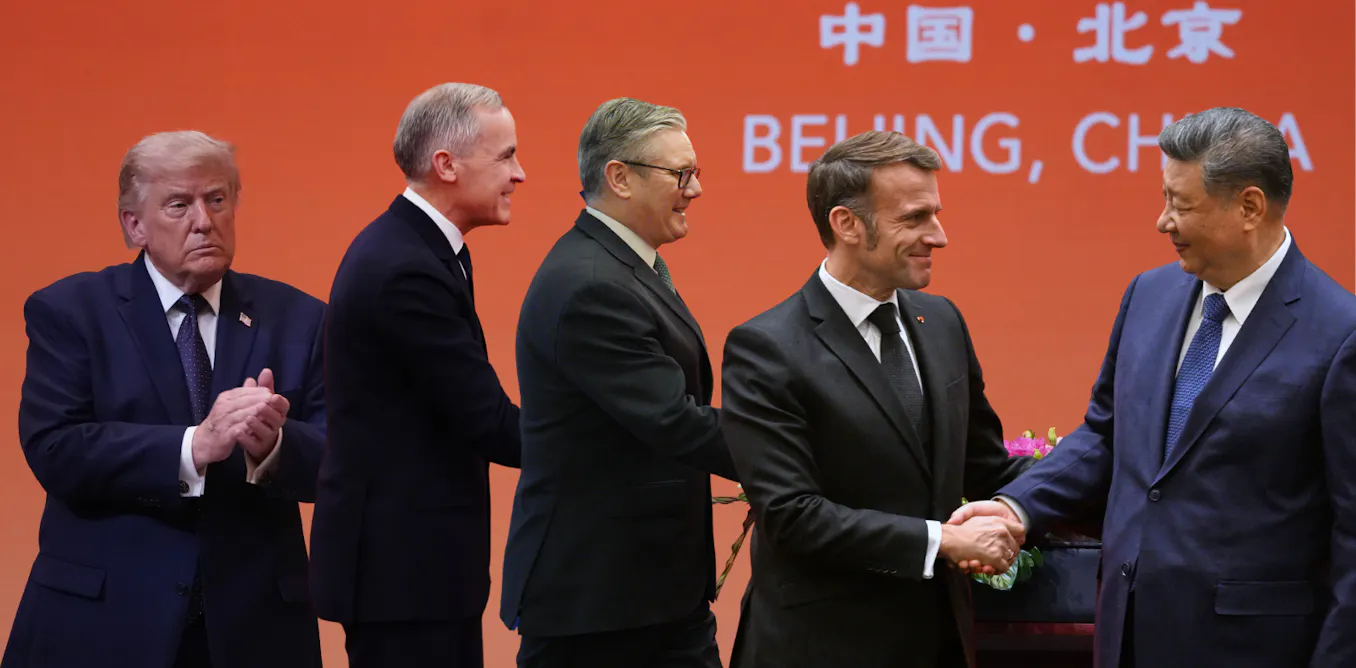
In recent weeks, Beijing has hosted back-to-back state visits from Russian President Vladimir Putin and U.S. President Donald Trump, placing China at the center of global diplomacy. The summits have prompted some analysts to describe China as a stabilizing force and broker between major powers, while others see President Xi Jinping as a world leader whose influence is growing.
Chinese media outlets portrayed the capital as an international "living room" offering stability amid global turbulence. Headlines in state media even suggested the world was entering "Beijing time," highlighting the string of visits from leaders including those from France, Britain, Canada, South Korea and Germany.
Many of these visits marked the first in years. It was the first visit in eight years by a UK prime minister and the first in nine years for leaders from Canada, South Korea and the United States, according to Chinese analysts.
Yet questions remain about the true drivers behind the visits. Some observers suggest world leaders may be seeking leverage in dealings with the Trump administration rather than responding solely to Chinese diplomatic outreach. Canadian Prime Minister Mark Carney's January trip to Beijing, for instance, was widely viewed as an effort to navigate Canada's dependence on the U.S. amid policy volatility.
Beijing appears to set a high entry price for access to its diplomatic stage. During Trump's visit, the president reportedly backtracked on earlier proposals to block Chinese nationals from buying U.S. farmland and to limit Chinese students at American universities. Chinese media noted the backlash these moves drew from Trump's MAGA supporters and Republican lawmakers.
Carney's visit produced a trade deal that lowered tariffs on made-in-China electric vehicles to 6.1 percent for the first 49,000 cars annually. Canada had previously imposed a 100 percent tariff on Chinese EVs in late 2024. The concession drew domestic criticism, with politicians warning of a potential flood of cheap Chinese vehicles without corresponding investment in Canada.
"The world is entering 'Beijing time,'" read one Chinese headline, capturing the optimistic tone in state media coverage of the recent summits.
Despite the high-profile meetings, core Chinese foreign policy positions have remained unchanged. Appeals from European leaders did not alter Beijing's material support for Russia's war in Ukraine or reduce China's substantial trade surplus with the European Union, according to reports.
Beijing also declined to assist the Trump administration regarding Iran, even after Trump praised Xi's leadership and paused a weapons sale to Taiwan. Similarly, Putin left without resolving differences over the Power of Siberia 2 pipeline, which could carry 50 billion cubic meters of Russian natural gas annually to China.
Domestic economic pressures continue to constrain Beijing's options. To meet growth targets and prevent factory closures, China maintains massive state subsidies in manufacturing sectors, resulting in surplus output exported globally at low prices. This approach has drawn complaints from trading partners including the EU.
China has also maintained support for Russia and Iran in ways that challenge U.S. and European security interests, even as Western markets remain vital to its economy. These tensions limit the concrete outcomes from the recent summits.
The visits reflect broader uncertainty in the global order following shifts in U.S. foreign policy under the Trump administration. Traditional American allies have expressed concern, creating space for China to present itself as a steady partner after earlier periods of more assertive diplomacy.
While the gatherings have increased China's visibility in global affairs, analysts note that this does not automatically translate into greater influence or effective leadership. Domestic priorities and competing international goals continue to shape what Beijing can deliver.