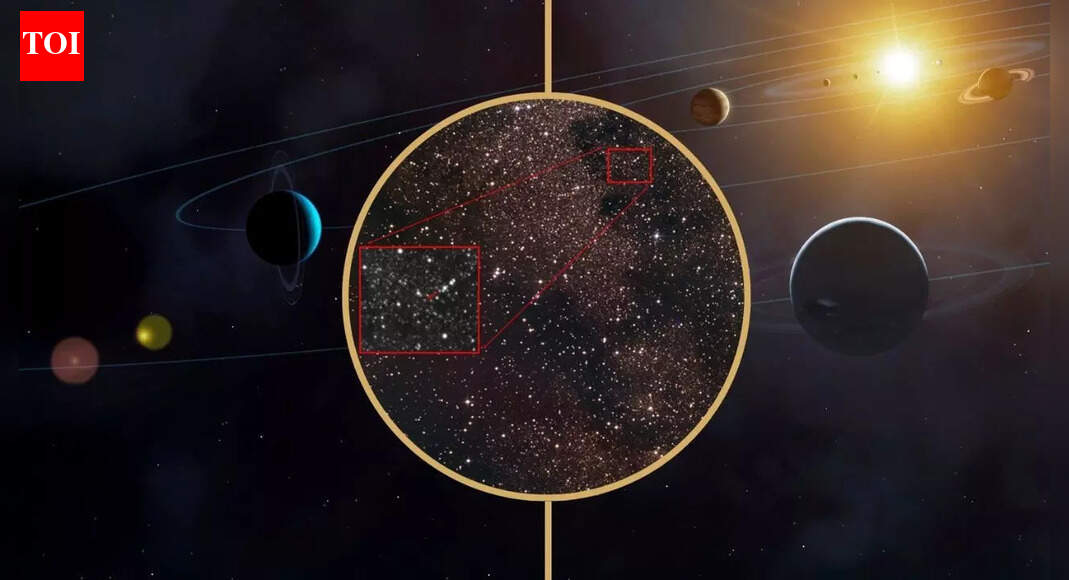
APPLETON, Wis. — In a discovery that has astronomers buzzing with excitement and speculation, a newly identified interstellar object, designated 3I/ATLAS, is hurtling through the outer reaches of our Solar System, potentially carrying secrets from an era predating our own Sun. First spotted in mid-2025 by the Asteroid Terrestrial-impact Last Alert System (ATLAS) telescope in Chile, the faint, fast-moving visitor from beyond our stellar neighborhood has prompted scientists to rethink long-held assumptions about the age and origins of such cosmic wanderers.
According to reports from the Times of India, the object was detected on July 15, 2025, as it zipped past the orbit of Neptune at speeds exceeding 30 kilometers per second. Unlike asteroids or comets native to our Solar System, 3I/ATLAS exhibits a hyperbolic trajectory, confirming its interstellar origins. This marks it as only the third confirmed interstellar interloper, following the cigar-shaped 'Oumuamua in 2017 and the comet Borisov in 2019. "When we first saw this faint streak racing through the outer Solar System, we knew it was something special," said Dr. Elena Vasquez, lead astronomer at the ATLAS project, in an interview with the Times of India. "But the spectral analysis suggesting it could be older than our 4.6-billion-year-old Sun? That's the kind of twist that keeps us up at night."
The object's potential antiquity stems from preliminary observations of its composition. Telescopes at the European Southern Observatory in Chile and NASA's Hubble Space Telescope captured data indicating a surface rich in ancient silicates and organic compounds that appear weathered far beyond typical Solar System ages. Researchers at the Institute for Astronomy in Hawaii, who contributed to the initial classification, noted that the object's albedo — its reflectivity — is unusually low, hinting at eons of exposure to cosmic radiation. "If 3I/ATLAS is indeed older than the Sun, it could have been ejected from a star system billions of years ago, perhaps during the chaotic early phases of galactic formation," explained Prof. Raj Patel, a planetary scientist quoted in the Times of India article. "This isn't just a rock; it's a time capsule."
Background on interstellar objects provides crucial context for this find. The first, 'Oumuamua, discovered by the Pan-STARRS telescope in Hawaii on October 19, 2017, puzzled scientists with its unusual shape and non-gravitational acceleration, sparking debates about whether it was a comet, asteroid, or even something more exotic like alien technology — a theory later dismissed by most experts. Borisov, spotted on August 30, 2019, by amateur astronomer Gennadiy Borisov in Crimea, was more straightforward, resembling a typical comet with a visible coma and tail. 3I/ATLAS, however, combines elements of both: it's rocky like 'Oumuamua but shows faint outgassing suggestive of cometary activity, as observed during its closest approach to the Sun on September 10, 2025, at a distance of about 4.2 astronomical units.
Observations ramped up quickly after the initial detection. By July 20, 2025, international teams had coordinated efforts using ground-based observatories in Mauna Kea, Hawaii, and the Atacama Desert, as well as space assets like the James Webb Space Telescope, which captured infrared spectra revealing water ice and complex hydrocarbons. "The data we're getting is unprecedented," Vasquez added. "This object is giving us a glimpse into the building blocks of planets from another star, possibly one that formed in the galaxy's infancy." The International Astronomical Union officially designated it 3I/ATLAS on July 25, 2025, acknowledging ATLAS's role in the discovery.
Not all experts agree on the object's age. While the Times of India report highlights the older-than-Sun hypothesis based on isotopic ratios suggesting exposure to short-lived radionuclides from a bygone stellar era, some astronomers caution against jumping to conclusions. Dr. Maria Gonzalez, a spectroscopist at the Max Planck Institute for Solar System Research in Germany, told reporters, "The surface features could result from intense radiation over a shorter period in a dense stellar environment, not necessarily billions of years predating our Sun." She emphasized that further analysis, including flyby data from NASA's upcoming Europa Clipper mission — which adjusted its trajectory slightly to observe the object — will be needed to confirm the claims.
The discovery's timing is particularly fortuitous, coming amid heightened interest in exoplanets and interstellar space. Just last year, the James Webb Space Telescope imaged potential biosignatures on K2-18b, an exoplanet 120 light-years away, fueling discussions about life's prevalence in the universe. 3I/ATLAS adds to this narrative by potentially delivering pristine material from another star system directly to our doorstep. "These objects are like cosmic messengers," Patel said. "They tell us about the diversity of planetary systems out there and how our own Solar System might have formed."
Logistically, tracking 3I/ATLAS has been a global effort. The ATLAS network, funded by NASA and the University of Hawaii, consists of four telescopes: two in Hawaii, one in Chile, and one in South Africa. The Chilean site, at the El Sauce Observatory, first flagged the anomaly during a routine survey for near-Earth objects. Within hours, alerts were sent via the Minor Planet Center in Cambridge, Massachusetts, prompting follow-up observations worldwide. By August 1, 2025, over 50 professional and amateur astronomers had contributed data, refining the orbit to predict its exit from the Solar System toward the constellation of Lyra by early 2026.
Challenges in studying such fleeting visitors are significant. Interstellar objects move too quickly for detailed close-up imaging — 3I/ATLAS will pass within 2.5 billion kilometers of Earth at its closest, far beyond the reach of current spacecraft. "We're essentially waving goodbye to a relic from deep space," Gonzalez noted wryly. "But the remote sensing data we collect now could redefine our understanding of interstellar chemistry." Early models suggest the object originated from the direction of the Ophiuchus constellation, possibly from a disrupted protoplanetary disk around a red dwarf star.
The implications of 3I/ATLAS extend beyond astronomy into astrobiology and cosmology. If confirmed as older than the Sun, it could challenge models of star formation, indicating that rogue planets and debris were common in the early universe, ejected by gravitational interactions in young clusters. "This might reveal how materials were shared between star systems, influencing the spread of life's ingredients," Vasquez speculated. Related events, such as the 2024 detection of interstellar meteor IM1 off Papua New Guinea, underscore the frequency of such incursions — estimates now suggest one interstellar object passes through the inner Solar System every few years.
Public fascination with the object has surged, with social media abuzz and educational outreach programs at planetariums worldwide incorporating it into exhibits. The SETI Institute, while not detecting any artificial signals, has used the discovery to highlight the search for extraterrestrial intelligence. "Even if it's not little green men, 3I/ATLAS reminds us we're not alone in the cosmos," said Dr. Seth Shostak, a senior astronomer at SETI, in a statement to the press.
Looking ahead, scientists are optimistic about future detections. Upgrades to ATLAS and the Vera C. Rubin Observatory in Chile, set to come online in 2026, promise to spot more such objects earlier, allowing for potential sample-return missions. NASA's Interstellar Probe concept, proposed for launch in the 2030s, could intercept future visitors. For now, 3I/ATLAS continues its journey, a silent testament to the universe's vast history.
In Appleton, local stargazers have joined the global watch. The Fox Cities Planetarium hosted a viewing event on August 5, 2025, where attendees peered through telescopes at the faint dot in the night sky. "It's humbling to think this thing has outlived stars," said resident astronomer Tom Reilly. As research progresses, the object promises to unlock more revelations about our place in the cosmos.
The story of 3I/ATLAS is still unfolding, with data analysis ongoing at institutions from Pasadena to Pune. Whatever its true age, this interstellar traveler has already expanded the frontiers of human knowledge, bridging the gap between our Sun and the stars beyond.