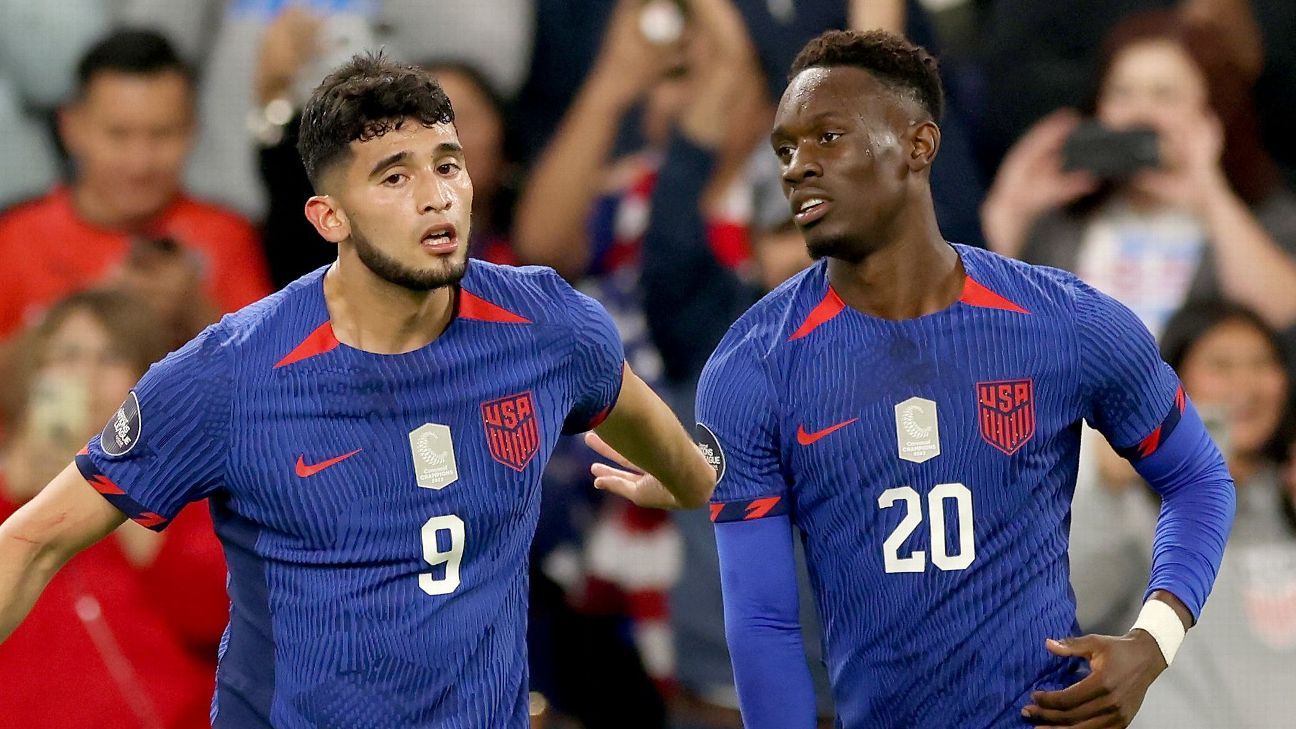
Less than three months before the 2026 FIFA World Cup kicks off in the United States, Mexico and Canada, U.S. men's national team coach Mauricio Pochettino faces a pivotal challenge: selecting his 26-player roster from a pool brimming with talent, particularly at the striker position. For American soccer fans, the striker spot has long been a source of uncertainty since Brian McBride retired from international duty in 2006, but the current generation appears to offer unprecedented depth and quality. Players like Folarin Balogun of AS Monaco, Ricardo Pepi of PSV Eindhoven, Haji Wright of Coventry City, and Patrick Agyemang of Derby County are not only thriving in competitive European leagues but also positioning themselves as key options for the tournament.
Pochettino, who took over as USMNT coach in recent years, must weigh club form, international experience, and statistical output as he finalizes his squad. According to an analysis by ESPN, drawing on data from TruMedia/StatsPerform, the 2026 striker group stands out for its efficiency and versatility compared to previous World Cup cycles in 2014, 2018, and 2022. While the U.S. team may not match the depth of powerhouses like Spain, France, or England, the improvement in overseas talent signals a maturing American soccer landscape.
At the forefront is Balogun, the New York City native who has emerged as the most complete forward in the pool. In the 2025-26 Ligue 1 season, he has scored eight goals, with his total rising to 14 across all competitions, including the UEFA Champions League. Balogun leads the current group in big chances created per 90 minutes, tying with Clint Dempsey's 2017-18 mark, and boasts a strong assists-per-90 ratio, second only to Dempsey and Aron Jóhannsson among historical comparables.
"Probably the most complete striker," said McBride, now general manager of USL Championship side Brooklyn FC. "He's good with the ball at his feet, he's good at runs in the penalty area, he's good at running behind. He also connects well and brings his teammates in." McBride, a two-time Fulham player of the year and former USMNT standout with 100 caps, provides valuable insight into the evolution of American forwards.
Pepi, the 23-year-old Texan, is turning heads with his clinical finishing in the Dutch Eredivisie. Despite not always starting for PSV, he has netted 10 goals in the 2025-26 season, topping the lists for goals per 90 minutes and non-penalty expected goals per 90 among the four World Cup groups analyzed. Fulham of the Premier League has been linked with a potential summer move for Pepi, underscoring his rising profile.
"Pepi, [his] movement is very good in the penalty area," McBride told ESPN. "A really good finisher of the ball." Pepi's numbers, however, come with a caveat: he often enters as a substitute against fatigued defenses in a league not renowned for its defensive rigor. Still, his efficiency marks him as a prime candidate for Pochettino's attack.
Wright, at 27 the oldest in the core group, brings versatility to the table. Playing for Coventry City in England's Championship, he has scored 16 regular-season goals this campaign, outpacing his peers. Beyond his goal tally, Wright can operate as a winger, adding flexibility to the USMNT's formations.
"Wright can play winger at the same time," McBride noted. "Not necessarily somebody that you're going to have hold up the ball, but he's got versatility." Wright's shot-conversion rate places him among the top performers in the 2026 class, alongside Pepi, further bolstering his case for inclusion.
Agyemang, a towering 6-foot-4 presence at Derby County, offers a different dimension with his aerial prowess. He matches Pepi's 10 regular-season goals and leads the group with 34 appearances in 2025-26, providing consistency. While his underlying metrics like xG per shot and big chances created per 90 are modest, Agyemang excels in aerial duels, winning a higher percentage than his contemporaries.
"Agyemang's hold-up play is strong," McBride said. "He gives us some quality in the air and aerial duels in the penalty area, both offensively and defensively." This physicality could prove invaluable in set-piece situations during the World Cup, where the U.S. will host matches across stadiums from Seattle to Miami.
Josh Sargent, who recently transferred to MLS's Toronto FC after stints in Europe, rounds out the contenders. At 26, he adds experience from leagues like the English Championship. Sargent's inclusion in recent USMNT camps suggests Pochettino values his adaptability, though his MLS move might raise questions about maintaining European-level sharpness.
Comparing this group to past eras reveals both progress and lingering challenges. Ahead of the 2014 World Cup, Jóhannsson dazzled in the Eredivisie with 17 goals and seven assists in 34 matches, topping xG per shot and ranking high in conversion rates. Yet, he earned only 19 USMNT caps, failing to fulfill his promise. Similarly, Altidore's 2017-18 MLS stint with Toronto FC saw him lead in shot-conversion rate and rank second in goals per 90, but injuries and the team's failed 2018 qualification bid curtailed his impact.
"If he was fit and still playing in 2026 at the peak of his abilities, he would have been the starting striker," the ESPN analysis posits regarding Altidore. Dempsey, though not a traditional No. 9, contributed significantly in 2017-18 with strong assist numbers. These historical benchmarks highlight how the current strikers—Balogun, Pepi, Wright, Agyemang, and Sargent—are building on elite precedents while addressing long-standing gaps in reliability.
Statistically, the 2026 group shines in key areas. Pepi, Wright, Sargent, and Balogun rank in the top seven for xG per shot, with Pepi and Wright in the top six for conversion rates. However, they lag in passes attempted per 90, reflecting their focus on finishing rather than distribution—a common trait for pure strikers. McBride emphasized the developmental stage of these players, all 27 or younger except Wright.
"Those things are challenges, and they're real challenges," McBride said of factors like injuries and availability that have plagued the position. "[But] there's some talent there, there's some goal scorers." For two decades, the USMNT has lacked a consistent No. 9, deploying various players up top amid variables that disrupted continuity.
As Pochettino prepares for March's training camp, his roster decisions will shape the team's World Cup aspirations. The co-hosting arrangement guarantees the U.S. a spot, but advancing deep requires a potent attack. Balogun's all-around game positions him as the likely starter, yet Pepi's finishing, Wright's versatility, Agyemang's physicality, and Sargent's grit offer robust alternatives.
"Someone can take that position and make it their own," McBride concluded. With the tournament set to unfold across North America starting in June 2026, this striker depth could mark a turning point for American soccer, potentially ending the drought for a dependable leading scorer on the global stage.