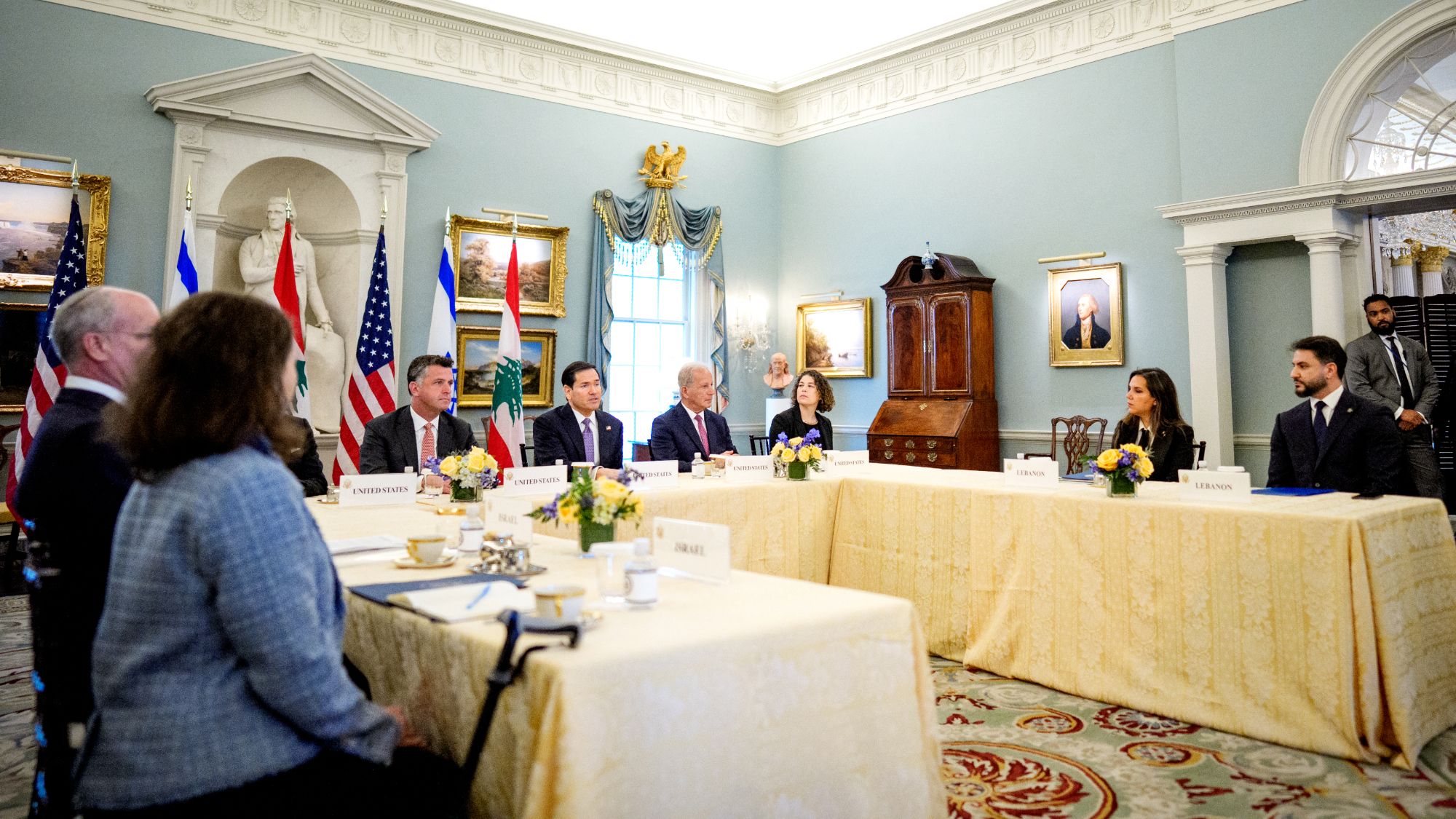
WASHINGTON, D.C. — In a rare diplomatic breakthrough amid escalating violence, Israel and Lebanon held their first direct talks in more than three decades on Tuesday, even as Israeli forces continued their military operations in southern Lebanon against the Iran-backed Hezbollah militia. The two-hour meeting, hosted by the United States in the nation's capital, brought together Israel's ambassador to the U.S., Yechiel Leiter, and his Lebanese counterpart, Nada Hamadeh Moawad, marking the initial formal dialogue between the two nations since 1993.
The discussions unfolded against the backdrop of a six-week war that has ravaged Lebanon, with Israeli strikes reportedly killing at least 2,124 people, including 168 children and 88 health workers, according to Lebanon's health ministry. On the Israeli side, officials reported that 13 soldiers and at least two civilians have been killed in the ongoing exchanges of fire. Despite the gravity of the conflict, the talks proceeded without interruption from the battlefield, where Israel maintains an occupation of parts of southern Lebanon while targeting Hezbollah strongholds.
According to reports from The New York Times, the meeting concluded on an optimistic note, with participants exchanging "encouraging words and talk of further meetings." However, no concrete commitments emerged, and Israel showed no signs of altering its aggressive military posture. Ambassador Leiter emphasized the shared goal of confronting Hezbollah, stating that he and Moawad had agreed "that the evil of Hezbollah must be eradicated." In response, Moawad highlighted Lebanon's priorities, saying she had "underscored the need to preserve our territorial integrity and state sovereignty" and "called for a ceasefire."
The Lebanese government's position in these negotiations appears constrained by its limited influence over Hezbollah, a powerful Shiite militant group that operates as a significant political and military force within the country. The BBC noted that the Lebanese government's "capacity to confront Hezbollah" remains "limited," underscoring the challenges Beirut faces in asserting control. Hezbollah itself has dismissed the bilateral talks, with the group stating it won't abide by any agreements reached without its involvement. A Lebanese government official, speaking to The Washington Post, expressed frustration over Lebanon's bargaining power, asking, "What does Lebanon have to offer on a negotiating table?" and concluding, "Nothing."
U.S. officials framed the encounter as a step toward broader de-escalation. Secretary of State Marco Rubio described the process to reporters as "a process, not an event," signaling that Washington views the talks as the beginning of a longer diplomatic effort. The U.S. State Department announced that Israel and Lebanon "agreed to launch direct negotiations" at an unspecified "time and venue," though details on the next steps remained vague. This initiative comes as the United States seeks to mediate in a region strained by multiple conflicts, including the ongoing war in Gaza and heightened tensions with Iran.
The rarity of such direct engagement cannot be overstated. Israel and Lebanon have maintained a state of hostility since Israel's invasion of Lebanon in 1982, which led to the creation of Hezbollah as a resistance force. A fragile ceasefire in 2006 ended a month-long war between Israel and Hezbollah, but no formal peace treaty has ever been signed. The current escalation began in earnest last month, triggered by Hezbollah's rocket attacks in solidarity with Hamas following the October 7, 2023, assault on Israel. Israel's ground incursion into southern Lebanon, launched to dismantle Hezbollah's infrastructure near the border, has displaced hundreds of thousands and drawn international condemnation.
United Nations Secretary-General António Guterres welcomed the diplomatic overture, pointing to the intertwined roles of the conflicting parties in Lebanon's instability. "Hezbollah and Israel have always helped each other to destabilize the government of Lebanon," Guterres said. He added, "It’s time for Israel and Lebanon to be working together," advocating for cooperation to rebuild the fragile nation. Guterres's comments reflect broader international concerns about Lebanon's sovereignty, which has been eroded by Hezbollah's dominance and repeated Israeli military actions.
From Israel's perspective, the talks represent an opportunity to legitimize its security measures. Israeli officials have long argued that Hezbollah's arsenal of over 150,000 rockets poses an existential threat, justifying preemptive strikes and the current occupation. Prime Minister Benjamin Netanyahu's government has faced domestic pressure to neutralize the group, especially after Hezbollah's cross-border attacks intensified. Yet, critics within Israel and abroad question the sustainability of the campaign, citing the high civilian toll and the risk of a wider regional war.
Lebanese leaders, meanwhile, navigate a delicate balance. The country's economy, already crippled by a financial crisis since 2019, has been further devastated by the fighting, with infrastructure damage estimated in the billions. President Joseph Aoun and Prime Minister Najib Mikati have repeatedly appealed for international aid and a ceasefire, but their authority is undermined by Hezbollah's parallel power structure. Moawad's call for sovereignty during the talks echoes longstanding Lebanese demands for Israel to withdraw from disputed border areas, including the Shebaa Farms region.
International observers see the Washington meeting as a potential turning point, though skepticism abounds. The European Union and Arab League have urged restraint, with France—Lebanon's former colonial power—pushing for a U.N.-backed resolution. However, Hezbollah's refusal to engage directly complicates matters, as the group controls key territories and decision-making in southern Lebanon. Analysts note that without addressing Iran's support for Hezbollah, any agreement may falter.
As the talks concluded, fighting persisted unabated. Israeli airstrikes targeted Hezbollah positions in Beirut's southern suburbs, while the militia fired rockets into northern Israel, prompting evacuations. The human cost continues to mount: Lebanon's health ministry reported over 10,000 injuries alongside the fatalities, overwhelming hospitals already short on supplies. In Israel, air raid sirens have become a daily occurrence, displacing communities near the border.
Looking ahead, the path to peace remains fraught. The U.S.-brokered framework could lead to more substantive negotiations, potentially involving multilateral parties like the U.N. or Qatar. Yet, with no immediate ceasefire in sight, the talks risk being overshadowed by the battlefield. Rubio's emphasis on process suggests patience, but for the civilians caught in the crossfire, the urgency is immediate. As one unnamed diplomat told The New York Times, the meeting was a "glimmer of hope in a dark tunnel," but translating words into action will test all involved.
The broader implications extend beyond the Israel-Lebanon frontier. A prolonged conflict could draw in Syria, where Hezbollah maintains supply lines, or escalate tensions with Iran, heightening the specter of a multi-front war for Israel. For Lebanon, stabilizing the south is crucial to national recovery, but it requires addressing root causes like political paralysis and economic despair. International donors, including the World Bank, have pledged reconstruction aid contingent on security improvements.
In the end, Tuesday's dialogue, while historic, underscores the deep-seated divisions. Israel insists on eradicating Hezbollah's threat before any withdrawal, while Lebanon demands an end to the occupation and respect for its borders. With further meetings on the horizon, the international community watches closely, hoping this rare instance of direct talk can pave the way for lasting calm in a volatile region.