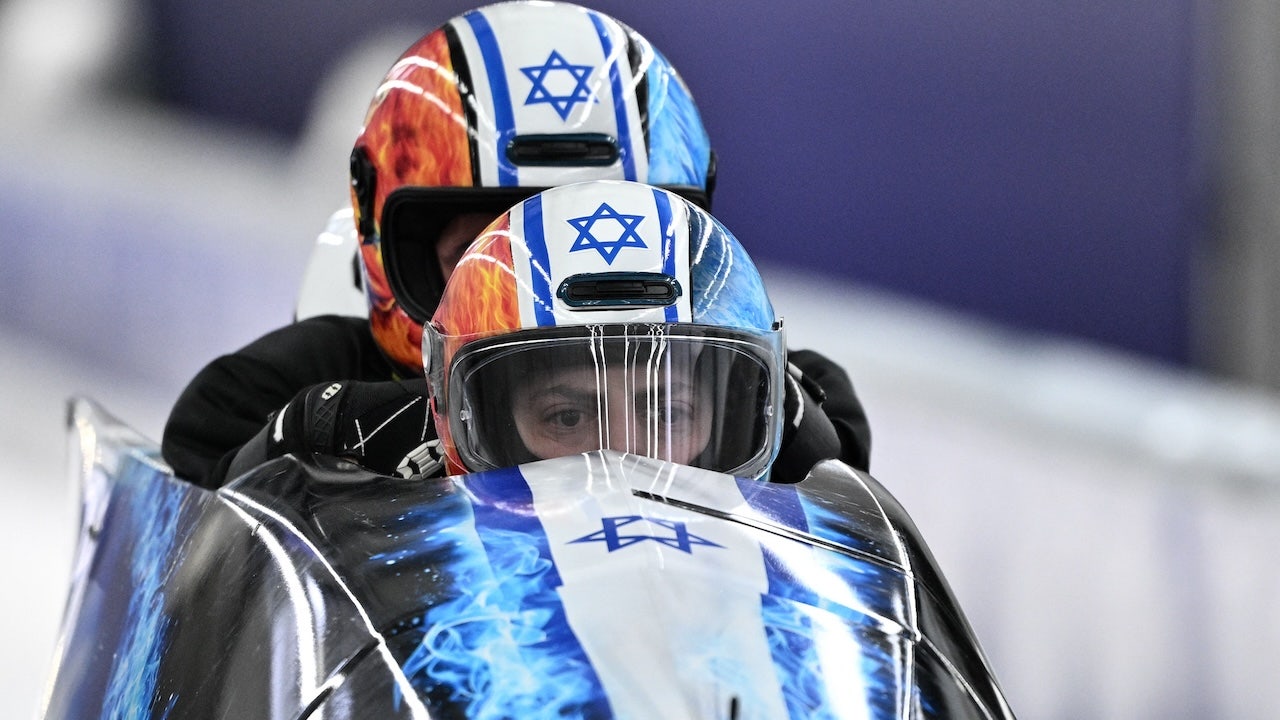
CORTINA D'AMPEZZO, Italy — AJ Edelman, captain of Israel's historic first bobsled team at the Winter Olympics, stood firm in his support for his country amid a storm of controversy sparked by a Swiss broadcaster's on-air criticism during the team's competition run.
On February 16, 2026, as Edelman and his teammate Menachem Chen raced in the men's two-man bobsled event at the Milan Cortina Games, RTS presenter Stefan Renna unleashed a politically charged commentary. According to the broadcast, Renna described Edelman as a 'first-time Olympian and self-described ‘Zionist to the core,’ who has posted several messages on social media in support of the genocide in Gaza.' Renna questioned Edelman's eligibility, citing International Olympic Committee guidelines that bar athletes who have 'actively supported the war by participating in pro-war events, being militarily engaged, or via their activities on their social media networks.'
The remarks, which aired during the team's two-minute heat, drew immediate backlash. The entire broadcast segment was swiftly removed from the RTS website after millions viewed it, but not before Edelman and his teammates learned of the tirade. 'This individual clearly pre-wrote a diatribe timed to two minutes, you know, the entirety of our run. I just think it's so sad, I don't know how you can live like that,' Edelman told reporters afterward.
Edelman, undeterred, reaffirmed his beliefs without apology. 'On a personal level, I've dealt with so much worse. I said those things. I said I'm a Zionist, I said I'm proud of Ward [Fawarseh], who served. I said that. I said what I said. I believe Israel is just. I believe it's a force for good. I stand for that force for good. I represent that force for good,' he said. 'So when someone just says that I represent evil or I am evil for representing what I represent, it's like water off the back.'
Several members of the Israeli team, including some who were deployed to Gaza following the October 7, 2023, Hamas attacks, have mandatory military service in their backgrounds. Edelman emphasized the separation between their athletic pursuits and national duties. 'Israelis are Israelis. What they do in the service of the country is always going to define who they are,' he said. 'We view ourselves right now entirely as athletes… I can say that as athletes, as men, as humans and Israelis, I'm very proud of their accomplishments on the Olympic stage.'
The team's journey to the 2026 Olympics was marked by perseverance and unexpected hurdles. Israel had come agonizingly close to qualifying for the Beijing Games in 2022, missing out by just 0.01 seconds. But the following year, after the October 7 attacks, many athletes were called up for military service, casting doubt on the program's future. For Edelman, this was his final shot at the Games after more than a decade of effort.
To fund the endeavor, Edelman reportedly sacrificed millions in Bitcoin holdings. Upon arriving in Europe, the team subsisted on smoked salmon and pizza for two weeks, though Edelman noted it paled in comparison to his preferred Chicago deep-dish style. Their challenges didn't end there. En route to Italy, while staying at a hotel in Prague, Czech Republic, the accommodations were burglarized and vandalized just days before the competition. As captain, Edelman had traveled ahead to Venice when he received the news. 'It was just another Tuesday for us,' he remarked dryly.
Anti-Semitic incidents plagued the team even before the Games. They were turned away from lodging in Germany on Christmas Eve after staff identified them as Jewish. Another athlete competing in Milan Cortina allegedly refused to join the Israeli team, calling Israel a 'bunch of baby killers.' A swastika was even drawn on their team van. Despite these setbacks, the athletes pressed on, focusing on their performance.
In the end, Edelman and Chen finished 26th in the two-man bobsled, short of Edelman's goal of a top-20 placement. Germany dominated the discipline, claiming 10 of the 12 medals, including all eight golds and silvers. Yet Edelman viewed the participation itself as a triumph. The Associated Press captured the duo celebrating at the finish line on February 16 and arriving there the next day, February 17, underscoring the emotional weight of the moment.
The controversy with the Swiss broadcaster highlighted broader tensions at the Olympics, where political undercurrents often simmer beneath the surface. RTS has not publicly commented on Renna's remarks beyond removing the broadcast, but the incident echoed past Olympic disputes over athlete activism and national conflicts. The IOC's eligibility rules, as referenced by Renna, aim to maintain the Games' apolitical ethos, though enforcement remains subjective.
Edelman, reflecting on the support from back home, spoke of the team's inspirational role. Fan mail poured in from Israel, reminding the athletes of their purpose. 'The reception of the team has been overwhelming,' he said. 'They're putting their hopes and their dreams into your journey, and that's just something very special. When they think back on it, they probably won't remember you, they probably won't remember you at all, but they'll remember the country was represented.'
As the Milan Cortina Games wound down, Edelman grappled with the end of his 12-year quest. 'I still haven't processed really being here,' he admitted. 'I don't know what it will look like when all that is said and done…. I've woken up every day for the last 12 years and went to bed every night for the last 12 years with a goal in mind, and with a determination to get this thing done. Now that I will have realized that it is done, I don't know exactly how that will look like, I think in some sense I'm worried, in some sense I'm excited.'
The Israeli bobsled team's debut not only broke new ground for their nation but also spotlighted the resilience required to compete on the world stage amid geopolitical strife. While the athletic results may not have dazzled, the symbolism of representation endured. As Edelman and his teammates return home, their story serves as a testament to overcoming adversity, both on and off the ice.
Looking ahead, the IOC may face calls to clarify its policies on athlete expressions of national loyalty, especially in polarized times. For now, Edelman's unyielding stance has resonated with supporters, reinforcing the complex interplay between sport, identity, and international relations at events like the Olympics.