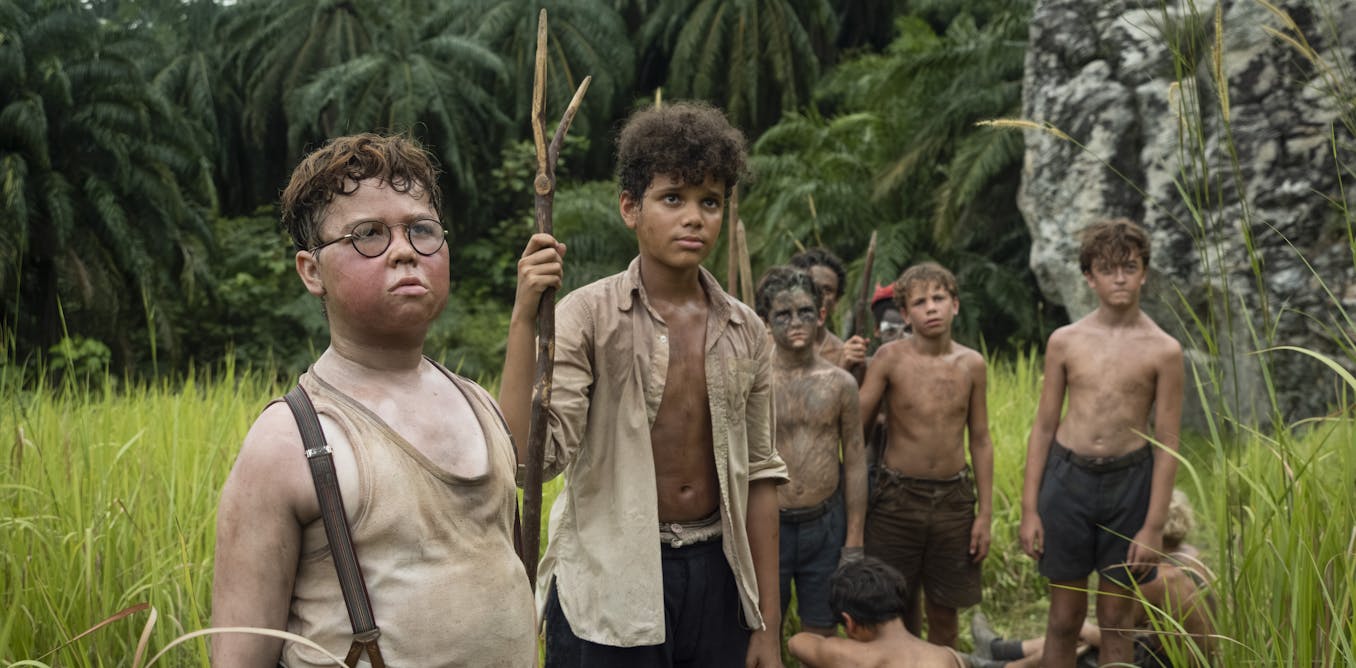
In a fresh take on a timeless classic, the BBC has released a new adaptation of William Golding's Lord of the Flies, penned by screenwriter Jack Thorne, known for his work on the series Adolescence. Streaming now on the platform, the production has garnered mixed reviews from critics, who praise its modern resonances while debating its fidelity to the source material. Thorne, speaking to the Australian Broadcasting Corporation, highlighted parallels between the novel's themes and today's political climate, noting the 'climate of populism and hate' that Golding addressed during the early Cold War era mirrors contemporary global tensions.
The original novel, published in 1954, has long been a fixture in classrooms across the UK, Australia, and beyond, sparking discussions on human nature, morality, and the fragility of societal order. Set against the backdrop of World War II, the story follows a group of British schoolboys stranded on a tropical island after their evacuation plane crashes. Without adult supervision, they attempt to establish rules and elect a leader named Ralph, but the structure quickly unravels amid rising fear, resentment, and violence. Rumors of a 'beast' on the island fuel paranoia, transforming abstract anxieties into tangible threats that drive the boys' descent into chaos.
At the heart of the conflict is the rivalry between Ralph, who clings to democratic principles and the hope of rescue, and Jack, whose focus shifts to hunting and authoritarian control. Caught in the crossfire is Piggy, an intelligent but marginalized boy with asthma and glasses, whose insights are often dismissed. As the group's moral compass, Piggy's treatment reflects the erosion of reason, with his fate serving as a stark warning about the perils of unchecked power.
Golding, a former schoolteacher and Royal Navy veteran, drew heavily from his wartime experiences to craft the narrative. Serving in the North Atlantic and participating in the D-Day landings at Normandy on June 6, 1944, he described the conflict as 'the great formative experience' of his life. Post-war, while teaching classics at a provincial grammar school in England, Golding drafted the book during lessons, observed by his pupils who recalled him writing intently at his desk.
The author's intent was clear and cautionary. In reflections shared in various essays, Golding warned that the evils witnessed in Nazi Germany could resurface anywhere. 'You think that now the war is over and an evil thing destroyed, you are safe because you are naturally kind and decent,' he wrote. 'But I know why the thing rose in Germany. I know it could happen in any country. It could happen here.' This message, born from his disillusionment with humanity's capacity for cruelty, underscores the novel's fable-like quality, as Golding himself described it in a 1965 essay: 'The fabulist is a moralist. He cannot make a story without a human lesson tucked away in it.'
Despite its enduring impact, Golding later grew to resent the book that propelled him to fame. In later years, he dismissed Lord of the Flies as 'boring and crude,' preferring his subsequent works, including the 1980 Booker Prize winner Rites of Passage. His Nobel Prize for Literature in 1983 cemented his legacy, though he acknowledged the moralistic approach was unfashionable, requiring the story to be 'sugared' with wit and engagement to reach audiences.
The novel's plot begins with optimism. The boys, freed from the constraints of school and wartime evacuations, initially revel in their island paradise. Ralph, patting a palm trunk, 'laughed delightedly again, and stood on his head,' capturing a moment of pure exhilaration as they believe in the island's reality. They convene assemblies, designate a conch shell as a symbol of authority—allowing only its holder to speak—and light a signal fire for potential rescuers. The island, described as abundant and beautiful, promises adventure.
Yet, cracks appear swiftly. Consensus wanes, discipline slips, and responsibilities go unfulfilled. Allegiances fracture along lines of grievance and power struggles, turning the once-idyllic setting into a battleground. Golding's characters draw from earlier literature; Ralph and Jack echo names from R.M. Ballantyne's 1857 novel The Coral Island, where shipwrecked boys triumph through Christian virtue and imperial pluck against external threats like cannibals and pirates.
Golding subverted this Victorian optimism, which he saw as reflective of 19th-century 'smugness.' His 20th-century tale interrogates innate goodness, influenced by the interwar rise of fascism in Hitler's Germany and Stalin's Russia. Pre-war, Golding believed in 'the perfectibility of social man,' trusting that proper structures could foster goodwill and reform injustice. But the war shattered this, revealing 'what one man could do to another'—not just in battles, but in the systematic atrocities of totalitarian states, perpetrated by 'educated men, doctors, lawyers, by men with a tradition of civilization behind them.'
He emphasized that Western civilization had not eradicated cruelty; in fact, it had sometimes systematized it. 'The problem was humanity,' Golding concluded, viewing 'man was sick—not exceptional man, but average man.' His novel traces how this 'diseased nature' leads to global chaos, urging against a future of 'national self-satisfaction and chauvinistic idiocies' if humanity is to endure on Earth for millions of years.
The book's relevance persists amid today's challenges. As resurgent authoritarianism grips parts of the world, including the United States, and conflicts rage in Sudan, Gaza, and Ukraine, the thin veneer of civilization feels precarious. The feverish public sphere, amplified by social media, echoes the boys' rumor-driven fears. Thorne's adaptation aims to revive these warnings, though some reviewers question whether it captures Golding's adolescent cruelty and toxic masculinity without diluting the original's starkness.
Scholars and educators continue to dissect the nature-versus-nurture debate central to the story. Were the boys' actions a revelation of inherent savagery, or a product of isolation? Golding leaned toward the former, shaped by his observations of educated perpetrators in wartime horrors. Yet, the novel's ambiguity invites ongoing debate, much like the classroom discussions it has inspired since 1954.
Looking ahead, the BBC production could introduce Lord of the Flies to new generations, potentially sparking renewed interest in Golding's oeuvre. With streaming availability, it arrives at a moment when societal fractures— from political polarization to global unrest—make its lessons urgently applicable. As Golding might have put it, the beast is not just on the island; it's within us all, waiting for circumstances to unleash it.
The adaptation's mixed reception underscores the challenge of translating a moral fable to screen. While some praise its timely reflections on power and herd behavior, others argue it softens the novel's unflinching portrayal of human darkness. Regardless, Golding's voice endures, a reminder from the ashes of World War II that civilization's collapse can happen swiftly, anywhere.