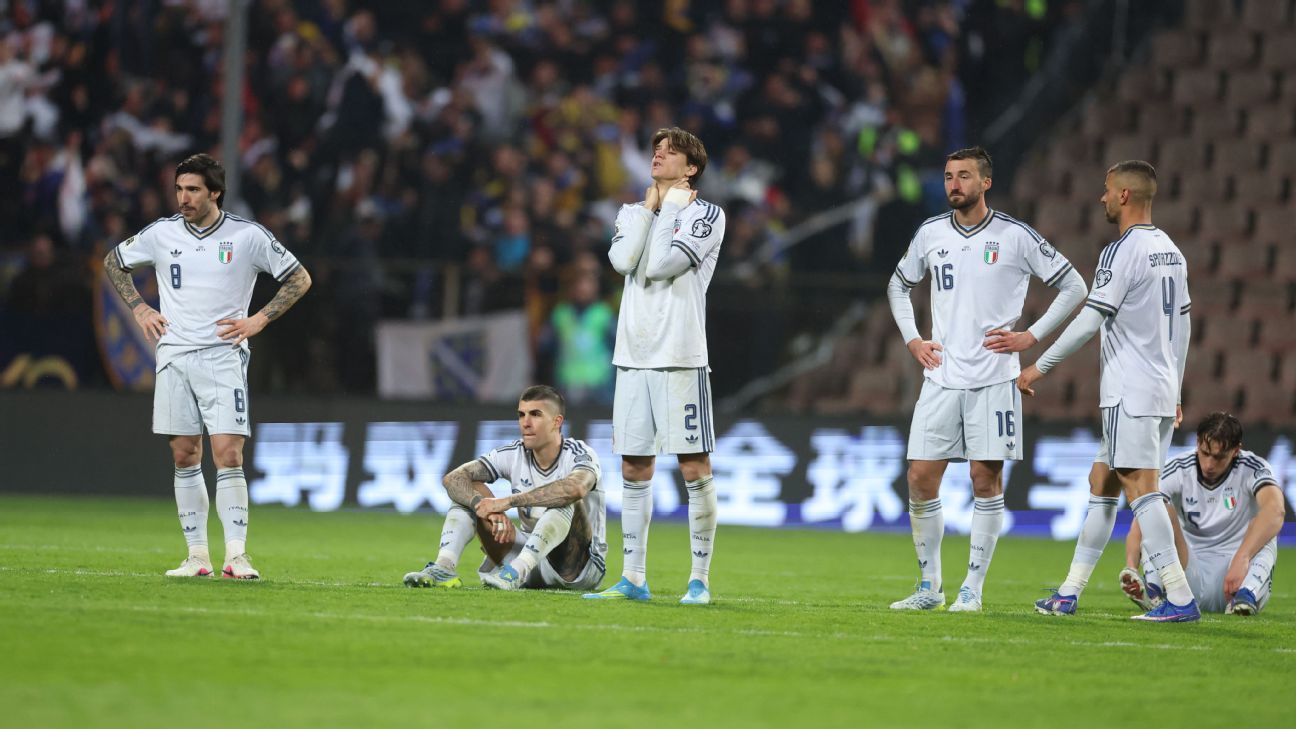
ROME — Italy's national soccer team suffered a heartbreaking exit from World Cup qualification on Tuesday, losing to Bosnia and Herzegovina in a penalty shootout after a tense playoff match in Sarajevo. The defeat marks the third consecutive World Cup that the Azzurri will miss, an unprecedented streak for a four-time champion and a stunning fall from grace in the expanded 48-team tournament format starting in 2026.
The match, played at the Bilino Polje Stadium, ended 1-1 after extra time, with Bosnia advancing 4-3 in the shootout. Italy, ranked 13th in the FIFA world standings, entered the playoff as favorites but were undone by a controversial red card to defender Alessandro Bastoni in the 41st minute, leaving them with 10 players for most of the game. Bastoni's dismissal came after a challenge that referee Felix Zwayer deemed reckless, shifting the momentum dramatically.
According to ESPN analyst Gab Marcotti, Italy's failure stems not from deep systemic issues in Italian soccer but from self-inflicted wounds during the qualifying campaign. "Italy may not be stacked with talent like France or Spain or England, but they had more than enough quality to qualify," Marcotti wrote. He pointed to early losses, including a defeat to Norway, that forced Italy into the high-stakes playoff format where "stuff can happen and moments attain outsized importance."
The game began promisingly for Italy, who took a 1-0 lead through a goal from Mateo Retegui in the 18th minute. But Bastoni's red card changed everything. With a numerical disadvantage, coach Gennaro Gattuso's side retreated into a defensive shell, inviting relentless pressure from Bosnia. The Bosnians equalized in the 72nd minute when Edin Dzeko’s shot was parried by goalkeeper Gianluigi Donnarumma into the path of Haris Tabakovic, who scored despite the ball grazing Dzeko's elbow—a moment Marcotti described as "cruel irony."
Donnarumma, Italy's star goalkeeper, made 10 saves, several of them world-class, but it wasn't enough. Bosnia fired 30 shots in total, creating numerous chances. Marcotti noted that if not for the red card, Italy could have managed the game better: "At 11 vs. 11, you would have liked their chances... Keep the ball, make Bosnia and Herzegovina chase you, tire them out, make your experience count." Instead, the match devolved into what Marcotti called an "80-minute nightmare" for Italy fans.
Gattuso, who took over as coach just 10 months ago with only about 15 training sessions under his belt, defended his team's effort post-match. "Nobody can fault their heart and effort, and how they didn't deserve to go out," he said, according to reports from the sidelines. He lamented missed opportunities, such as Moise Kean's counterattack in the second half and Fede Dimarco's failure to finish with his weaker foot. However, Marcotti dismissed such excuses, arguing that Bosnia displayed equal or greater heart, especially with 40-year-old Dzeko leading the line after a grueling 120-minute tie against Wales days earlier.
The penalty shootout sealed Italy's fate. Bosnia's Nikola Vasilj saved Francesco Pio Esposito's effort, while Italy's Jorginho saw his shot stopped. Bosnia converted four of their five penalties, with Dzeko stepping up confidently. Marcotti highlighted the irony: if Donnarumma had saved Dzeko's earlier shot outright, a handball off Dzeko's elbow might have disallowed Bosnia's goal, potentially sending Italy through.
This loss continues a painful trend for Italy, who also missed the 2018 and 2022 World Cups—the first such absences since 1958. The Azzurri won the European Championship in 2020 but faltered in World Cup qualifying both times, losing to Sweden in 2017 and North Macedonia in 2021. The expansion to 48 teams was supposed to ease the path for traditional powers like Italy, yet they remain on the outside looking in. No other World Cup-winning nation has missed three straight tournaments.
"So where do you turn to now that Italy have failed to qualify for three straight World Cups, something no other World Cup winning nation has ever done? Especially at a time when the World Cup field was increased by 50%, from 32 to 48 teams?" — Gab Marcotti, ESPN
Marcotti rejected calls for sweeping reforms in Italian soccer, arguing that Serie A was arguably weaker during Italy's successful Euro runs in 2012 and 2021, when they reached the final and won the tournament, respectively. "It's not because Serie A today isn't as good as it was in the 1990s that Italy failed to qualify," he wrote. Instead, he blamed tactical missteps under Gattuso, who opted for a conservative approach after the early lead and red card rather than leveraging Italy's superior talent.
Gattuso's tenure, marked by limited preparation time due to club commitments, drew criticism. Italian clubs have been accused of doing little to support the national team, including denying even short training camps. Marcotti questioned whether more time with Gattuso would have helped: "Though to be fair, you can't help but wonder if more time might have given him more opportunities to screw things up." Gattuso's style—simple game plans, high energy from the sidelines—worked in spurts but faltered against Bosnia's grit.
Bosnia's performance was a testament to underdog resilience. Coming off extra time against Wales, they showed no signs of fatigue, with midfielders Esmir Bajraktarevic and Kerim Alajbegovic dictating play. Dzeko's experience proved invaluable, embodying the "heart and effort" Gattuso praised in his own team. Bosnia, ranked 74th by FIFA, now joins debutants like Curacao, Uzbekistan, Cape Verde, and Jordan in the 2026 field, as outlined in related ESPN analyses.
While structural issues in Italian youth development persist—such as an overemphasis on tactics over technical skills and a reluctance to promote homegrown players to first teams—Marcotti insisted these weren't decisive here. "Bad decisions and bad performances in qualifying left them with margins that were far slimmer than they should have been," he concluded. Italy's early qualifying stumbles, including the Norway loss amid poor refereeing calls, set the stage for this playoff peril.
The implications for Italian soccer are profound. With four World Cup titles—matching the combined total of England, Spain, and France—missing out stings deeply. Fans and pundits alike expressed devastation, with Marcotti noting, "When you've won four World Cups, believe me, it hurts even more." Questions swirl around Gattuso's future, though his contract runs through the Euros. The Italian Football Federation may face pressure to overhaul preparations for the 2026 qualifiers, which begin next year.
Looking ahead, Italy turns focus to UEFA Nations League matches and Euro 2024 preparations. Yet the shadow of three straight World Cup absences looms large, prompting reflection on how a nation of Italy's pedigree rebuilds its global standing. As Bosnia celebrates a historic qualification, Italy must confront whether this is a blip or a deeper malaise.
In the broader context of the 2026 World Cup, hosted by the United States, Canada, and Mexico, the tournament's expansion promises more inclusivity but hasn't shielded traditional giants from upsets. Italy's exit underscores the fine margins in modern qualifying, where even top-ranked teams can't afford early missteps.